BOSWELL IN SEARCH OF A WIFE, 1766-1769. Edited
by Frank Brady '46 andFrederick A. Pottle. New York: McGraw -Hill Book Company, Inc. 1956. 352 pp. $6.
Dartmouth may well take pride in Frank Brady, now Assistant Professor of English, Yale University, because his eighteenth-cen-tury studies have established him as co-editor, with the Sterling Professor of English, Frederick A. Pottle, of the sixth volume of the Yale Editions of the Private Papers of James Boswell. All Brady, the introduction is informative and provocative (Boswell, he says, is not eccentric); and the Brady footnotes are so fascinating that they may be read without the text.
Poised among a mistress as a probable disadvantage for an Edinburgh lawyer with his way to make, Scottish and Irish heiresses as possible wives with social and financial advantages, and his "valuable friend" and cousin with only a meager dowry, Margaret Montgomerie, whom he truly loves, Boswell achieves now a maturity denied him earlier under the strong influences of his tender mother and dour father; his religious friend, Rev. William J. Temple; Dr. Johnson, Rousseau, and Voltaire, philosophers; and General Paoli, Corsican patriot.
But poised is hardly the word. Only for brief moments towards the end of the volume does Boswell remain in contented adjustment: a victim of moods, he is forever torn this way and that. Drunkenness and lechery result in headaches and heartaches; melancholy, in soul-aches; but Margaret's devotion and strength help Boswell to a health and integrity one may have thought impossible.
In this volume even more than in the previous ones, the richness and variety of Boswell's adventures make almost every page varied and rich. Before Boswell proves to himself that his friendship for his confidante and cousin is true love, he becomes infatuated with English, Dutch, Italian, Scottish, and Irish women, most of them emotionally at some little distance from erotic naivete. More amazing than his virility is his veracity. He tells all.
He likes men too and is a man's man in Edinburgh, Oxford, London, and everywhere else his ebullient nature leads him. At tea, tavern, and dinner tables, he is regarded as delightful company. After separations, Dr. Johnson and General Paoli, both high-minded and virtuous men, throw their arms around him because they love him so much. Hardfisted Garrick soft-heartedly lends him five pounds at the garish Shakespeare festival in Stratford at which Boswell creates a sensation by appearing in the costume of an armed Corsican chieftain. (Before the touch, Boswell ingenuously had, shown Garrick his poem suggesting that Garrick had purloined Dame Nature's pencil just where Shakespeare had dropped it.)
Boswell is at home in any society. With protean swiftness he moves from dukes to chambermaids, from generals to criminals whose dying confessions he enjoys almost as much as their executions. Morbidly fascinated by death, Boswell loves life. If some men have lived life as fully, no one has ever equalled him as commentator and recorder of other men's virtues and his own vices, the consequences of debauchery, and, finally, love that redeems and ennobles.
JOHN HURD '21
-
 Books
BooksALL THE BEST IN GERMANY & AUSTRIA.
April 1957 -
 Feature
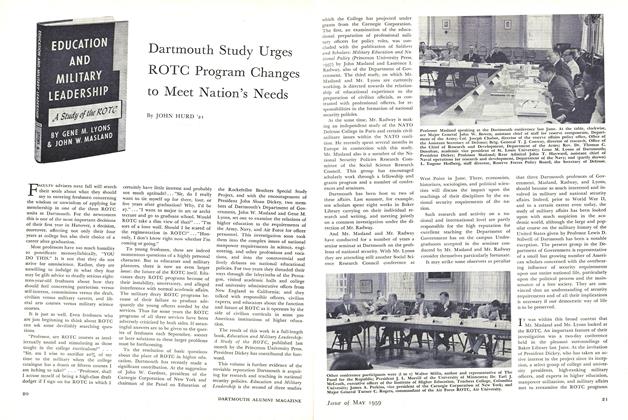
Dartmouth Study Urges ROTC Program Changes to Meet Nation's Needs
MAY 1959 -
 Books
BooksALL THE BEST IN THE CARIBBEAN.
January 1960 -
 Article
Dean of Travel Writers
OCTOBER 1968 -
 Books
BooksJOHN JAY, FOUNDER OF A STATE AND NATION.
MARCH 1969 -
 Books
BooksNO TIME FOR SCHOOL, NO TIME FOR PLAY: THE STORY OF CHILD LABOR IN AMERICA.
NOVEMBER 1972