Opening Assembly
SELECTIONS FROM THE ADDRESSES AND PANEL DISCUSSIONS OF THE CONVOCATION
September 8, 9 and 10, 1960
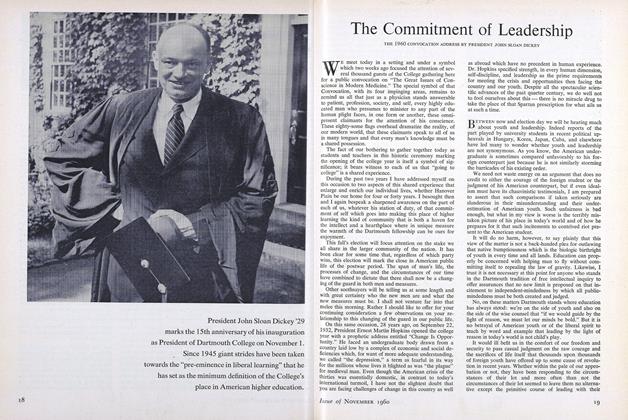
Chairman : JOHN SLOAN DICKEY PRESIDENT OF DARTMOUTH COLLEGE
THREE years ago this September, Dartmouth held her first Great Issues Convocation. The theme of that gathering focused on the problems of public policy within the Anglo-Canadian-American community. The occasion, which fell on the tenth anniversary of the Great Issues Course in the Dartmouth curriculum, marked the launching of the College's campaign to raise $17 million as the first major step toward fulfilling the 1969 Bicentennial aim of pre-eminence in liberal learning - from its purpose to its perpetuation The theme of this second Great Issues Convocation may at first seem narrower and more professionally limited than the international relations of the ACA community, and, in a sense, it is. But from the knowledge of these participants mat I have, I suspect that 48 hours from now most of us will feel so stretched out intellectually, that keeping the peace will seem dull, compared with the challenge of getting up early enough to make man healthy, wealthy and wise. I am leaving the "early to bed" aspect of that perception, Dr. Dubos, for further pondering by the learned Panel.
Indeed, when all has been said here, and much more has been done elsewhere in all necessary things, may we well not discover that peace, and health, and wealth and wisdom are, after all, one? ...
Before we come face to face with some of these issues, a word or two ought to be said about modern medicine, because if it were not for modern medicine, and especially perhaps for modern science, on which modern medicine rests, many of these issues and, come to think of it, many of us simply would not exist - a solution which has at least the superficial appeal of simplicity.
The medicine of which we speak rests squarely on the twin pillars of teaching and research. At this Convocation our attention is mainly centered on the Medical School - on all medical schools — as the indispensable agency for joining teaching and research. But here at Dartmouth, especially, let us not forget that medicine is for man and not vice versa. Any man who aspires to minister greatly to any human ill, or need, must be more than merely a skilled professional. Liberal learning is that transcending more, which however it is acquired, gives all callings the possibility of greatness.
Speaker: S. MARSH TENNEY, M.D. DEAN OF DARTMOUTH MEDICAL SCHOOL
THERE'S a rather remarkable, and to me prophetic, passage that appears as a digression in one of the tragedies of Sophocles. I think it betrays that even then there must have been great concern, and certainly great interest, in the extensive range of human science. The passage begins: "Wonders are many but there is no wonder wilder than man - only against Death he has fought in vain, and yet, many a mortal illness he has conquered."
In the almost two thousand years since this passage was written the history of medicine has recorded a remarkable list of achievements against man's suffering and disease. And more recently the growth of medical knowledge and its application have accelerated enormously, due in no small part to the evolution of medicine as a scientific discipline. Historically, medicine was the first profession to join firmly on to the natural sciences, but together with biology it has only recently progressed from classification and dissection into an era more deeply concerned with quantity and circumstance. Though its foundations have become more rational, its practice that supreme welding of science and humanism is said to have become more remote and indifferent to human values, and once again medicine has been forced to remind itself that it is often the human factors that are determinant. Now, in the broader context, scientific medicine shares with science as a whole not only the glory of achievement but all those problems that are consequent to its deep permeation of our culture. In our attempt to interpret the effect of this phenomenon we have been slow to appreciate that there is a profound difference between what science is and what science does, a difference between its content and its exploitation.
Gillispie has written that "even now science continues to be what it was in Greece, conceptual thought mediating between consciousness and nature. But it is also something more. It has become determinate instead of simply speculative.
Still Bacon's dream of a scientific Utopia has not come to pass. And the reason for our disenchantment may be quite simple. Science tells us what we can do - never what we should do. While science itself cannot be immoral, neither can it establish a morality. Its objective posture absolutely precludes competence in the realm of values. The popular tendency to equate scientific progress with ethical advance is as fallacious as were some of the early attempts to find morality in the law of evolution. In his allusion to this problem Loren Eiseley commented as follows: "The western scientific community, great though it is, has not concerned itself enough with the creation of better human beings, nor with self discipline. It has concentrated instead upon things, and assumed that the good life would follow. Therefore, it hungers for infinity. Outward in that infinity lies the Garden the sixteenth century voyagers did not find. We no longer call it the Garden. We are sophisticated men. We call it, vaguely, progress."
The purpose of this conference is to examine the issues of conscience in that "progress." The objective is not simply the question of the survival or the extinction of man. But it is, what kind of survival? A future of what nature?
Thus with his wisdom, subtle past foretelling, man wins to joy or sorrow."
Speaker: RENÉ J. DUBOSMEMBER AND PROFESSOR OF THE ROCKEFELLERINSTITUTE; CHAIRMAN OF THE CONVOCATION
IT is sophistic that science, I believe Dean Tenney said, "tells us what we can do, but never tells us what we should do." I think more precisely - or I think it is more precise because this is what I had intended to say - "Science tells us how to do things, but never tells us what to do among all things that could be done." And this will be the topic of my discussion tonight among all the things that could be done.
Now in the past this difficulty of selecting among all the things that could be done was not a great difficulty, because there were so few things that could be done. In reality, it is only for two or three decades that scientific medicine has made available to us techniques sufficiently powerful to affect the health of the individual and the health of the community. So that, in reality, there was very little choice. But now, and much more in the near future, there will be endless things that we know how to do.
At first thought, you would say, "So much the better. This brings us nearer to medical Utopia." In reality, however, the greatest difficulty in the achievement of health in the modern world will not come from learning more things and learning to handle a little better what we know, but, rather, from all sorts of social limitations that would prevent us from applying the knowledge that we have. These social limitations cannot help bringing to the medical community extremely difficult problems of conscience in the near future.
What are the limitations which will make it difficult for us to decide how we can use medical science to minister to the ills of mankind? Let me first start with the easiest of all, the one that seems to present no difficulty to understanding - namely, the problems of disease in the underprivileged part of the world. I think there is not one of us in medical science who is not aware of the fact that in 90 per cent of the total world the problems of disease can be traced either to inadequate nutrition or to problems of infection. Now these happen to be two fields in which our theoretical and practical knowledge is enormous. We really know what should be done to control the problem of nutrition, to control the problem of infection, but in reality we cannot do what we know how to do for obvious economic limitations. Clearly, there is no need of discussing scientific problems of nutrition in the underpnvileged part of the world. The primary need is enough food of adequate composition and presented in a form which is socially acceptable. Likewise, there is no need to go into deep problems of study of infectious diseases, because what we first have to do is apply the practices of sanitation and to raise the standard of living, which we know would solve these problems. So that clearly what is needed here is an economic revolution without which medical science cannot apply what it has worked out. aPPty
Now you may say, "Well, these problems, interesting as they are, do not apply to us, because we are a wealthy com. munity, we are medically well-informed, we are socially minded, we are open to change." But in reality we too are prisoners of habit and of social tensions which prevent us rom applying medical science. The examples that I shall select to illustrate this point of view are trivial, known to all of you, but I believe this is their very merit, because they will illustrate for you, I hope, the kind of paralysis that can affect the community as a whole in front of problems that are recognized as actions desired by all but for which there are conflicting interests.
First, let me briefly consider one practical problem in which action is prevented by the fact that as a group we are not emotionally prepared to act toward problems that are remote in time The obvious problem is that of air pollution which will be discussed at greater length tomorrow. Now I think we know a great deal about not only the causing of air pollution, the chemical components of it, but also its effects on humans. Well, now, how do you - the public - react to that problem? What disturbs you is that your eyes smart, that you don't feel very comfortable, but that's about all. In reality, the problems of air pollution are such that they affect the health, not necessarily this year, next year, or in ten years but certainly your health — the health of the community in twenty years. So, in reality, the kinds of study that have to be carried out are not those that concern your comfort of today, but they are those which concern your health and that of your children in twenty years. Thus it is extremely difficult to enlist public interest, and even the interest of scientists, in such long-range problems.... And I think this points to one of the very great problems of medical science; namely, that one can get public support - your support - only if one can point to something in which you, today, are interested, but it is extremely difficult to enlist your support for something which is vaguely in the future.
There is no question, of course, that the problems of air pollution could be solved if we were to redesign automobile engines all the combustion engines - change the design of smoke stacks, reroute some of your traffic. But, in reality, are you as a community willing to accept the inconveniences, the economic cost, that would have to be accepted, if you want to apply these social, practical solutions of which I speak? What it comes to is this: how much of economic prosperity and of conveniences of life is society - or are you - willing to sacrifice to prevent lung cancer, emphysema, chronic bronchitis, that will become apparent only in the future? In other words: how can we balance the value of human suffering that will occur in some undetermined future against the effectiveness of the socio-economic performance of today? ...
Another example to relate economic problems to those problems of conscience in medicine has to do with food additives. Agriculture and food-technology are more and more using a very large range of chemical compounds. I think this trend will continue - indeed, it will increase. Moreover, I think it will be perfectly impossible to test all these substances for their possible toxicity - especially for their long-range toxicity. It would be far too costly, indeed take far too much time, to test all the substances that have been proven or will be proven to be useful in agriculture and in technology. So it seems to me that you as a community will probably be willing to take a few chances - to take many chances - for the sake of lower costs of food production.
All these examples show what is going to be before you. It is not a lack of knowledge of dangers, but the need for a decision as to whether you are willing to take certain risks.
Now, let me move to another related aspect of this problem - namely, the need to choose between different kinds of medical helps More and more rapidly, advances in fundamental knowledge are paving the way for practical methods applicable to the prevention and treatment of disease, but as you may not know as well as all of us who are in this game know, to work out any one of these applications (even when the principle is clear in our mind) is extremely costly - not so much costly in money as costly in terms of the amount of specialized skill that it demands - medical skills, technical skills. So that even if funds were available to deal with all the problems that we know we could solve, there are not enough scientists - and there cannot be enough scientists to solve them all at the same time.
Now, in case this is vague, let me try to make this matter of choice clear with an example taken from my own profession - the production of vaccine against virus infections. During the past ten years there have been developed wonderful techniques for the production of most any kind - probably any kind - of virus on a large scale, and for the development of vaccine for most any virus - I suspect, any virus infection. So that, theoretically, the problem is no longer the scientific one of how to produce vaccine. This is just a question of development. We know how it could be done. The real problem is a social one - of deciding which vaccine should be produced. There is a question of choice, and the choice
is the community's, because it involves a decision as to what kind of a disease you, as a community, think it is most desirable to be protected against. This is a very difficult problem from the medical point of view, but it's an even more difficult problem from the social point of view. For example: should emphasis be placed on diseases which are fatal, or crippling, but affect only a small number of individuals - like poliomyelitis, for example; or should priority be given to ailments of the upper respiratory tract, rather mild and self-limited, but of enormous economic importance because they affect a large percentage of the population and disrupt industrial production and other national activities? ...
Now, I shall approach one of the most difficult problems of medical ethics which we are likely to encounter within the next decade. As all of us know, there are now many techniques available for postponing death in every age group and for almost any type of disease. For example, we can save the lives of children suffering from almost any type of congenital or hereditary defects, and there is no question, of course, that to save such a life is a humane act and a source of professional gratification, but it is a sorry fact that in many cases saving the life of an individual suffering from hereditary defects has long-range consequences, which will then magnify medical problems for the following generation.
Consider if you will the problem that each and every one of us will encounter in his personal life - namely, prolonging the life of aged and ailing persons. This also is a source of great humane gratification, but it must be weighed against the consequences that it entails for the individual himself, and even more for the community of which the individual is a part. These ethical difficulties are not new. They have always been part of medical practice, but in the past they were not compelling because there were so few things that could be done. But in my opinion this kind of difficulty is going to become one that the physician, and the individual, is bound to experience many times in the course of his own life. To what extent can we afford to prolong biological life in individuals who cannot derive either profit or pleasure from existence, and whose survival creates painful burdens for the community?
Let me state here a fact that I shall restate later because I regard it as so important. That kind of decision is not a decision for the physician. In our society our ethics dictate that it is the duty of the physician to save and prolong life - whatever the cost, whatever the consequences. The physician must act according to the ethics of the society of which he is a part, so that it will be for society to redefine these ethics, if the problem becomes one that society is no longer willing or able to carry. . . .
Let me, however, come to a simpler one: all our medical and social structure is built on the assumption that we must make life as pleasant and as easy as possible for everyone, especially for children. There is no doubt, of course, that by so doing we have removed a great deal of the hardships of the past and have made, now and then, for a happier life. But there is no doubt in my opinion that by so doing we have been eliminating from our lives, and especially from the lives of our children, all the stimuli that in the past used to call into action all the adaptive potentialities of the individual, upon which depends his natural resistance to the strain and stresses of life. Here again, I believe that before long we will have to reconsider our ethics, having in view not only comfort of today, but preparing for the life of tomorrow....
I realize that in all this discussion I have taken attitudes which in reality have been very painful for me. First, is the fact that I appear to deal with human life as if it were merchandise, the production and maintenance of which must be evaluated against economic costs and social conveniences, whereas I believe that human life has spiritual values that far transcend material considerations. I also seem to be pessimistic and to be skeptical as to the ability of mankind to overcome the dangers that prosperity and social advantage bring in their train. And yet, I know that mankind has experienced in the past many difficulties, far more and far greater than the present ones, and has taken them in its stride. And I seem to foster an empty intellectual attitude by expressing some doubt as to the effectiveness of certain scientific pursuits, whereas in reality I cannot possibly think of a retreat from reason and from science. So to try to clarify my situation, allow me to state once more my conviction.
And my conviction is that experimental and clinical science can solve the biological aspect of almost any medical problem, but that, in practically all cases, the situation would be very costly, especially in terms of specialized talent - and this will limit what we can do. While it is possible in theory to deal with all the new health problems that will be created by our rapidly changing social and technological order, many measures of control that are possible in theory will have to be neglected in practice, because of the limitations of economy and human resources. Hence, there will have to be choices and these choices are not to be made by physicians. These choices will have to be made by society as a whole, because they will involve judgment values.