1909
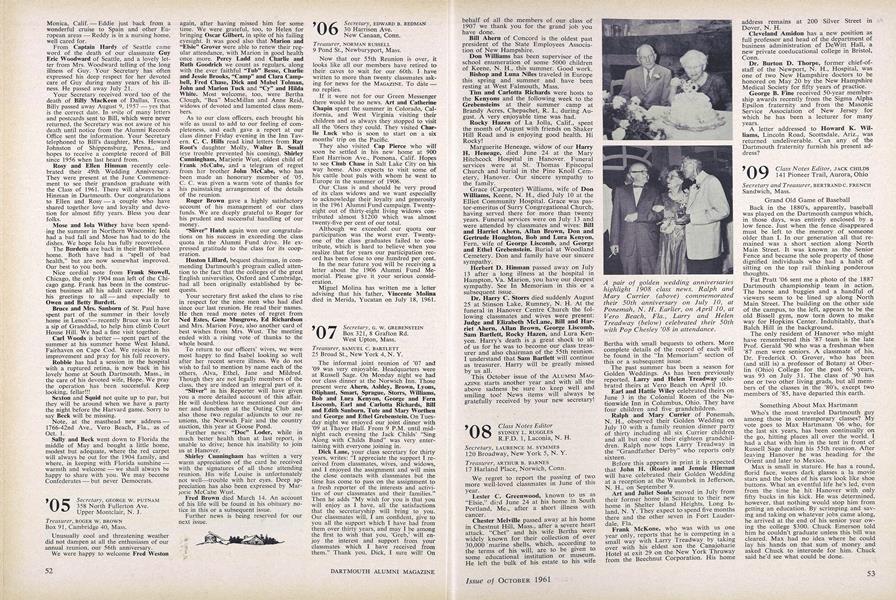
Grand Old Game of Baseball
Back in the 1880's, apparently, baseball was played on the Dartmouth campus which, in those days, was entirely enclosed by a low fence. Just when the fence disappeared must be left to the memory of someone older than I. In our generation all that remained was a short section along North Main Street. It was known as the Senior Fence and became the sole property of those dignified individuals who had a habit of sitting on the top rail thinking ponderous thoughts.
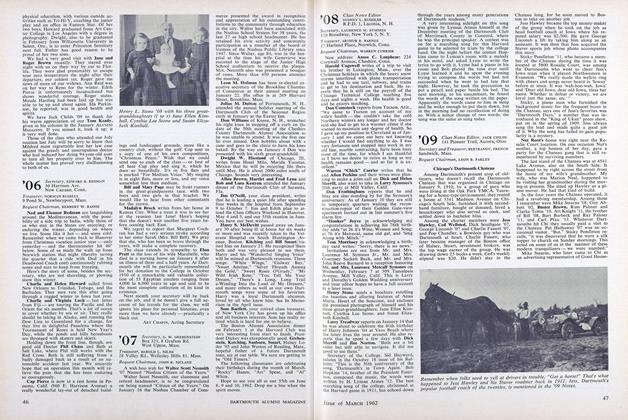
Fat Pratt 'O6 sent me a photo of the 1887 Dartmouth championship team in action. The horse and buggies and a handful of viewers seem to be lined up along North Main Street. The building on the other side of the campus, to the left, appears to be the old Bissell gym, now torn down to make way for Hopkins Center. Indubitably, that's Balch Hill in the background.
The only resident of Hanover who might have remembered this '87 team is the late Prof. Gerald '90 who was a freshman when '87 men were seniors. A classmate of his, Dr. Frederick O. Grover, who has been (and still is) a professor of Botany at Oberlin (Ohio) College for the past 65 years, was 93 on July 31. The class of '90 has one or two other living grads, but all members of the classes in the 'Bo's, except two members of '85, have departed this earth.
Something About Max Hartmann
Who's the most traveled Dartmouth guy among those in contemporary classes? My vote goes to Max Hartmann '06 who, for the last six years, has been continually on the go, hitting places all over the world. I had a chat with him in the tent in front of Russell Sage during his 55th reunion. After leaving Hanover he was heading for the Orient and later to Mexico.
Max is small in stature. He has a round, florid face, wears dark glasses a la movie stars and the lobes of his ears look like shoe buttons. What an eventful life he's led, even from the time he hit Hanover with only fifty bucks in his kick. He was determined, however, that nothing would stop him from getting an education. By scrimping and saving and taking on whatever jobs came along, he arrived at the end of his senior year owing the college $300. Chuck Emerson told him he couldn't graduate unless this bill was cleared. Max had no idea where he could lay his hands on that sum of money and asked Chuck to intercede for him. Chuck said he'd see what could be done.
This was in May. Commencement time was drawing closer and closer and nothing further was heard from Chuck. As a last resort, Max called on President Tucker who listened attentively to his story. At the close of the interview, President Tucker took out his check book and wrote Max a check for the required amount, telling him to repay it when he could. That was the type of president we knew in college. (Note: Yes, Max repaid the loan.)
After leaving Dartmouth Max took graduate work at Harvard and was an instructor in a prep school until 1914. He then became director of Hartmann Bros, from 1914 to 1925, and director of Schuster Engineering Corp., New York, from 1925 to 1930. He then made a novel (or would you call it noble?) experiment. Approaching Harvard University, he offered to teach international trade relations without salary, provided he would not be tied down with any faculty routine and could handle his classes as he saw fit. Harvard turned down the offer. Boston University, College of Business Admin- istration, however, gladly accepted and Max became a full professor. He remained at this post from 1930 to 1952 when he retired, rating the title of Professor Emeritus since that date.
Max was married during his senior year to Margaret C. Daley who remained his loyal companion until her death in 1948. With a start like that it was natural that their first born would be the class baby - Ralph 8., who was a member of the class of 1930 at Dartmouth. He was later killed in the Pacific in 1944 while serving in World War 11. Ralph Thompson '06 was his official godfather.
Philip P., who attended the College of Business Administration, Boston University, in the class of '32, also served in World War 11, retiring with total disability as a lieutenant colonel, U. S. A.
Paul E., the third son, was rated as the most brilliant of Max's four boys (one to be mentioned later). When it came time to go to college, Max wanted him to go to Dartmouth, but Paul thought it was too big. "I want to go to a small college like you did, Dad," and he chose Bowdoin. Later, however, he took examinations for Annapolis and came out at the very top of the list. Graduating in 1938, he has made the Navy a career and now holds the rank of Captain. Paul is such an unusually gifted young man that he was promoted ahead of his class in peacetime by a special act of Congress for "unusually distinguished services in the cause of National Defence."
The youngest son, Robin M. who has been a commander in the U. S. Navy since 1951, was the second son to attend Dart- mouth, in the class of '4O. Even in prep school he was a star hurdler who could compete on even terms with college men. He had numerous offers from colleges and universities all over the country. One such, from a subsidize-minded school, was the guarantee of a college degree, full scholarship with $100 per month to spend and $500 vacation funds. Robin was given plenty of attention from Ivy League schools, but it must be said to their credit that not one of them offered him any dough.
Robin made a good athletic record at Dartmouth, but an injury while trying out for the high jump prevented him from attaining a stellar record in the hurdles. In character, he was an individualist. In chinning season he and a group of his friends made up their minds they would all go the same frat. This caused somewhat of a problem for the frats, but Phi Gam finally bid them all and that's the way they went. When it came time for senior societies, Robin and company decided to flip a coin to see which group it would be. C & G got wind of the decision and withdrew its bids. The coin was flipped and the gang went Sphinx.
In alumni activities, Max has been secretary of the Dartmouth Club of Boston, 1918-19, and class agent 1948-53. He is ever appreciative of "what a grand bunch of men were in Hanover" during his years on campus. In his travels hither and yon, he likes to talk to all manner of people, in bars, hotels, on shipboard, train, or plane. "I take things as they come," says Max, "but a good share of my time is spent trying to figure out what the world's coming to."
Class Notes Editor, 141 Pioneer Trail, Aurora, Ohio
Secretary and Treasurer, Sandwich, Mass.
More From This Issue
-
 Feature
... AND MANY DARTMOUTH YESTERDAYS
October 1961 -
 Feature
WHY a Hopkins Center at Dartmouth?
October 1961 -
 Feature
WHAT OF ADMISSIONS AT DARTMOUTH?
October 1961 -
 Feature
ADMISSIONS – As Seen at the President's Desk
October 1961 -
 Feature
It Was Summer, Yes, But Quiet... NO
October 1961 -
 Article
THE FACULTY
October 1961