1909
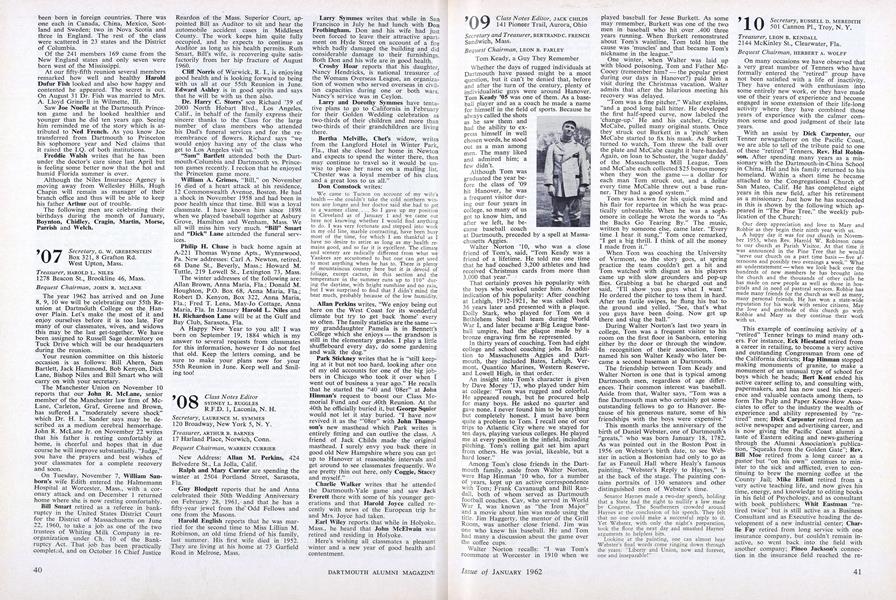
Whether the days of rugged individuals at Dartmouth have passed might be a moot question, but it can't be denied that, before and after the turn of the century, plenty of individualistic guys were around Hanover. Tom Keady '05 was one of them. As a baseball player and as a coach he made a name for himself in the field of sports. Because he always called the shots as he saw them and had the ability to express himself in well chosen words, he stood out as a man among men. The many liked and admired him; a few didn't.
Although Tom was graduated the year before the class of '09 hit Hanover, he was a frequent visitor during our four years in college, so many of us got to know him, and after we left, he became baseball coach at Dartmouth, preceded by a spell at Massachusetts Aggies.
Walter Norton '10, who was a close friend of Tom's, said, "Tom Keady was a friend of a lifetime. He told me one time that he had coached 3,200 athletes and had received Christmas cards from more than 3,000 that year."
That certainly proves his popularity with the boys who worked under him. Another indication of his popularity: After coaching at Lehigh, 1912-1921, he was called back 36 years later and presented with a plaque. Dolly Stark, who played for Tom on a Bethlehem Steel ball team during World War I, and later became a Big League baseball umpire, had the plaque made by a bronze engraving firm he represented.
In thirty years of coaching, Tom had eight college and school coaching jobs. In addition to Massachusetts Aggies and Dartmouth, they included Bates, Lehigh, Vermont, Quantico Marines, Western Reserve, and Lowell High, in that order.
An insight into Tom's character is given by Dave Morey '13, who played under him at college: "Tom was rugged and colorful. He appeared rough,' but he procured help for many boys. He asked no quarter and gave none. I never found him to be anything but completely honest. I must have been quite a problem to Tom. I recall one of our trips to Atlantic City where we stayed for ten days, playing various colleges. He played me at every position in the infield, including pitching. Tom's rolling gait set him apart from others. He was jovial, likeable, but a hard loser."
Among Tom's close friends in the Dartmouth family, aside from Walter Norton, were Hap Hinman '10 who, for a number of years, kept up an active correspondence with Tom; Frank Cavanaugh and Bill Randall, both of whom served as Dartmouth football coaches. Cav, who served in World War I, was known as "the Iron Major" and a movie about him was made using the title. Jim Haggerty, the mentor of the Grill Room, was another close friend. Jim was one who knew his baseball. He and Tom had many a discussion about the game over the coffee cups.
Walter Norton recalls: "I was Tom's roommate at Worcester in 1910 when we played baseball for Jesse Burkett. As some may remember, Burkett was one of the two men in baseball who hit over .400 three years running. When Burkett remonstrated about Tom's waistline, Tom told him the cause was 'muscles' and that became Tom's nickname in the league."
One winter, when Walter was laid up with blood poisoning, Tom and Father McCooey (remember him? - the popular priest during our days in Hanover?) paid him a visit during the Christmas vacation. Walter admits that after the hilarious meeting his recovery was delayed.
"Tom was a fine pitcher," Walter explains, "and a good long ball hitter. He developed the first half-speed curve, now labeled the 'change-up.' He and his catcher, Christy McCabe, pulled many original stunts. Once they struck out Burkett in a 'pinch' when McCabe started to fix his mask. As Burkett turned to watch, Tom threw the ball over the plate and McCabe caught it bare-handed. Again, on loan to Schuster, the 'sugar daddy' of the Massachusetts Mill League, Tom and McCabe each collected $25 bonus money when they won the game - a dollar for each man Tom struck out, and a dollar every time McCable threw out a base runner. They had a good system."
Tom was known for his quick mind and his flair for repartee in which he was practically unbeatable. When he was a sophomore in college he wrote the words to "As the Backs Go Tearing By." The music, written by someone else, came later. "Every time I hear it sung," Tom once remarked, "I get a big thrill. I think of all the money I made from it."
When Tom was coaching the University of Vermont, so the story goes, at spring practice the team couldn't get a hit and Tom watched with disgust as his players came up with slow grounders and pop-up flies. Grabbing a bat he charged out and said, "I'll show you guys what I want." He ordered the pitcher to toss them in hard. After ten futile swipes, he flung his bat to the ground and yelled, "See, that's what you guys have been doing. Now get up there and slug the ball."
During Walter Norton's last two years in college, Tom was a frequent visitor to his room on the first floor in Sanborn, entering either by the door or through the window. In recognition of their association, Tom named his son Walter Keady who later became a second baseman at Dartmouth.
The friendship between Tom Keady and Walter Norton is one that is typical among Dartmouth men, regardless of age differences. Their common interest was baseball. Aside from that, Walter says, "Tom was a fine Dartmouth man who certainly got some outstanding fellows to go to Hanover. Because of his generous nature, some of his friendships with the boys were expensive."
This month marks the anniversary of the birth of Daniel Webster, one of Dartmouth's "greats," who was born January 18, 1782. As was pointed out in the Boston Post in 1956 on Webster's birth date, to see Webster in action a Bostonian had only to go as far as Faneuil Hall where Healy's famous painting, "Webster's Reply to Haynes," is at the back of the stage. The painting contains portraits of 130 senators and other distinguished men of Webster's time.
Senator Haynes made a two-day speech, holding that a State had the right to nullify a law made bv Congress. The Southerners crowded around Haynes at the conclusion of his speech. They felt that no one could make a successful reply to it. Yet Webster, with only the night's preparation, took the floor the next day and smashed Haynes' arguments to helpless bits.
Looking at the painting, one can almost hear Webster's final words come ringing down through the years: "Liberty and Union, now and forever, one and inseparable!"
Class Notes Editor, 141 Pioneer Trail, Aurora, Ohio
Secretary and Treasurer,: Sandwich, Mass.
Bequest Chairman,
Tom Keady, a Guy They Remember
More From This Issue
-
 Feature
A Gulf That Needs Closing
January 1962 -
 Feature
John Wheelock's Laws of Conduct and Regulations for Students
January 1962 -
 Feature
DARTMOUTH SKIWAY
January 1962 -
 Feature
The Erickson-Bismarck Plan
January 1962 -
 Feature
Dr. Gilbert Horton Mudge Named Dean of Medical School
January 1962 -
 Class Notes
1956
January 1962