1909
Class Notes Editor, 141 Pioneer Trail, Aurora, Ohio
Secretary, Sandwich, Mass.
Class Agent, 66 Lilac Dr., Rochester 20, N.Y.
The Trek Back to Hanover
Come June and old-time Dartmouths get the urge to visit the scene of their undergraduate days to capture, in some degree, the youth that once was theirs. Plenty of gabbing and reminiscing goes on and then, all of a sudden, it's time to return to the home bases.
The year 1954, for '09, marked its first year of organized entertainment. My friend, Charlie Truman, had introduced me to a violin player named Lee Bennett who claimed that Indian blood flowed in his veins and he had a right to the title, Chief Black Bear. Be that as it may, the Chief knew his way around on the fiddle, and he could play almost any number you might mention. He said he knew of an accordion player named Dusty Godfrey who lived in a trailer on the road to Thetford.
The three of us piled into Charlie's car and went to see Dusty. Dusty had a rented accordion which he trotted out and we had a short jam session with the Chief and his violin and me on the banjo. It worked out real nice, and I thought the entertainment setup was in the bag.
One hitch appeared. Dusty had to return the accordion that day. The dealer had told him he was interested in selling instruments and not renting them, and if he could raise 75 bucks, the accordion would be his. Back we went to reunion headquarters and, through the generosity of certain members of the three classes ('07, '08, and '09) enough dough was raised to get Dusty his accordion and to pay him and the Chief for a couple of nights' playing.
The entertainment sure made a hit. The weather was ideal for gathering on the terrace in front of Tuck School where singing and dancing were the order of the evening. Some of the lads, who retired to their couches early in the evening, said they were lulled to sleep by dulcet tones of music wafted over the ozone. (Hold on there, Childs, don't get too lyrical.)
That was the year we had memorial services for Hal Pratt at the gravesite of Eleazar Wheelock, scattering his ashes around Eleazar's tombstone. Parsons Wilbur Bull and Leon Morse conducted the services. Joe Worthen was president of the class and Al Newton, who was destined to become president four years later was demonstrating his ability as an organizer.
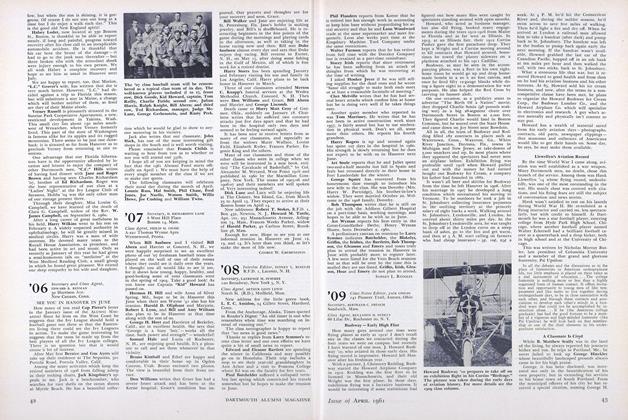
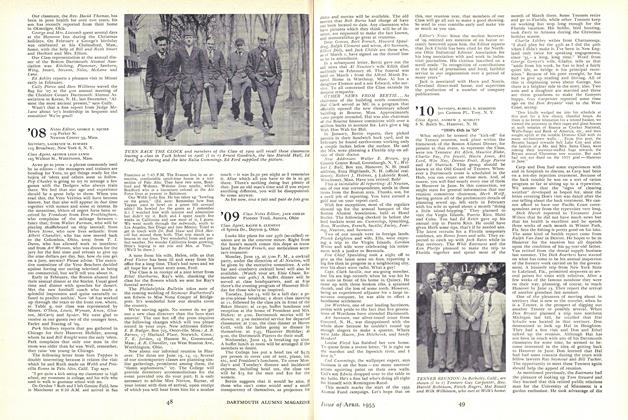
Those appearing in the accompanying photo are: (front row) Dick Southgate '07 (left), Freddie Munkelt '08, Jack Childs '09, General Ben Knox '08, and Mrs. Munkelt. (rear) Bill Sanborn '07, Mrs. Alice Sass, a relative of Bill, George Grebenstein '07 and his wife; Mrs. Gleason, Percy Gleason '08, Joe Coburn '07, and Luey Amidon '08.
Three in this group have since departed this earth. Joe Coburn died in December, 1958, Dick Southgate suffered an accidental death some months before his fiftieth re: union, and General Knox, one of the most loyal Dartmouth guys who ever lived, died in January of last year.
And now, at the time this issue is distributed, '09's informal reunion of 1961 is only a short month away — June 12-14. As President Al Newton poetizes:
To know your classmates better And to bind a closer link, Attend your class reunions, For 'tis later than you think!
"The Promenaders," Prom Show
A correction is in order. In the March issue of the MAGAZINE that carried a shot of the dazzling all-male chorus girls, I said they appeared in the prom show, "If I Were Dean." Nothing could be farther from the truth. They were featured in "The Promenaders" which was staged at Junior Prom and Commencement in 1908. The book and most of the lyrics were written by our own Ced Wellsted; Harry Wellman '07 wrote the music and some of the lyrics; extra numbers were written by Walter Rogers, Larry Gardner, and R. C. Hopkins.
The cast included Henry (Spider) Johnson, described as having wits but no money, played by Ced Wellsted, who was prominent in dramatics during his college course, in addition to playing basketball. Mort Hull 'OB had the part of John (Peaches) Grigsby, the son of a rich daddy, and his old man was Art Lewis, also 'OB, who was described as a bloated bond holder. Another '08er, George Squier, took the part of Lil Carter, a local celebrity. George seemed to specialize in rube types during his career as a collegiate thespian.
Spunk Troy '11 had the part of Jerry Jumps from South Boston and that's exactly where Spunk was from, along with Clarke Tobin, Greetings Norton and others. Three Rah Rah boys were Freddie Carroll, Bob Burns, and Duke Naylor who was described as "the same in a dress suit." Freddie Morawski, a great little comedian, took the part of a waiter.
In the female department, love interest was supplied by Artie Soule 'OB, described as "lovely vision of beauty," who was courted by Peaches Grigsby. Charlie Fay '10 was Mrs. Gander, a Hanover matron, and A. Patrick Donovan '11 was Lulu Gad, a so-called lady.
The Promenaders was a musical comedy in three acts. Like similar shows, popular at the time, Act I opened with an elaborate overture and ended with a finale. Act II had neither opening chorus nor finale, but Act III had an opening number and a grand finale.
Mort Hull, who had the romantic lead, was featured in two musical numbers, "The Girl Out There" and "Twilight," and his "girl" friend, Artie Soule, soloed "The Prom Girl" supported by a bevy of prom girls. Music for the Twilight song was written by Walter Golde, who started out with '09 but became affiliated with '10. Larry Gardner collaborated with Harry Wellman on the song, "Message of the Chapel Bells," and R. C. Hopkins collaborated on "The Prom Girl". Walt Rogers wrote the music for two numbers: "Hello Folks," sung by Spunk Troy, and "Grand-Father John" in which Spunk and George Squier were featured.
From this musical came the immortal Dartmouth song — "Men of Dartmouth" in which Harry Wellman reached musical heights, inspired by the words of Dartmouth's famous poet, Richard Hovey. Indeed, the words are worthy of repeating here:
Men of Dartmouth give a rouse For the college on the hill, For the lone pine above her, And the loyal sons who love her; Give a rouse, give a rouse with a will For the sons of old Dartmouth, The sturdy sons of Dartmouth, Tho' 'round the girdled earth they roam, Her spell on them remains.
They have the still North in their hearts, The hill winds in their veins, And the granite of New Hampshire In their muscles and their brains.
(In the song the last two lines are repeated)
Whenever and wherever Dartmouth men gather, this song never fails to give them a lift, and it reaffirms their loyalty to the college that has meant so much to them as undergrads and as alumni.
When you men are asked to do your bit in the Alumni Fund campaign, thinking about the sentiment expressed in this song should prompt you to do your best for Dartmouth.