Did Webster Really Say It?
That "small college" phrase ...
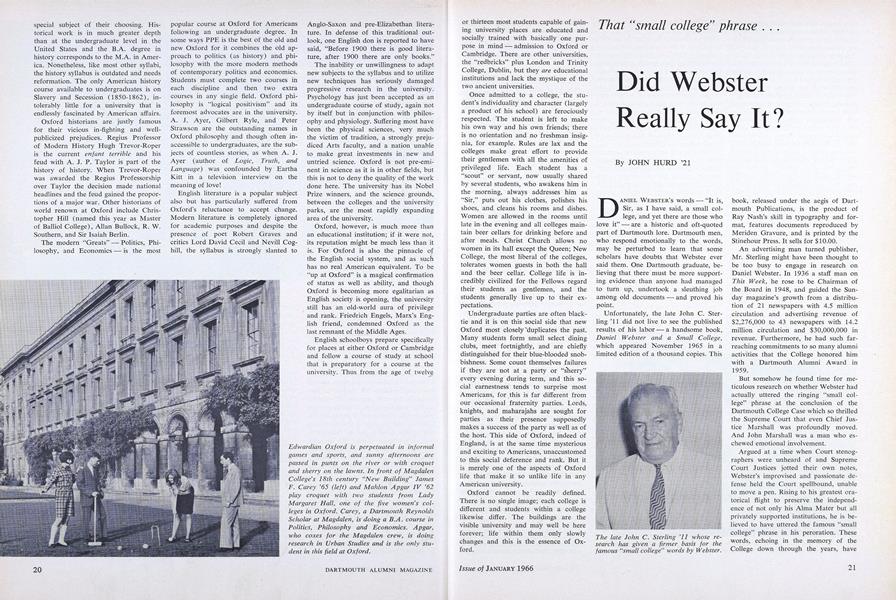
DANIEL WEBSTER'S words - "It is, Sir, as I have said, a small college, and yet there are those who love it" — are a historic and oft-quoted part of Dartmouth lore. Dartmouth men, who respond emotionally to the words, may be perturbed to learn that some scholars have doubts that Webster ever said them. One Dartmouth graduate, believing that there must be more supporting evidence than anyone had managed to turn up, undertook a sleuthing job among old documents - and proved his point.
Unfortunately, the late John C. Sterling '11 did not live to see the published results of his labor - a handsome book, Daniel Webster and a Small College, which appeared November 1965 in a limited edition of a thousand copies. This book, released under the aegis of Dartmouth Publications, is the product of Ray Nash's skill in typography and format, features documents reproduced by Meriden Gravure, and is printed by the Stinehour Press. It sells for $10.00.
An advertising man turned publisher, Mr. Sterling might have been thought to be too busy to engage in research on Daniel Webster. In 1936 a staff man on This Week, he rose to be Chairman of the Board in 1948, and guided the Sunday magazine's growth from a distribution of 21 newspapers with 4.5 million circulation and advertising revenue of $2,276,000 to 43 newspapers with 14.2 million circulation and $30,000,000 in revenue. Furthermore, he had such far-reaching commitments to so many alumni activities that the College honored him with a Dartmouth Alumni Award in 1959.
But somehow he found time for meticulous research on whether Webster had actually uttered the ringing "small college" phrase at the conclusion of the Dartmouth College Case which so thrilled the Supreme Court that even Chief Justice Marshall was profoundly moved. And John Marshall was a man who eschewed emotional involvement.
Argued at a time when Court stenographers were unheard of and Supreme Court Justices jotted their own notes, Webster's improvised and passionate defense held the Court spellbound, unable to move a pen. Rising to his greatest oratorical flight to preserve the independence of not only his Alma Mater but all privately supported institutions, he is believed to have uttered the famous "small college" phrase in his peroration. These words, echoing in the memory of the College down through the years, have such impact that many Dartmouth men consider them sacrosanct. However, scholars have been skeptical that Webster spoke them • at least in the way they have come down to us. Why?
Sterling shared this scholarly concern which, sought an explanation for certain singular facts which cast doubt on the authenticity of the alleged phraseology.
Why did Webster, his Portsmouth law partner, Timothy Farrar, and the other three lawyers associated with him in the suit "Dartmouth College vs Woodward" leave the peroration unremarked in a lengthy document written between the time of Webster's plea in March 1818 and the Court's decision in February 1819? Why is there no mention of the phrase "a small college" in the two volumes of his speeches (1830 and 1835) and the six volumes of his Works (1851)? Why is there no reference to it in the eighteen volumes of his letters, published posthumously in 1903? Why did John King Lord ignore it in his History of Dartmouth (1913)? Why did the greatest authority on Webster, Claude Moore Fuess, not allude to it in his Rufus Choate: The Wizard of the Law (1928), and two years later, in his definitive biography of Webster, treat it with great diffidence? He wrote, "The story has become so bound up with Websterian tradition that it is almost irreverent to cast doubt on its verbal authenticity." But Fuess obviously did entertain some doubt.
Nor is this all. Professor Leon Burr Richardson in his two-volume History ofDartmouth (1932) suggests that because the description was written a year after Webster's death by one who was himself a matchless phrase-maker, and depends for its accuracy on the memory of yet another man concerning an event occurring thirty years before, it is indeed a balTling exercise to attribute credit.
And, finally, Bartlett's Familiar Quotations, 1955 edition, gives 34 excerpts from Webster, none of which refers to "small college" and "love."
Central to the controversy is a speech made by the noted lawyer Rufus Choate, an undergraduate at Dartmouth when Webster argued his case. At the Dartmouth Commencement exercises in 1853, eight months after Webster's death, Choate quoted a letter from a Yale professor, Chauncey A. Goodrich, who attended the trial in Washington in 1818 to represent Yale's interests which were also likely to be affected by the outcome.
It is one of the curiosities of American scholarship that the Goodrich letter disappeared from sight. It is this letter, to refer to Professor Richardson again, that "undoubtedly conveyed a true picture of the atmosphere of the occasion," and "the impression is all that is of importance." ". . . with clear conscience, we may resolve not to allow questions of literal exactness to interfere with our enjoyment of this marvelously painted picture or to diminish our conception of the essential greatness of its central figure."
In the Commencement Address, later produced in pamphlet form, Choate said:
Well, as if of yesterday, I remember how it was written home from Washington that "Mr. Webster closed a legal argument of great power by a peroration which charmed and melted his audience." Often since I have heard vague accounts, not much more satisfactory, of the speech and the scene. I was aware that the report of his argument, as it is [sic] published, did not contain the actual peroration, and I supposed it lost forever. By the great kindness of a learned and excellent person, Dr. Chauncey A. Goodrich, a Professor in Yale College, with whom I have not the honor of a personal acquaintance, although his virtues, accomplishments, and most useful life, were well known to me, I can read to you the words whose power, when those lips spoke them, so many owned, although they could not repeat them.
This paragraph in Choate's pamphlet becomes the core of the debate for historians who were quick to point out that the famous words were reported for the first time and became a matter of record 34 years after the Dartmouth College Case.
This period is the gulf separating Webster's adherents from the skeptical scholars. Moreover, the man who reported the words, Rufus Choate - who, be it remembered, was an undergraduate at the time of Webster's four-hour address to the Supreme Court - had, according to Fuess, "a vivid and romantic imagination."
Shunning romanticism and soft-focus procedures, Sterling addressed himself to the astringent facts. He urged his friend, the late Carroll A. Wilson, a Harvard Law School graduate and an authority on first editions, to keep an eye out. Wilson found the original Goodrich letter, somewhat damaged, in the Boston Public Library. Research in other libraries on questionable points supported his declaration that Goodrich was reliable, and that Choate, although he altered Goodrich's letter, had not falsified the essentials.
Wilson's article, "Daniel Webster and Dartmouth," published in The Colophon, 1938, was reprinted in the DARTMOUTH ALUMNI MAGAZINE in 1943. Its most important section gladdened the hearts of the faithful:
The marvel is that after complete silence in newspapers, official documents, correspondence, biography and reports of speeches, throughout Webster's long life, the quotation comes to light thirty-four years after the event, almost through fortuity, from a source that is unimpeachable. Dartmouth College, as, thanks to Webster, it still remains, should erect a tablet to the Reverend Chauncey Allen Goodrich.
To me, at any rate, at the end of this investigation, the scene described and the words used in Goodrich's letter to Choate of November 25, 1852 should be taken as gospel.
The DARTMOUTH ALUMNI MAGAZINE also published a letter from Fuess, acknowledging Wilson's researches and conclusion, and stating that although Wilson "made a real contribution to Websteriana" and even if Wilson's "conclusion is substantially sound," he, Fuess, could not believe that Goodrich after a lapse of more than thirty years could have recalled the exact wording.
Still determined, Sterling pursued the matter to New York where he discovered that the first description of the trial scene in print was not Choate's pamphlet but in the New York Daily Times, July 29, 1853. He had the great good luck to find a small, obscure book called Reminiscences of the Eulogy of Rufus Choate onWebster by Charles Caverno, published in 1914. This book described how a clerk of Choate's had sat up all night with a Mr. Raymond from the Times, then an eight-page newspaper with a circulation of 25,000.
On microfilm, Sterling examined a newspaper phenomenon. The entire front page of this issue, and five of the six columns on page two, "were devoted to Choate's eulogy on Webster. Sterling believed that Choate's clerk may have helped Raymond with the famous phrase, but its origin was still in doubt.
Sterling next investigated the Goodrich family papers in the Yale University Library and found Professor Goodrich's notes on lectures and sermons. These revealed that he faithfully recorded his thought on the great issues and events of his day and was ever fascinated by Daniel Webster's magnetism and the Dartmouth College Case.
The biggest research plum, a letter by Choate to Goodrich, unknown for more than 110 years, thanked Goodrich for his eye-witness description of the trial scene in Washington and declared that unless Goodrich objected, he would use the entire letter in the Dartmouth Commencement Address of 1853.
More of Sterling's good fortune was obtaining the assistance of an expert in the Boston Museum of Fine Arts, Francis W. Dolloff, who restored the Goodrich letter to its original condition. Choate had made chronological changes on its face, had pasted in several newspaper clippings, and bound the letter itself into his manuscript of the Commencement Address.
To his surprise, Sterling also discovered that 25 years before the restoration of the letter, Professor John W. Black of Ohio State, an authority on phonetics whose Master's thesis had been done on Rufus Choate, had published an article using the exact phraseology of the Goodrich letter before it had been restored. How could that have happened? Black had found the letter in the Boston Public Library and, aided by an associate, had raised the paste-overs by Choate and copied the letter as originally written by Goodrich.
The 34-year span between the Washington court scene and the Goodrich-Choate letter was suddenly bridged by a book Black used, Reminiscences of RufusChoate by E. G. Parker, published 1860. A junior partner in Choate's law firm, Parker had studied Choate closely for ten years and wrote that Choate faithfully recorded his daily thoughts, impressions and experiences. The Reminiscences were written diary-fashion, and one particular entry formed Black's opinion that Goodrich's letter to Choate was not the reminiscence of a 62-year-old man writing of an event which occurred 35 years earlier, but was a re-writing or a copy of an earlier, undiscovered report written possibly an hour or so after the trial or certainly sometime during the ensuing 16 years, not 34. It is conceivable that the missing manuscript may still come to light or that it may have been destroyed in that portion of the Goodrich papers which were accidentally burned in 1919.
But Sterling believes that even if there were no other base for Goodrich's letter than his own memory, we can still rely on his accuracy. A trained public speaker, Professor of Rhetoric, and the greatest lexicographer of his time, when professional men prided themselves on formidable feats of memory, Chauncey Goodrich would not have been taxed by the Webster peroration with a first paragraph of 220 words, beginning "This, Sir, is my case"; and a second of only 49 words: "Sir, I know not how others may feel. . . ." This would indeed have been easy because the memory was of a speech supercharged with all the drama and emotion surrounding a most crucial issue: the life or death of a college in particular, and the rights of private institutions in general.
Increasingly, the reference to Webster's "small college" pervades the American vernacular. Sterling tells of overhearing an Eli, after Dartmouth won a football game in the Yale Bowl, remark, "Don't count on me as one who loves it." Even when parodied, the phrase continues to move us as if we had heard a trumpet call.
Sterling's book permits alumni to quote Webster with the fervor of renewed conviction.
The late John C. Sterling 'll whose research has given a firmer basis for thefamous "small college" words by Webster.
This Thayer Hall painting of Webster arguing the Dartmouth College Casewas done by artist Robert Burns through bequest of Henry N. Teague '00.
JOHN HURD '21
-
 Article
From Kidneys to Tokyo
January 1950 -
 Books
BooksPOLITICAL WRITERS OF THE EIGHT-EENTH-CENTURY.
MAY 1964 -
 Article
Dean of Travel Writers
OCTOBER 1968 -
 Books
BooksBriefly Noted
MARCH 1971 -
 Books
BooksNO TIME FOR SCHOOL, NO TIME FOR PLAY: THE STORY OF CHILD LABOR IN AMERICA.
NOVEMBER 1972 -
 Books
BooksWHERE THE POOLS ARE BRIGHT AND DEEP
November 1973
Features
-
 Feature
Dead Aim
JANUARY | FEBRUARY 2018 -
 Feature
Taking the Sky
NOVEMBER • 1987 -
 Feature
My "Most Unforgettable Character"
February 1954 -
 Feature
On the Air
DECEMBER • 1985 -
 Feature
A Look Backward and A Look Ahead
JULY 1964 -
 Feature
The Nelson A. Rockefeller Center for the Social Sciences at Dartmouth College
OCTOBER, 1908


