The HIGH COST of Running a College
MUCH has been written and spoken about "forward thrust" as Dartmouth carries out planned programs in the years leading up to the 1969 Bicentennial. The law that applies here, insofar as college finances are concerned, is that what goes forward also goes up.
An example of the forward-upward concurrence is provided by Dartmouth's 1964-65 financial report, prepared for the Trustees by Vice President and Treasurer John F. Meek '33 and Comptroller Robert D. Funkhouser '27 and released last month in printed form. The figures in nearly every category have risen to new highs.
The grand total of annual operating expense passed $20 million for the first time. The expense figure of $21,536,740 compares with $19,363,247 for the year before. The increase of slightly more than $2 million "again reflected, in the main, higher levels of compensation throughout the College, growth in the volume of sponsored research, expansion of services and facilities, and expansion of the summer lerm program."
Income fortunately kept pace with rising costs. The total here, including the 1965 Alumni Fund, was a record $21,567,354, leaving a black-ink balance of $30,614 to be added to the College's unrestricted current fund. This latter fund, which acquired $36,409 from current operations in the previous year, now stands at $272,695.
Other highlights presented in a capsule summary at the beginning of the 1964-65 financial report were these:
• Gifts and bequests, including the Alumni Fund and payments on pledges to the Capital Gifts Campaign, totaled the record sum of $10,336,358, far ahead of the $6,162,572 total for the year before. This total was made up of $7,701,837 for endowment and plant, and $2,634,521 for current use.
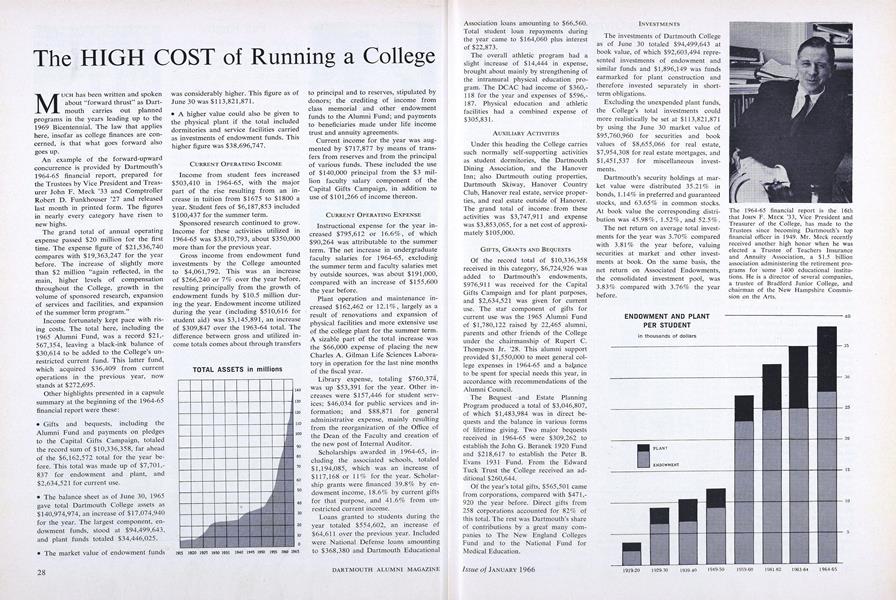
• The balance sheet as of June 30, 1965 gave total Dartmouth College assets as $140,974,974, an increase of $17,074,940 for the year. The largest component, endowment funds, stood at $94,499,643, and plant funds totaled $34,446,025.
• The market value of endowment funds was considerably higher. This figure as of June 30 was $113,821,871.
• A higher value could also be given to the physical plant if the total included dormitories and service facilities carried as investments of endowment funds. This higher figure was $38,696,747.
CURRENT OPERATING INCOME
Income from student fees increased $503,410 in 1964-65, with the major part of the rise resulting from an increase in tuition from $1675 to $lBOO a year. Student fees of $6,187,853 included $100,437 for the summer term.
Sponsored research continued to grow. Income for these activities utilized in 1964-65 was $3,810,793, about $350,000 more than for the previous year.
Gross income from endowment fund investments by the College amounted to $4,061,792. This was an increase of $266,240 or 7% over the year before, resulting principally from the growth of endowment funds by $10.5 million during the year. Endowment income utilized during the year (including $510,616 for student aid) was $3,145,891, an increase of $309,847 over the 1963-64 total. The difference between gross and utilized income totals comes about through transfers to principal and to reserves, stipulated by donors; the crediting of income from class memorial and other endowment funds to the Alumni Fund; and payments to beneficiaries made under life income trust and annuity agreements.
Current income for the year was augmented by $717,877 by means of transfers from reserves and from the principal of various funds. These included the use of $140,000 principal from the $3 million faculty salary component of the Capital Gifts Campaign, in addition to use of $101,266 of income thereon.
CURRENT OPERATING EXPENSE
Instructional expense for the year increased $795,612 or 16.6%, of which $90,264 was attributable to the summer term. The net increase in undergraduate faculty salaries for 1964-65, excluding the summer term and faculty salaries met by outside sources, was about $191,000, compared with an increase of $155,600 the year before.
Plant operation and maintenance increased $162,462 or 12.1%, largely as a result of renovations and expansion of physical facilities and more extensive use of the college plant for the summer term. A sizable part of the total increase was the $66,000 expense of placing the new Charles A. Gilman Life Sciences Laboratory in operation for the last nine months of the fiscal year.
Library expense, totaling $760,374, was up $53,391 for the year. Other increases were $157,446 for student services; $46,034 for public services and information; and $88,871 for general administrative expense, mainly resulting from the reorganization of the Office of the Dean of the Faculty and creation of the new post of Internal Auditor.
Scholarships awarded in 1964-65, including the associated schools, totaled $1,194,085, which was an increase of $117,168 or 11% for the year. Scholarship grants were financed 39.8% by endowment income, 18.6% by current gifts for that purpose, and 41.6% from unrestricted current income.
Loans granted to students during the year totaled $554,602, an increase of $64,611 over the previous year. Included were National Defense loans amounting to $368,380 and Dartmouth Educational Association loans amounting to $66,560. Total student loan repayments during the year came to $164,060 plus interest of $22,873.
The overall athletic program had a slight increase of $14,444 in expense, brought about mainly by strengthening of the intramural physical education program. The DCAC had income of $360,118 for the year and expenses of $596,187. Physical education and athletic facilities had a combined expense of $305,831.
AUXILIARY ACTIVITIES
Under this heading the College carries such normally self-supporting activities as student dormitories, the Dartmouth Dining Association, and the Hanover Inn; also Dartmouth outing properties, Dartmouth Skiway, Hanover Country Club, Hanover real estate, service properties, and real estate outside of Hanover. The grand total of income. from these activities was $3,747,911 and expense was $3,853,065, for a net cost of approximately $105,000.
GIFTS, GRANTS AND BEQUESTS
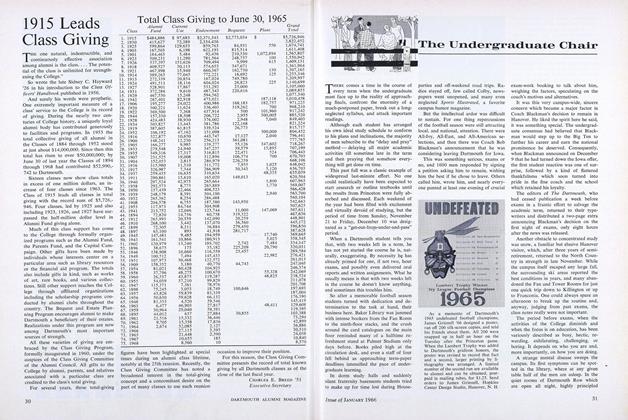
Of the record total of $10,336,358 received in this category, $6,724,926 was added to Dartmouth's endowments, $976,911 was received for the Capital Gifts Campaign and for plant purposes, and $2,634,521 was given for current use. The star component of gifts for current use was the 1965 Alumni Fund of $1,780,122 raised by 22,465 alumni, parents and other friends of the College under the chairmanship of Rupert C. Thompson Jr. '28. This alumni support provided $1,550,000 to meet general college expenses in 1964-65 and a balance to be spent for special needs this year, in accordance with recommendations of the Alumni Council.
The Bequest and Estate Planning Program produced a total of $3,046,807, of which $1,483,984 was in direct bequests and the balance in various forms of lifetime giving. Two major bequests received in 1964-65 were $309,262 to establish the John G. Beranek 1920 Fund and $218,617 to establish the Peter B. Evans 1931 Fund. From the Edward Tuck Trust the College received an additional $260,644.
Of the year's total gifts, $565,501 came from corporations, compared with $471,920 the year before. Direct gifts from 258 corporations accounted for 82% of this total. The rest was Dartmouth's share of contributions by a great many companies to The New England Colleges Fund and to the National Fund for Medical Education.
INVESTMENTS
The investments of Dartmouth College as of June 30 totaled $94,499,643 at book value, of which $92,603,494 represented investments of endowment and similar funds and $1,896,149 was funds earmarked for plant construction and therefore invested separately in shortterm obligations.
Excluding the unexpended plant funds, the College's total investments could more realistically be set at $113,821,871 by using the June 30 market value of $95,760,960 for securities and book values of $8,655,066 for real estate, $7,954,308 for real estate mortgages, and $1,451,537 for miscellaneous investments.
Dartmouth's security holdings at market value were distributed 35.21% in bonds, 1.14% in preferred and guaranteed stocks, and 63.65% in common stocks. At book value the corresponding distribution was 45.98%, 1.52%, and 52.5%.
The net return on average total investments for the year was 3.70% compared with 3.81% the year before, valuing securities at market and other investments at book. On the same basis, the net return on Associated Endowments, the consolidated investment pool, was 3.83% compared with 3.76% the year before.
The 1964-65 financial report is the 16th that JOHN F. MECK '33, Vice President and Treasurer of the College, has made to the Trustees since becoming Dartmouth's top financial officer in 1949. Mr. Meck recently received another high honor when he was elected a Trustee of Teachers Insurance and Annuity Association, a $1.5 billion association administering the retirement programs for some 1400 educational institutions. He is a director of several companies, a trustee of Bradford Junior College, and chairman of the New Hampshire Commission on the Arts.