The Undergraduate Chair
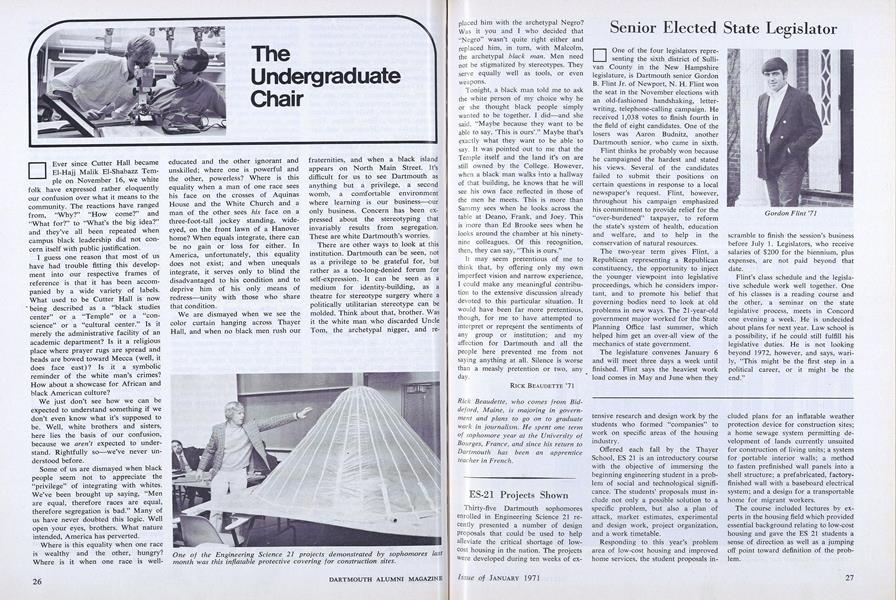
Ever since Cutter Hall became El-Hajj Malik El-Shabazz Tempie on November 16, we white folk have expressed rather eloquently our confusion over what it means to the community. The reactions have ranged from, "Why?" "How come?" and "What for?" to "What's the big idea?" and they've all been repeated when campus black leadership did not concern itself with public justification.
I guess one reason that most of us have had trouble fitting this development into our respective frames of reference is that it has been accompanied by a wide variety of labels. What used to be Cutter Hall is now being described as a "black studies center" or a "Temple" or a "conscience" or a "cultural center." Is it merely the administrative facility of an academic department? Is it a religious place where prayer rugs are spread and heads are bowed toward Mecca (well, it does face east)? Is it a symbolic reminder of the white man's crimes? How about a showcase for African and black American culture?
We just don't see how we can be expected to understand something if we don't even know what it's supposed to be. Well, white brothers and sisters, here lies the basis of our confusion, because we aren't expected to understand. Rightfully so—we've never understood before.
Some of us are dismayed when black people seem not to appreciate the "privilege" of integrating with whites. We've been brought up saying, "Men are equal, therefore races are equal, therefore segregation is bad." Many of us have never doubted this logic. Well open your eyes, brothers. What nature intended, America has perverted.
Where is this equality when one race is wealthy and the other, hungry? Where is it when one race is welleducated and the other ignorant and unskilled; where one is powerful and the other, powerless? Where is this equality when a man of one race sees his face on the crosses of Aquinas House and the White Church and a man of the other sees his face on a three-foot-tall jockey standing, wideeyed, on the front lawn of a Hanover home? When equals integrate, there can be no gain or loss for either. In America, unfortunately, this equality does not exist; and when unequals integrate, it serves only to blind the disadvantaged to his condition and to deprive him of his only means of redress—unity with those who share that condition.
We are dismayed when we see the color curtain hanging across Thayer Hall, and when no black men rash our fraternities, and when a black island appears on North Main Street. It's difficult for us to see Dartmouth as anything but a privilege, a second womb, a comfortable environment where learning is our business—our only business. Concern has been expressed about the stereotyping that invariably results from segregation. These are white Dartmouth's worries.
There are other ways to look at this institution. Dartmouth can be seen, not as a privilege to be grateful for, but rather as a too-long-denied forum for self-expression. It can be seen as a medium for identity-building, as a theatre for stereotype surgery where a politically utilitarian stereotype can be molded. Think about that, brother. Was it the white man who discarded Uncle Tom, the archetypal nigger, and replaced him with the archetypal Negro? Was it you and I who decided that "Negro" wasn't quite right either and replaced him, in turn, with Malcolm, the archetypal black man. Men need not be stigmatized by stereotypes. They serve equally well as tools, or even weapons.
Tonight, a black man told me to ask the white person of my choice why he or she thought black people simply wanted to be together. I did—and she said, "Maybe because they want to be able to say, 'This is ours'." Maybe that's exactly what they want to be able to say. It was pointed out to me that the Temple itself and the land it's on are still owned by the College. However, when a black man walks into a hallway of that building, he knows that he will see his own face reflected in those of the men he meets. This is more than Sammy sees when he looks across the table at Deano, Frank, and Joey. This is more than Ed Brooke sees when he looks around the chamber at his ninetynine colleagues. Of this recognition, then, they can say, "This is ours."
It may seem pretentious of me to think that, by offering only my own imperfect vision and narrow experience, I could make any meaningful contribution to the extensive discussion already devoted to. this particular situation. It would have been far more pretentious, though, for me to have attempted to interpret or represent the sentiments of any group or institution; and my affection for Dartmouth and all the people here prevented me from not saying anything at all. Silence is worse than a measly pretention or two, any day.
One of the Engineering Science 21 projects demonstrated by sophomores lastmonth was this inflatable protective covering for construction sites.
Rick Beaudette, who comes from Biddeford, Maine, is majoring in government and plans to go on to graduatework in journalism. He spent one termof sophomore year at the University ofBourges, France, and since his return toDartmouth has been an apprenticeteacher in French.
More From This Issue
-
 Feature
Public Policy: The Ordeal of Choices
January 1971 -
 Feature
Alumni Council to Meet
January 1971 -
 Feature
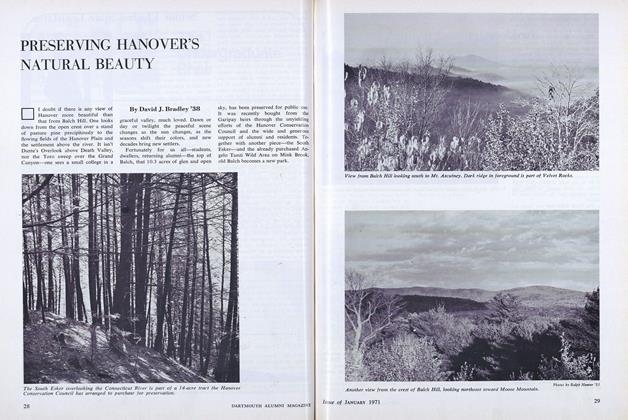
PRESERVING HANOVER'S NATURAL BEAUTY
January 1971 -
 Feature
The Dartmouth Alumni College August 15-26, 1971
January 1971 -
 Article
Faculty
January 1971 -
 Article
The Class of 1926 Collection
January 1971
Article
-
 Article
Dartmouth Services for Dartmouth Menin Service
October 1943 -
 Article
THE COLLEGE
March 1956 -
 Article
$3 Million Gift for Science Center
FEBRUARY 1972 -
 Article
Cameos of a Crisis
January 1940 -
 Article
Dartmouth's Oldest Living All-American Football Star
APRIL 1990 -
 Article
An Heir to Ledyard's Wanderlust
October 1980

