1938
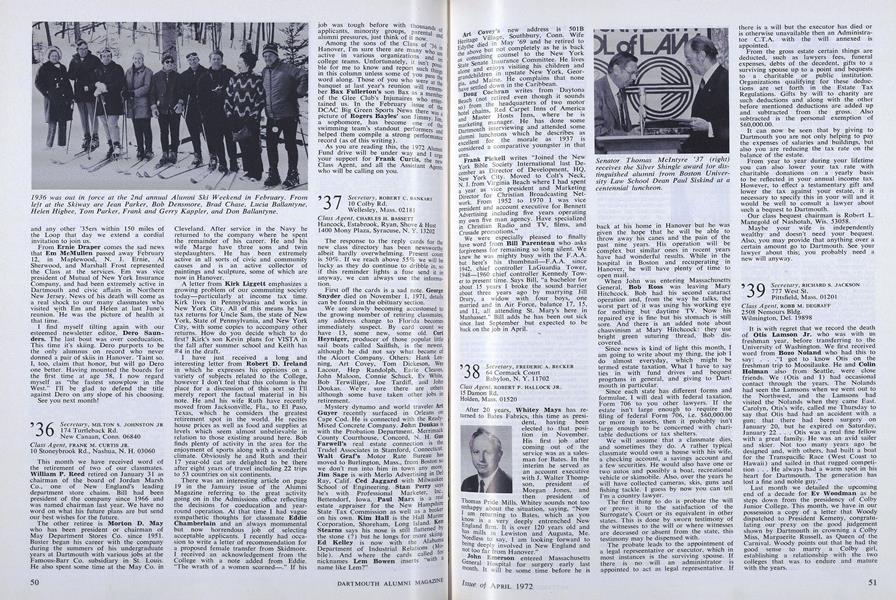
After 20 years, Whitey Mays has returned to Bates Fabrics, this time as president, having been elected to that position in November. His first job after coming out of the service was as a salesman for Bates. In the interim he served as an account executive with J. Walter Thompson, president of Morgan Jones, and then president of Thomas Pride Mills. Whitey sounds not too unhappy about the situation, saying, "Now I am returning to Bates, which as you Know is a very deeply entrenched New England firm. It is over 120 years old and has mills in Lewiston and Augusta, Me. Needless to say, I am looking forward to being deeply involved in New England and not too far from Hanover."
John Emerson entered Massachusetts general Hospital for surgery early last month. It will be some time before he is back at his home in Hanover but he was given the hope that he will be able to throw away his canes and the pain of the past nine years. His operation will be complex but similar ones in recent years have had wonderful results. While in the hospital in Boston and recuperating in Hanover, he will have plenty of time to open mail.
When John was entering Massachusetts General, Bob Boss was leaving Mary Hitchcock. Bob had his second cataract operation and, from the way he talks, the worst part of it was using his working eye for nothing but daytime TV. Now his repaired eye is fine but his stomach is still sore. And there is an added note about chauvinism at Mary Hitchcock: they use bright green suturing thread, Bob dis- covered.
Since news is kind of light this month, I am going to write about my thing, the job I do almost everyday, which might be termed estate taxation. What I have to say ties in with fund drives and bequest programs in general, and giving to Dartmouth in particular.
Since each state has different forms and formulae, I will deal with federal taxation, Form 706 to you other lawyers. If the estate isn't large enough to require the filing of federal Form 706, i.e. $60,000.00 or more in assets, then it probably isn't large enough to be concerned with charitable deductions or tax shelters.
We will assume that a classmate dies, and sometimes they do. A rather typical classmate would own a house with his wife, a checking account, a savings account and a few securities. He would also have one or two autos and possibly a boat, recreational vehicle or skimobile. Also, over the years he will have collected cameras, skis, guns and fishing tackle. I guess by now you can tell I'm a country lawyer.
The first thing to do is probate the will or prove it to the satisfaction of the Surrogate's Court or its equivalent in other states. This is done by sworn testimony of the witnesses to the will or where witnesses are deceased or absent from the state, this testimony may be dispensed with.
The probate leads to the appointment of a legal reprseentative or executor, which in most instances is the surviving spouse. If there is no will an administrator is appointed to act as legal representative. If there is a will but the executor has died or is otherwise unavailable then an Administrator C.T.A. with the will annexed is appointed.
From the gross estate certain things are deducted, such as lawyers fees, funeral expenses, debts of the decedent, gifts to a surviving spouse up to a point and bequests to a charitable or public institution. Organizations qualifying for these deductions are set forth in the Estate Tax Regulations. Gifts by will to charity are such deductions and along with the other before mentioned deductions are added up and subtracted from the gross. Also subtracted is the personal exemption of $60,000.00.
It can now be seen that by giving to Dartmouth you are not only helping to pay the expenses of salaries and buildings, but also you are reducing the tax rate on the balance of the estate.
From year to year during your lifetime you can also lower your tax rate with charitable donations on a yearly basis to be reflected in your annual income tax. However, to effect a testamentary gift and lower the tax against your estate, it is necessary to specify this in your will and it would be well to consult a lawyer about such a bequest to Dartmouth.
Our class bequest chairman is Robert L. Manegold of Nashotah, Wis. 53058.
Maybe your wife is independently wealthy and doesn't need your bequest. Also, you may provide that anything over a certain amount go to Dartmouth. See your lawyer about this; you probably need a new will anyway.
Senator Thomas McIntyre '37 (right)receives the Silver Shingle award for distinguished alumni from Boston University Law School Dean Paul Siskind at acentennial luncheon.
Secretary, 64 Cormack Court Babylon, N. Y. 11702
Class Agent, 15 Damon Rd. Holden, Mass. 01520