Nervi's Concrete Aesthetic

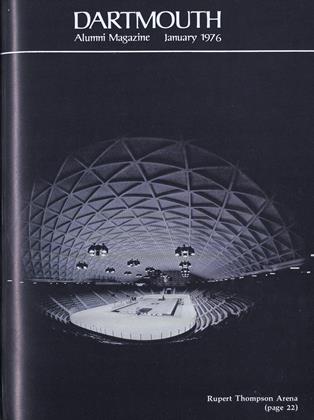
Rupert Thompson Arena
FOR the second time in a little more than a decade Dartmouth has gone to the Italian engineer Pier Luigi Nervi for the design of a large indoor space for the primary use of athletics. Nervi, one of the handful of pioneers in the development of reinforced concrete for the construction of large vaulted halls, is one of the more controversial figures in the practice of contemporary architecture. Over the years there have always been a few critics and historians reluctant to admit that his work is architecture or that his structures possess anything more than incidental artistic intent, but these are the ones who would likewise patronizingly dismiss the Brooklyn Bridge as mere engineering! However, it is sadly true that most of the respected histories of modern architecture mention Nervi only in passing, and some not at all. I am somewhat relieved to discover that in my own text (Twentieth Century Architecture, The MiddleYears) written a decade ago, Nervi's work is illustrated and discussed with relative thoroughness (his Rome Olympiad structures were then new and much admired). But to my amazement, no general writer on the subject has since seemed much interested in analyzing his distinctive concrete vaults, or examining the extent and meaning of Nervi's concrete inventions.
Before coping with the deadline for this article I had planned to attend a game at the new Rupert Thompson Arena. Naturally, I was curious about certain operational details: lighting, acoustics and so forth, features that are not apparent in seeing the space when empty. For more than a year I had watched the assembling of the pre-cast concrete vault and the closing off of the space by the end walls. A system of arched metal centering traveling along a rail, similar to that employed in the early '60s for Leverone Field House, was utilized for assembling the concrete parts lifted into place by a crane. But if I had attended its construction, I have yet to see Thompson Arena in action, and so it has seemed best to postpone for the present a more detailed and specific commentary on the new building. Nervi himself seemed in need of a closer look.
Over the past two centuries the professions of architect and engineer have diverged. The problem has been exacerbated by a marked professional tendency on both sides to bad-mouth the other. True, upon occasion this rupture of the two dependent professions has been announced as miraculously healed by some designer-saviour whose works have come into being out of a simultaneous consideration of technical and aesthetic problems. The late Le Corbusier, who, in his writings, payed homage to what he called, with a certain irony, "The Engineers' Aesthetic," was burdened by his friends and critics with this messiah-like role. However, he never pretended to possess the special competence of an engineer, although he deliberately dressed as one. (Indeed, his later concrete buildings seem more the work of a sculptor than a technician).
The contemporary split between architects and engineers can, well and poignantly be illustrated by the co-existence, in the same large publishing house, of two entirely separate editorial staffs producing important professional magazines, one for architecture, the other for engineering. They occupy contingent office space on the same floor of a mid-town New York skyscraper, but otherwise share nothing. They never confer on an official or personal level, and each has little but derogatory comment for the work of the other. So much for conglomeration in the publishing industry.
This is the situation that Nervi has found himself in throughout his professional career. He was trained as an engineer, and his contribution to the forms of modern architectural design came about as a result of his consideration of an industrial-age material, reinforced concrete - its structural properties and the means of erecting it. Over a half-century his forms have evolved out of a search for the most elegant and efficient solution to the given problem. Contrary to popularly held opinion, the growth of modern architecture and its new forms has not primarily evolved from such practical considerations of structure and function. Indeed, what is commonly called functional architecture, meaning a simple, unadorned purist style, is only incidentally functional on an operational level. Like so many conceptual words in architectural criticism (or literary criticism for that matter), "functional" is really a metaphor used to describe certain visual or formal characteristics. In the beginning, in the '20s, the word identified any new building that had no recognizable historical dress. More recently, it has fallen out of use among critics, though I suspect its employment by the general public continues.
Even the word "concrete" does not merely identify a building material; more than once it has been used to describe a specific virtue of contemporary architectural design. Le Corbusier used it adjectivally, but with a punning intent, speaking of concrete architecture much as one speaks of concrete music or concrete poetry. Moreover, many of the early works of the modern movement in architectural design appear to have been built in concrete, and their forms seem to express this new industrial-age technology. However, they were actually built in conventional materials and then covered with stucco to simulate concrete. The simple truth is that in the '20s most builders were not geared up to work in the new methods, conventional ways remained much more economical, and that was normally the controlling factor.
One of the problems that avant-garde architects of our century have not faced up to pertains to the actual and rather restricted relevance of new technologies to the building situation. Spaced-out (literally!) architectural fantasies of the past decade appear to have "discovered" applications for much sophisticated moon- shot hardware in radical, revolutionary design, but they are for the most part the works of starry-eyed sentimentalists seduced by strange-looking forms. They lack understanding with respect to use, cost, and so forth. They think that architectural design and applied science can be brought together again though a few well-intentioned strokes of the pen, some Pop Art graphics, and a few flashy captions. A pretty try, but no more; interesting to the critic in exactly the same way that the flying-saucer phenomonon is of concern to the psychohistorian.
Nervi is one of the very few modern designers to have worked realistically in this gap between art and technology, in the actual creation of buildings that consistently face up to economic structural realities while simultaneously contributing to the expanding vocabulary of contemporary design. His exclusive interest in concrete, that Cinderella material of contemporary design (but almost never considered favorably as the final exterior surface of a prestige building), has perhaps been responsible for his relative lack of prominence. Although he was involved with the structural design of an important skyscraper, Milan's Pirelli Building, in the 19505, Nervi has not been called upon for other office structures. His forte is the vaulted hall, once, in the time of the Gothic cathedral, the most noble of architectural forms, but an art which has fallen upon evil days of late — witness the depressing enclosed colosseums of Houston and New Orleans, just for starters.
Significantly, diagrams and views of several Gothic cathedrals are illustrated by Nervi at the beginning of his book, Aestheticsand Technology in Building (1965), which grew out of his lectures as Charles Eliot Norton Professor at Harvard a few years earlier. These illustrations are followed by those of the Eiffel Tower and other 19th century works of metal technology, and lead to a consideration of Nervi's own early work in cast-in-place concrete, the Municipal Stadium in Florence. He pointedly refers to this structure as his first problem of a combined technical and aesthetic nature. (Coincidentally, at this time, he was one of several experts called upon to evaluate some cracks that had developed in Brunelleschi's 15th-century Renaissance dome of the Florentine cathedral, itself an earlier masterpiece in the history of architecture and technology.)
With this Florence stadium project, Nervi discovered that only the slightest refinements in the basic economic solution of the structural problem were necessary to achieve a satisfying appearance, that constraints of this restrictive type of solution in fact suggested the aesthetically expressive lines that would finally be taken. That a building should be economically efficient and that its forms should grow out of structural considerations are two criteria that modern architects and critics have been repeating for generations now. Rare, however, is the architect who has even occasionally kept these or similar promises while exciting our eye through the rhythm of form or the shapeliness of space. Nervi, almost alone among contemporaries, has made a point of following this rational path in everything he has set his hand to; indeed, as we shall see, almost to a fault.
Of recent architects, Eero Saarinen was one of the most admired creators of grand, monumental spaces. His airport structures of the early '6os in New York and Washington are heady examples of expressive spatial dramatization in concrete. They remain a world removed from the principles of Nervi. More often than not, Saarinen's forms were generated without respect for constructive logic, with the result that subsequent to the building's design the collaborating engineers were forced to develop highly inefficient structural solutions to make the thing stand up. The most notorious engineering nightmare in concrete architecture in recent times occurred in the protracted construction of the Sydney Opera, the initial design (commissioned from a competition) of its dramatic sail-like concrete shell vaults having been conceived without any serious reference to the dictates of structural economics. After much controversy, the architect was forced to resign from the project before its completion, and the final costly, compromised result is a telling instance of how too many contemporary buildings and public monuments come into being. Nervi's concrete structures are of a totally different, logical order.
True, much noble architecture of the present as well as the past provides legitimate formal excitement that is not primarily generated by structural logic. But that is not the point here: Nervi's particular genius has been to develop a number of large-scale vaulting solutions logically keyed to the unique ductile and monolithic characteristics of concrete — a creative achievement comparable though totally unrelated to, say, Frank Lloyd Wright's development of a characteristic modern house plan that answered both his symbolic and expressive intentions and met the functional requirements of a servantless middle class. Nervi's two works at Dartmouth are particularly apt instances of concrete structures whose forms have been shaped by the nature of the material and the building technology employed for erection. Closely akin to their shape and function were several hangars constructed by Nervi and his firm for the Italian Air Force on the eve of World War II, when he resorted to a vaulted solution for the first time. Destroyed by the retreating German army in 1944, these buildings were, to judge from photographs, among the most expressive and thrilling feats of structural form since the glass and iron exhibition halls and depots of the 19th century.
The first two of these to be built were 131 by 328 feet in plan. In his preliminary studies Nervi looked for the solution along the traditional lines of a beam structure, and then he abandoned that concept for the more unified system of the ribbed vault, which in the eyes of the layman or critic is infinitely more dramatic. But it was chosen by the designer because it offered definite economies and ease of construction. Although these hangars were cast in place, the concrete being poured into wood and metal frames assembled on the spot, a second group of six, built to slightly different dimensions, marked the successful beginning of Nervi's projects in pre-cast concrete. Pre-cast allowed substantial savings in the formwork by making possible the virtually factory-like mass production of small, uniform concrete elements. Ad- ditionally, it reduced the amount of form-work and scaffolding needed for erection, and, in the case of the construction of several similar or identical buildings, the savings mount proportionally. Predictably, Nervi insists that the search for these new technical means has led to an increased freedom and richness of the plastic (i.e. sculptural or formal) element, a point that I will return to later.
After the war, in 1947, Nervi's firm undertook the construction of an Exhibition hall in Turin with a span of 262 feet, to which the principles of pre-fabrication were again applied. This thin, undulating shell vault assembled of pre-cast parts was sufficiently strong to permit opening for skylights in the curved surface. The engineer described the creative procedure that evolved for this type of construction: "Once all the technical and construction problems were examined and resolved and once the stresses resulting from the vault were approximately determined, it was possible to pass to the second design phase, this is, to the definition and proportioning of the whole and of the parts, with the goal of achieving the greatest possible harmony and architectural expression."
It is sobering to reflect how unique this attitude is, how much it is even resented by certain modernist architects, even the most distinguished. Most buildings large or small are, today as in the past, designed through a sequence of sketches, models, and drawings, with the working drawings and specifications emerging last. To oversimplify, Nervi reverses this habitual process. Some would claim that this is merely the engineer's mentality at work, and that such an attitude would only lead to mechanical, insen- sitive designs. However, more to the point is that in Nervi's case the methodology works, while in the case of the Astrodome the engineering results, incomparably large, are architecturally risible. Working in an alternate design methodology, Le Corbusier created some of the most powerful images of contemporary architecture with little or no reference to advanced technical systems; indeed, he sometimes employed primitive or unskilled labor on his concrete structures to obtain a crude, naive effect. Other, lesser designers, in creating the hotels of Miami Beach or Las Vegas likewise designed from a preconceived image, but with ludicrous if fashionable results. In short, there is no royal methodological road to architectural (or structural) design.
In Nervi's case, the virtues and the drawbacks of his procedure are apparent in his two Dartmouth buildings, and a study of their details is most instructive. In both cases the visible diagonal ribbing of the vault is expressive of the network of forces at work in the structure. Even more dramatic are the diagonal columns that bring the structure down to its foundations; they look as if they are simultaneously supporting and anchoring the structure, that they are at once in tension and in compression. No other material or technology gives rise to a form of quite this shape and proportion, and there is no doubt that it is one of the most beautiful as well as one of the most characteristic of Nervi's entire structural system. Unfortunately, in the case of Leverone, these supports are largely hidden from view on the exterior by awkwardly proportioned, box-like structures running along both sides. Obviously dictated by necessity, they suggest that Nervi overstated some of his claims, that in at least some instances the solution of a practical problem paradoxically leads to an obscuring of the basic structural and aesthetic expression. Happily, in Thompson this important expressive feature of the building is clearly visible on the exterior, providing an image that is conceptually more effective. There is in this newer work a more consistent relation between the exterior mass and interior space, so common a criterion of any fine building that its very mention often seems banal.
While admiring the dominant sweep of the vault and the linear tension of the diagonal ribs of both Leverone and Thompson, the sum of which creates a dramatic spatial effect, one of lightness, balance, efficiency, and precision, I find it hard not to cavil at certain specific details. For one thing, I wish that the actual method of pre-cast assembly had somehow been left apparent for the benefit of the lay observer because the structural method invariably needs explanation. However, I suspect there are very good technical reasons why the joints are filled in and smoothed over, giving the vault a seamless, uniform look.
I also worry about the unintegrated character of the short end walls. In Leverone these are largely glass surfaces supported by extruded metal columns, handsome in themselves but totally irrelevant in proportion and placement to the concrete vaults. I suspect that this is a matter that does not much worry Nervi, that the two elements join up in, for him, a most natural, candid manner. Critics, alas, are less patient with the differing natures of structural materials than are engineers! In Thompson, however, this problem seems to have been reviewed, since its end walls are an infinitely more satisfactory system of concrete panels, continuing the color and texture of the rest of the structure both inside and out. However, these panels do not match the size of the vault elements, so that the interior vertical lines of the end walls, which could have been designed to match the spacing of the ribs above, bear no relationship with an otherwise highly articulated space. This may seem a small detail, but one with large and somewhat disquieting consequences.
Finally, several people have griped to me about the lighting fixtures, which again seem not to go with the concrete aesthetic of the vault. True enough, but here perhaps I do not object to the inconsistency. While I know of more elegant solutions to the illuminating problem, I'm not sure I would care for them here, and I have a hunch they would not have been economical. Anyway, I rather like those ominous black forms hovering over the center of the rink.
With both Leverone and Thompson the big thing in every sense is the vault, a continuous unified surface, hovering, it would seem, almost unsupported, like a kind of tent over a vast open space. It was not just the controlling element in the design, it was the whole design virtually to the exclusion of everything else. It is possible, as I have implied above, to criticize such works on the basis of a continuous logic of style carrying over from the vaults into a myriad of other details. But such an approach has its limitations, just as Nervi's structural rationalism itself stops short at some point in the design process. This does not obscure, indeed it points up Nervi's special importance in the history of modern architectural design, a movement still sufficiently in flux (some would say chaos) to need stimuli in the form of aggressively thought-out, even doctrinaire structures. I know it will make medievalists burn to hear this, but there are plenty of rib-vaulted Gothic cathedrals of the 13th century with as many if not more unresolved details as those encountered in Nervi's work. Flaws and all, they generally make it into the history books in glossy photographs accompanied by hushed, admiring texts. It is a structure like Nervi's that forces us to re-examine our present-day way of building things, and, just as important, to recast our ways of looking at, revering, or castigating the monuments of the past.
Sixty feet below Nervi's distinctive roof vault, constructionworkers finish off the subsurface of the Thompson Arena rink.
Suggesting both support and anchor, tension and compression,these massive columns link the roof vault to its foundations.
Suggesting both support and anchor, tension and compression,these massive columns link the roof vault to its foundations.
Thompson's curtained end walls, "infinitely more satisfactory"than Leverone's, still pose unresolved problems for the critic.
John Jacobus has taught history of art at Dartmouth since 1969.He is the author of several books and articles on 20th centurypainting and architecture.
More From This Issue
-
 Feature
Our Way in the World: A Conversation with John Dickey
January 1976 -
 Feature
A Season on the Racetrack Special
January 1976 -
 Feature
Farewell Dear (BOOZY, BRAWLING) Davis
January 1976 -
 Article
A Reasonable Balance?
January 1976 -
 Class Notes
1959
January 1976 -
 Article
All This And Coffee, Too
January 1976
Features
-
 Feature
231 Years for Dartmouth
June 1976 -
 Cover Story
HOW TO DITCH YOUR WHEELS AND JAZZ UP YOUR SEX LIFE
Jan/Feb 2009 -
 Feature
McLaughry Closes 14-Year Regime As Dartmouth's Head Football Coach
January 1955 -
 Feature
Five Plays for All Seasons
September 1975 -
 Feature
Son of Animal House
SEPTEMBER 1989 -
 Feature
You Laughed
JUNE • 1986


