Our Way in the World: A Conversation with John Dickey
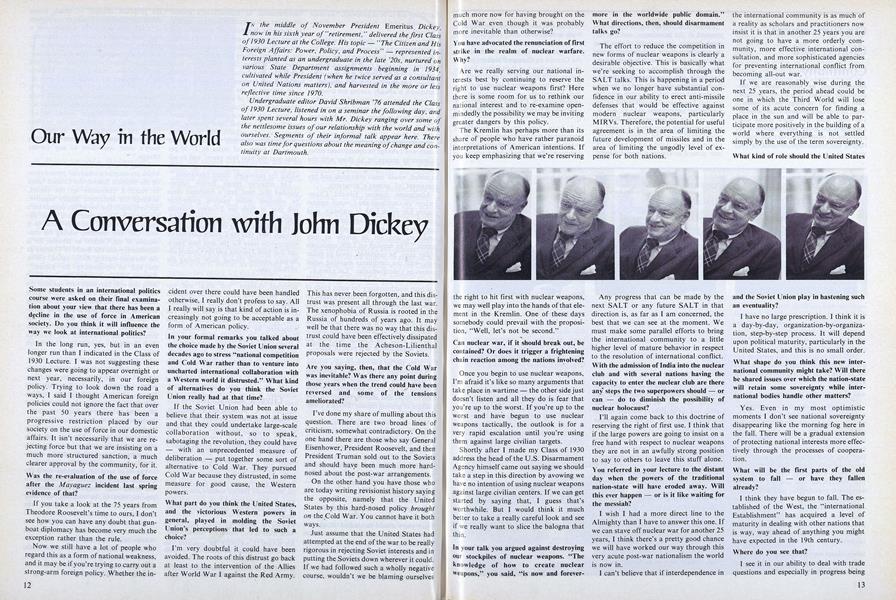
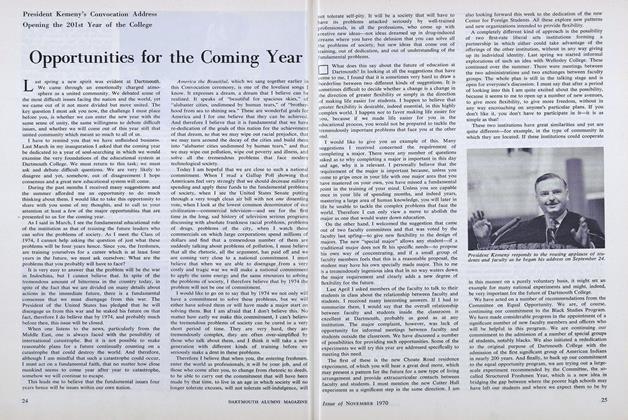
In the middle of November President Emeritus. Dickey,now in his sixth year of "retirement," delivered the first Classof 1930 Lecture at the College. His topic —"The Citizen and HisForeign Affairs: Power, Policy, and Process" - represented interests planted as an undergraduate in the late '20s, nurtured onvarious State Department assignments beginning in 1934,cultivated while President (when he twice served as a consultanton United Nations matters), and harvested in the more or lessreflective time since 1970.Undergraduate editor David Shribman '76 attended the Classof 1930 Lecture, listened in on a seminar the following day, andlater spent several hours with Mr. Dickey ranging over some ofthe nettlesome issues of our relationship with the world and withourselves. Segments of their informal talk appear here. Therealso was time for questions about the meaning of change and continuity at Dartmouth.
Some students in an international politicscourse were asked on their final examinationabout your view that there has been adecline in the use of force in Americansociety. Do you think it will influence theway we look at international politics?
In the long run, yes, but in an even longer run than I indicated in the Class of 1930 Lecture. I was not suggesting these changes were going to appear overnight or next year, necessarily, in our foreign policy. Trying to look down the road a ways, I said I thought American foreign policies could not ignore the fact that over the past 50 years there has been a progressive restriction placed by our society on the use of force in our domestic affairs. It isn't necessarily that we are rejecting force but that we are insisting on a much more structured sanction, a much clearer approval by the community, for it.
Was the re-evaluation of the use of forceafter the Mayaguez incident last springevidence of that?
If you take a look at the 75 years from Theodore Roosevelt's time to ours, I don't see how you can have any doubt that gunboat diplomacy has become very much the exception rather than the rule.
Now we still have a lot of people who regard this as a form of national weakness, and it may be if you're trying to carry out a strong-arm foreign policy. Whether the incident over there could have been handled otherwise, I really don't profess to say. All I really will say is that kind of action is increasingly not going to be acceptable as a form of American policy.
In your formal remarks you talked aboutthe choice made by the Soviet Union severaldecades ago to stress "national competitionand Cold War rather than to venture intouncharted international collaboration witha Western world it distrusted." What kindof alternatives do you think the SovietUnion really had at that time?
If the Soviet Union had been able to believe that their system was not at issue and that they could undertake large-scale collaboration without, so to speak, sabotaging the revolution, they could have - with an unprecedented measure of deliberation - put together some sort of alternative to Cold War. They pursued Cold War because they distrusted, in some measure for good cause, the Western powers.
What part do you think the United States,and the victorious Western powers ingeneral, played in molding the SovietUnion's perceptions that led to such achoice?
I'm very doubtful it could have been avoided. The roots of this distrust go back at least to the intervention of the Allies after World War I against the Red Army.
This has never been forgotten, and this distrust was present all through the last war. The xenophobia of Russia is rooted in the Russia of hundreds of years ago. It may well be that there was no way that this distrust could have been effectively dissipated at the time the Acheson-Lilienthal proposals were rejected by the Soviets.
Are you saying, then, that the Cold Warwas inevitable? Was there any point duringthose years when the trend could have beenreversed and some of the tensionsameliorated?
I've done my share of mulling about this question. There are two broad lines of criticism, somewhat contradictory. On the one hand there are those who say General Eisenhower, President Roosevelt, and then President Truman sold out to the Soviets and should have been much more hard-nosed about the post-war arrangements.
On the other hand you have those who are today writing revisionist history saying the opposite, namely that the United States by this hard-nosed policy broughton the Cold War. You cannot have it both ways.
Just assume that the United States had attempted at the end of the war to be really rigorous in rejecting Soviet interests and in putting the Soviets down wherever it could. If we had followed such a wholly negative course, wouldn't we be blaming ourselves much more now for having brought on the Cold War even though it was probably more inevitable than otherwise?
You have advocated the renunciation of firststrike in the realm of nuclear warfare. Why?
Are we really serving our national interests best by continuing to reserve the right to use nuclear weapons first? Here there is some room for us to rethink our national interest and to re-examine open-mindedly the possibility we may be inviting greater dangers by this policy.
The Kremlin has perhaps more than its share of people who have rather paranoid interpretations of American intentions. If you keep emphasizing that we're reserving
the right to hit first with nuclear weapons, we may well play into the hands of that element in the Kremlin. One of these days somebody could prevail with the proposition, "Well, let's not be second."
Can nuclear war, if it should break out, becontained? Or does it trigger a frighteningchain reaction among the nations involved?
Once you begin to use nuclear weapons, I'm afraid it's like so many arguments that take place in wartime - the other side just doesn't listen and all they do is fear that you're up to the worst. If you're up to the worst and have begun to use nuclear weapons tactically, the outlook is for a very rapid escalation until you're using them against large civilian targets.
Shortly after I made my Class of 1930 address the head of the U.S. Disarmament Agency himself came out saying we should take a step in this direction by avowing we have no intention of using nuclear weapons against large civilian centers. If we can get started by saying that, I guess that's worthwhile. But I would think it much better to take a really careful look and see if we really want to slice the balogna that thin.
In your talk you argued against destroyingour stockpiles of nuclear weapons. "Theknowledge of how to create nuclearweapons," you said, "is now and forevermorein the worldwide public domain."What directions, then, should disarmamenttalks go?
The effort to reduce the competition in new forms of nuclear weapons is clearly a desirable objective. This is basically what we're seeking to accomplish through the SALT talks. This is happening in a period when we no longer have substantial confidence in our ability to erect anti-missile defenses that would be effective against modern nuclear weapons, particularly MIRVs. Therefore, the potential for useful agreement is in the area of limiting the future development of missiles and in the area of limiting the ungodly level of expense for both nations.
Any progress that can be made by the next SALT or any future SALT in that direction is, as far as I am concerned, the best that we can see at the moment. We must make some parallel efforts to bring the international community to a little higher level of mature behavior in respect to the resolution of international conflict.
With the admission of India into the nuclearclub and with several nations having thecapacity to enter the nuclear club are thereany steps the two superpowers should - orcan - do to diminish the possibility ofnuclear holocaust?
I'll again come back to this doctrine of reserving the right of first use. I think that if the large powers are going to insist on a free hand with respect to nuclear weapons they are not in an awfully strong position to say to others to leave this stuff alone.
You referred in your lecture to the distantday when the powers of the traditionalnation-state will have eroded away. Willthis ever happen - or is it like waiting forthe messiah?
I wish I had a more direct line to the Almighty than I have to answer this one. If we can stave off nuclear war for another 25 years, I think there's a pretty good chance we will have worked our way through this very acute post-war nationalism the world is now in.
I can't believe that if interdependence in the international community is as much of a reality as scholars and practitioners now insist it is that in another 25 years you are not going to have a more orderly community, more effective international consultation, and more sophisticated agencies for preventing international conflict from becoming all-out war.
If we are reasonably wise during the next 25 years, the period ahead could be one in which the Third World will lose some of its acute concern for finding a place in the sun and will be able to participate more positively in the building of a world where everything is not settled simply by the use of the term sovereignty.
What kind of role should the United States
and the Soviet Union play in hastening such an eventuality?
I have no large prescription. I think it is a day-by-day, organization-by-organization, step-by-step process. It will depend upon political maturity, particularly in the United States, and this is no small order.
What shape do you think this new international community might take? Will therebe shared issues over which the nation-statewill retain some sovereignty while international bodies handle other matters?
Yes. Even in my most optimistic moments I don't see national sovereignty disappearing like the morning fog here in the fall. There will be a gradual extension of protecting national interests more effectively through the processes of cooperation.
What will be the first parts of the oldsystem to fall - or have they fallenalready?
I think they have begun to fall. The established of the West, the "international Establishment" has acquired a level of maturity in dealing with other nations that is way, way ahead of anything you might have expected in the 19th century.
Where do you see that?
I see it in our ability to deal with trade questions and especially in progress being
On Retirement Change and Continuity
Jefferson said he spent much of his presidency looking forward to the time when he would no longer be President. After 25 years as President of Dartmouth, you must have had some plans and aspirations put aside, some gardens to be cultivated in retirement. Have the expectations and realizations matched up for you?
made in very difficult circumstances in dealing with the international financial community. I think you see it in a considerable degree in the concern of the West not to throw its weight around militarily compared with even 75 years ago.
Let's not assume that this progress has got to be made just internationally. It's going to have to be led. Big moves don't just happen.
And where will that leadership come from?
The United States has a tremendous stake in having its leadership effective. The place to begin in making that leadership effective is to take a really critical look at the functioning of our democratic processes. We must candidly recognize that the Cold War took us down a dangerous path in an effort to match the other fellow's behavior. Only when we get that straightened out and get our own democratic processes - particularly with respect to the authorization and approval of international agreements and policies - worked out a little better will we be in the position to exert the kind of leadership I think this country has a tremendous stake in developing.
International interdependence is one of the main themes of contemporary international politics. Why was it ignored for so long? I never had the feeling of being imprisoned in the presidency, and I never cared, frankly, for the point of view that the presidency of one of these institutions is some sort of punishment to be endured. My 25 years were a thoroughly, thoroughly fine experience, and the difficult problems were just part of the job.
I decided even before I came onto the job that I was seriously interested in the substantive educational side of education, not just its management. When I was in the State Department I taught – moonlighted — at the School of International Studies. I did a bit of writing. In later years I picked up a special interest
Twenty-five years from now we may think that we over-emphasized interdependence. But I would take my chances on that over-emphasis. The under-emphas is was a form of ignorance as to the nature of the modern world and an attempt to square the circle by dealing with the modern world in terms which were suited, really, to the reality of the 19th century.
Do you think the erosion of the differencebetween domestic and foreign policy hasrendered the way we think about ourpolitics and the machinery we have to dealwith them out of date? Do we need a majoroverhaul?
There is a need to work out a more positive relationship between presidential leadership and congressional authorization. It's just absolutely essential to have the American people informed in matters of foreign policy. And that is easier said than done.
It is a tremendous task, ranging from grade school education to scholarship to the large opinion-making institutions of our country. We've got to close the prerogative gap set up by our separation of powers between the executive and the legislature.
What changes have to be made?
If we're talking about a world increasingly in U.S.-Canada relations and edited a book in that field.
Then a very nice thing happened. When my plans to retire were announced, the Council on Foreign Relations invited me to come down as their Senior Visiting Fellow for a year. Out of that came my book — after three or four years of normal frustrations — and teaching the seminar on U.S.-Canada relations once a year here at Dartmouth just for the fun of it.
I have kept up my foundation trusteeships and have taken on one other major responsibility, a responsibility that I purposefully declined while I was on the
committed to policies made through agreements, and if we're talking about an American democratic process that requires the people in the nation to know what they're committed to, then we've got to have an international agreement procedure that doesn't involve a large political issue every time it's invoked.
During the past 25 years at least, the executive has tried to carry out cooperative foreign policy largely through the executive agreement route. That is not a satisfactory process for the long-range exercise of this nation's power. Unless you have the American public understanding what these commitments involve, there's going to be very little stability behind these commitments.
A two-third's vote in the Senate for the approval of treaties may work for a very limited number of major treaties where there is a large national opinion, but in respect to the needs for the daily formulation of international agreements it is totally unworkable.
What specifically do you have in mind?
In some fields there's the possibility of prior congressional authorization by majority vote. In other fields where prior authorization is not feasible, Congress might have the right to call for review job, namely a connection with a private commercial enterprise. I became a disinterested trustee of a group of mutual funds in Boston. This has been very interesting, indeed demanding.
So you haven't exactly "retired."
I've had plenty to do.
We often hear about the mission of theliberal arts college. Is that mission anydifferent today from what it was in 1925or 1945?
No. The great validity of the liberal arts education is that in the most fundamental sense it is not bounded by time Liberation from what?
and circumstance. It is concerned with the human experience in its most profound manifestations — the nature of human beings, the mixture of joy and misery that almost every human life knows. An exposure to the depth and breadth of human experience is the essence of a liberating education.
From the provincialisms of time, place, and circumstance.
And the changes in the educational program?
One obvious change in content is the ability to deal with quantification through the computer. This has opened up new frontiers. But in my eyes it doesn't change the deep, fundamental purpose of giving an individual perspective through the experience of others — through the beauty that's been created by others — and perspective against which to have a larger and more meaningful experience throughout life.
The subject matter changes. The purposes do not.
We hear a lot of talk about great changesat Dartmouth in recent years. Have thesebeen profound changes that strike at theheart of the College, or have they been the
normal kinds of changes experienced bynormal kinds of institutions in abnormaltimes?
One never knows how profound a change is until sometime after it has taken place. I am increasingly inclined to the view that the continuities of college life are far more important than the changes. This is what you might call upstream wisdom.
I don't want to minimize the changes that took place in the 25 years while I was on the job and the changes that have taken place since I left. Over the years I have experienced or watched three or possibly four periods in which the
of an agreement under the so-called congressional veto process. We've got to be creative. But we've only just begun.
Then the closing of the prerogative gapbetween the President and the Congress isas much of a structural as an educationalimprovement?
They go together. The exposure of an international commitment through congressional debate, either on the authorization beforehand or on the agreement afterwards, is the most effective way of informing the American people about the matter.
Does this call for a new role for the press?
You can sit down in the Congress and debate and deliberate until you go to sleep, but unless the press shares these discussions with the American public, nothing's going to happen. The press is also essential for its criticism.
Then must the press begin to cover more thesubstance of issues than the politics of themin the Congress?
Yes. There's plenty of room for a higher level of sophistication in the press - and in all institutions of American life.
You remarked in the formal talk that youfelt the United States, in trying to defeatthe Soviet system, grew to become like theSoviet system. This comment seems to get students were charged with apathy. Then I lived through the period of the late '60s when the American college student was thought to be transforming everything — himself, the world, the country — and we were supposed to be entering a totally new era as far as college education was concerned. Today one wonders what happened to all of these transformations.
Very possibly the attitudes you are seeing on the campus today are simply continuities. Maybe these continuities are more important than the changes of the late '60s.
What are the continuities you speak of?
They're the continuities of biology, of
to the heart of the national debate on intelligence. What should have been the size and scope of our intelligence community after World War II?
We could have gone at it much more modestly. I just cannot believe we couldn't have done a better job with a smaller, more focused effort. But beyond that, the essential mistake was attempting to carry out these covert operations of intervening in the affairs of other nations through everything from bribery to assassinations. This had to be carried out under a cloak of secrecy which was just incompatible with the American democratic process. The naive notion that some day this was not going to have to be washed in public is unbelievable.
What should the intelligence communityhave been involved in during the Cold War?
I'm not one who believes public policy is necessarily best served by not knowing what is going on in the world. I think that is a form of foolishness. Gathering information can be done without involving yourself in bribery on a large-scale or in corrupting the political processes of other nations.
To whom, and to what extent, should ourintelligence system have been responsible?
It should have been responsible to the age, the continuities of experience or the lack of it that are present in American society between the ages of 18 and 22.
It's very hard to move away from biology. Biology from 18 to 22 is a very stable thing. Your lack of experience, your lack of caution, your confidence that the world is your oyster — these are wonderful things that come with physical exuberance, with not having been knocked down yet too many times.
College is the great breaking-away experience, and it's terribly important in nature. It's the time when the cubs are big enough to forage on their own - or at least think they are. This happens
White House and the Congress. The Congress is definitely responsible for having kept the CIA and the FBI in a very highly privileged position of secrecy.
I want to emphasize we're talking about peacetime. Where we got into trouble was that the Cold War was a different kind of peace from what we'd ever experienced before. This is where you get into really difficult judgments and nuances, but they don't require you to fool around with large-scale corruption.
Has the concept of an intelligence community been so discredited that the UnitedStates will be unable to develop a responsibleintelligence community?
No. This is nonsense. If it really focuses in on doing a first-rate job it can be highly effective within a couple of years.
This thing has just simply gotten out of hand. It was not subjected to honest accountability and it got in deeper and deeper and deeper and now some people are crying, "You're ruining the nation by exposing these things."
Exactly the opposite. The most important thing from the point of view of a strong, self-respecting nation will turn out to have been the investigations of Watergate, the CIA and the FBI.
Copies of Mr. Dickey's Class 0f 1930 Lecturemay be obtained by writing to him at244 Baker, Hanover.
between 18 and 22, and a good college is seeking to aid and abet it.
Then you come to the challenge to authority that started in the mid-'60s. The challenge didn't originate in the campuses. There was a stirring, a re-examination of the role of authority in the human community. A good bit of the challenge on the campus was Vietnam - focused, and it was expressing, to be very blunt about it, the concern with personal welfare — the draft and the possibility of fighting in the jungles of Vietnam.
There was great turmoil in the nation'scolleges and at Dartmouth during theyears of World War 11, when it seemed
the ideals of the liberal arts college wereunder siege. Do you see strong threats tothe liberal arts ideal today?
There always have been strong threats to any education that aims to bring human beings to an independent, individual view of the world. The world has never been very tolerant about too much individual independence. Internationally, we are witnessing a resurgence of nationalism, and nationalism is a very intolerant emotion.
Can the liberal arts education survive inthe United States? Is a Dartmouth education worth $25,000?
I've seen quite a few people who have wasted $25,000. Merely being in Hanover, New Hampshire, for four years doesn't guarantee anyone an education.
There is a measure of concern throughout the country about getting an education that will prepare one for a good job. These things must not be incompatible with a liberal arts education.
A liberal arts education ought to be the preparation for life. One had better prepare to make a living as well as to live wisely. I'm not one who believes that starvation is the best way to living wisely. The first requirement for being genuinely well educated is to have the capacity for being useful.
" We've got to close the prerogative gap between theexecutive and the legislature
"I never cared, frankly, forthe point of view that thepresidency of one of theseinstitutions is some sortof punishment to be endured."
"Where we got into troublewas that the Cold War wasa different kind of peace."
"Quite a few people havewasted $25,000. Merely beingin Hanover, New Hampshire,for four years doesn'tguarantee anyone an education."