If
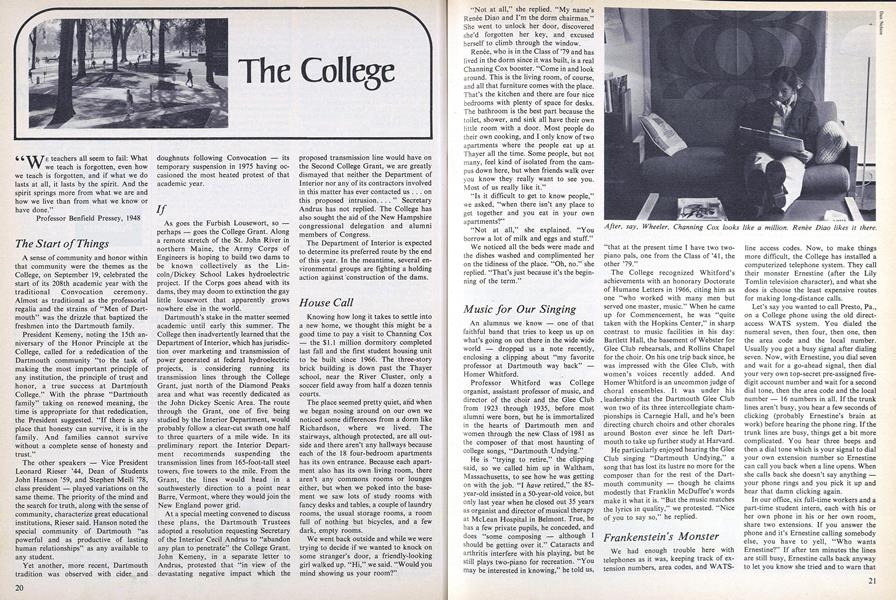
As goes the Furbish Lousewort, so - perhaps - goes the College Grant. Along a remote stretch of the St. John River in northern Maine, the Army Corps of Engineers is hoping to build two dams to be known collectively as the Lincoln/Dickey School Lakes hydroelectric project. If the Corps goes ahead with its dams, they may doom to extinction the gay little lousewort that apparently grows nowhere else in the world.
Dartmouth's stake in the matter seemed academic until early this summer. The College then inadvertently learned that the Department of Interior, which has jurisdiction over marketing and transmission of power generated at federal hydroelectric projects, is considering running its transmission lines through the College Grant, just north of the Diamond Peaks area and what was recently dedicated as the John Dickey Scenic Area. The route through the Grant, one of five being studied by the Interior Department, would probably follow a clear-cut swath one half to three quarters of a mile wide. In its preliminary report the Interior Department recommends suspending the transmission lines from 165-foot-tall steel towers, five towers to the mile. From the Grant, the lines would head in a southwesterly direction to a point near Barre, Vermont, where they would join the New England power grid.
At a special meeting convened to discuss these plans, the Dartmouth Trustees adopted a resolution requesting Secretary of the Interior Cecil Andrus to "abandon any plan to penetrate" the College Grant. John Kemeny, in a separate letter to Andrus, protested that "in view of the devastating negative impact which the proposed transmission line would have on the Second College Grant, we are greatly dismayed that neither the Department of Interior nor any of its contractors involved in this matter has ever contacted us... on this proposed intrusion...." Secretary Andrus has not replied. The College has also sought the aid of the New Hampshire congressional delegation and alumni members of Congress.
The Department of Interior is expected to determine its preferred route by the end of this year. In the meantime, several environmental groups are fighting a holding action against construction of the dams.
More From This Issue
-
 Feature
Men and Women: What's the Difference?
October | November 1977 -
 Feature
The Singing of the Cider
October | November 1977 -
 Feature
The Bakke Case
October | November 1977 -
 Feature
With Pen In Hand...
October | November 1977 -
 Class Notes
1971
October | November 1977 -
 Article
"My hardships were excessive"
October | November 1977