WINTER
Hating it, escaping it, coping with it
What matter how the night behaved? What matter how the north wind raved? Blow high, blow low, not all its snow Could quench our hearth-fire's ruddy glow. John Greenleaf Whittier, Snow-Bound: A Winter Idyl
FOR two days and nights a fierce December storm dumped snow on Whittier's family home in Massachusetts. Inside, on the second night, the family drew together, each member sharing his or her thoughts and life experiences. The entire evening passed without so much as a whisper of longing for the gentle sandy curves and soothing waters of Eleuthera or Barbados. Whittier's brother, a schoolmaster, mentioned something about doings "In classic Dartmouth's college halls," and finally the children went to sleep with snow drifting through the cracks in their unplastered walls.
When the storm passed, everyone went out and enjoyed the strange and beautifully shaped winter world. The town road crew came by with rollers packing down the snow, elders were reminded of their duties, and the separate, snow-bound homes once again became part of a community.
No stranded airport crowds, jammed interstates, frozen pipes, or downed power lines involved, just a roaring fire and all that love and fellowship.
In Ursula K. LeGuin's science fiction novel The Left Hand of Darkness, the inhabitants of a world called Winter are in the midst of an ice age. It is winter most of the time. They enter their homes through doors built ten feet off the ground to allow for snow accumulation. Their homes are heated by fireplaces as they were in Whittier's time.
But the Gethenians, as LeGuin calls them, are 3,000 years into their industrial age. They have the technology to cover their cities with domes and install heating coils in the streets if they wish. Yet they pack the snow down on the roads with rollers the same way New Englanders once did.
An envoy from another world, who has traveled 17 light years to offer the Gethenians membership in a sort of United Worlds of the Universe, shivers constantly as his hosts stand outside in shirt tails and bare feet. These people decided long ago to use central heating in their factories, but they have consciously resisted most other opportunities to put technology between them and nature, for fear of losing their adaptability.
No policy of bare roads the minute the snow stops falling, no grinding of teeth over weather reports, no coughs and running noses, and presumably, no heart attacks from shoveling snow.
In many ways it seems that we late-20th-century earthlings have allowed ourselves to be duped by technology. We have been fooled into thinking winter isn't out there, fooled by our central heating, indoor plumbing, road salt, sun lamps, jet planes to Antigua. Yet, every now and then nature asserts herself, and the whole apparatus comes unglued. Then it's snow-bound for us, free of our responsibilities, how nifty ... if we can just let go and enjoy it, treat winter as a thing in itself. Perhaps the problem goes beyond a mere dependence on technology, however, to a point where we have a hard time just living in the present.
THOSE first few flakes are pure joy to Phil Peck '77. A co-captain last year of Dartmouth's cross-country ski team, Peck is one of those apparitions you see on roller skis in August, skating up the street and covered with sweat. He runs, he rides his bike 50 miles a day, lifts weights, climbs mountains and can't wait for the chance to put all that training to use. If snow hasn't covered the ground in Hanover by December 15, the cross-country team goes looking for it, sometimes up to Quebec. Winter weekends bring races with other schools, and the season culminates the second week in March with six or seven races in 12 days, which decide Eastern and national championships. The skiers then return to campus to complete missed final exams. "It's exhilarating outside in the winter, when the sun is out and the air sparkles. I can't imagine living anywhere without snow," says Peck. His parents moved recently from Washington to Florida, a place of warm weather and flat terrain that he can't stand.
There's no doubt that winter puts strains on most people. We can't take our automobiles for granted" in cold weather. Our bodies need more care. Most of us spend more time indoors, and by the time February and March come around, tempers are short and there is talk of cabin fever.
"The winter term at Dartmouth is intense," says Jerry Mitchell '51. "Students and teachers work long hours and people are dead beat by March 15." Mitchell talks about winter with a slight smile and a glint in his eye, perhaps because he holds the key to those hidden beaches and all that warmth and relaxation in faraway places. He runs the Dartmouth Travel Bureau. His manner is Mephistophelian - come on, let me put you on a plane. "Our business peaks in March and April with people wanting to go south for a break," says Mitchell. "They show up in our office on March 15 and say 'get me out of here tomorrow.' Some people, most of them retired, just wait around until Christmas and family gatherings are over, and then take the first plane or ship they can find headed south, their means dictating how they travel."
The working family is also taking a winter break these days. According to Mitchell, on the weekend of February 17, when practically every school in New England is out, every bus, train and plane from Boston to Miami is booked solid. There's a catch, however, Mitchell says: while the sun-seekers are gone, the snowplows are at work in the airport parking lot and upon return "your car is packed solid in a snowbank and covered with two weeks of crud."
In spite of the long list of weather-related events that are capable of driving most of us up a wall, according to Raymond Sobel, retired professor of psychiatry at Dartmouth, there is no hard data on the direct effects of winter on the mind. Nevertheless, the effects indisputably exist, and Sobel himself admits to being the sort of man who is out there shoveling while the snow is still falling. He says he finds it hard to accept the loss of control that comes with winter.
A Hanover psychologist, Paul Breer, says that his business peaks in January and February with people "wanting to change." Those bleak, gray winter days seem to be a force for "confronting people with how stuck they are in their lives," says Breer.
Young mothers, stuck inside all day dur- ing the winter with no one to talk to but their infant children are, according to Charlotte Sanborn, director of community services for Dartmouth-Hitchcock Mental Health Center, very susceptible to cabin fever or mid-winter depression. The most drastic disorder, suicide, doesn't neces- sarily come with cold and snow. Sanborn points out that New England suicides most often occur in spring, in the month of May. There is conjecture that the suicide-prone are overwhelmed by the contrast of beauty blooming outside and the picture of ugliness they may have of themselves within.
Merton (Jim) Nott has come through 71 Vermont winters, and he seems to have flourished with the experience. He retired from dairy farming in September 1969 and now lives with his wife on what's left of a Vermont farm that has been in the family since 1820. Starting with one acre in 1820, Nott's land, located in a beautiful corner called Jericho in the town of Norwich, grew to 300 acres supporting 40 milk cows and shrank to the present level of 12 acres.
In winters past, Nott and his father and brother spent time cutting and selling fire wood. In March they would gather and boil down maple sap, although Nott recalls his father saying he "wouldn't sugar if there was anything else for a man to do at that time of year."
It's fair to say that ingrained in prac- tically every Yankee, even the rural nouveau among us, is the urge to outfox the weather. In Jim Nott it's just second nature. His wife Erminie naturally buys food a week at a time in uncertain weather, and although he had central heating in- stalled in the farm house when he retired, one can see that Nott isn't readily fooled by technology. "The by-word in farming when you're all tooled up with the latest labor-saving devices," he says, "is throw a switch and grab a wrench." This notion causes him to break up with laughter.
Noel Perrin, Dartmouth professor of English, says that Robert Frost seemed to view life in terms of a series of expansions and contractions. In his poem In Winter inthe Woods Alone Frost uses winter and a person's retreat as a way of saying that this is a natural time for each of us to draw in and gather our strength. So be it.
In winter in the woods aloneAgainst the trees I go.
I mark a maple for my ownAnd lay the maple low.
At four o'clock I shoulder axe,And in the afterglowI link a line of shadowy tracksAcross the tinted snow.
I see for Nature no defeatIn one tree's overthrowOr for myself in my retreatFor yet another blow.
Woody Rothe wrote "The Well-TemperedSynclavier" in the December issue. "InWinter in the Woods Alone" is reprintedfrom Selected Poems of Robert Frost. Holt, Rinehart and Winston. Copyright1962.
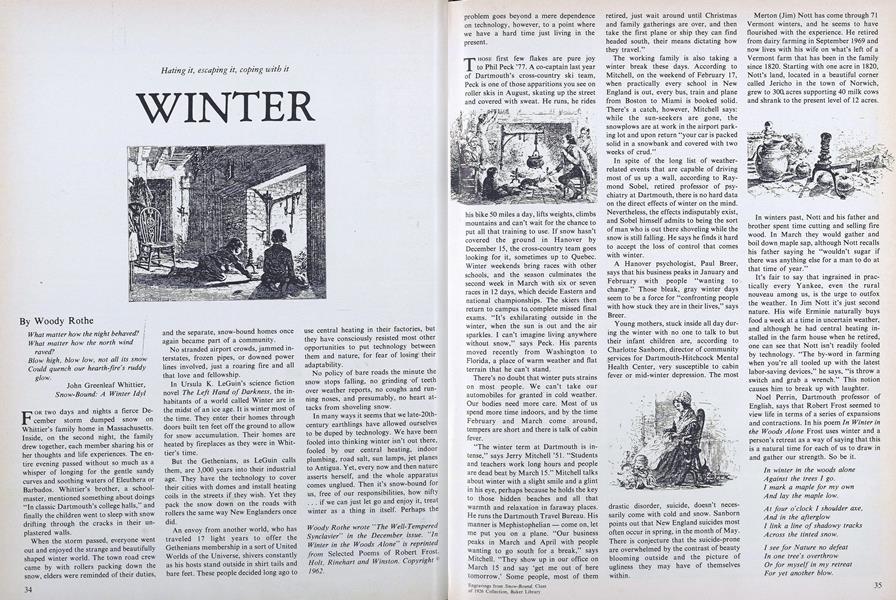
Engravings from Snow-Bound; Class of 1926 Collection, Baker Library
More From This Issue
-
 Feature
Scions of Rhodes
January | February 1978 -
 Feature
Of Sun-Gazers and Seal-Hunters
January | February 1978 -
 Feature
Here's Looking At It
January | February 1978 -
 Article
Guardian of the Oasis
January | February 1978 -
 Class Notes
1923
January | February 1978 -
 Article
A Solution to Our Woes
January | February 1978