1963
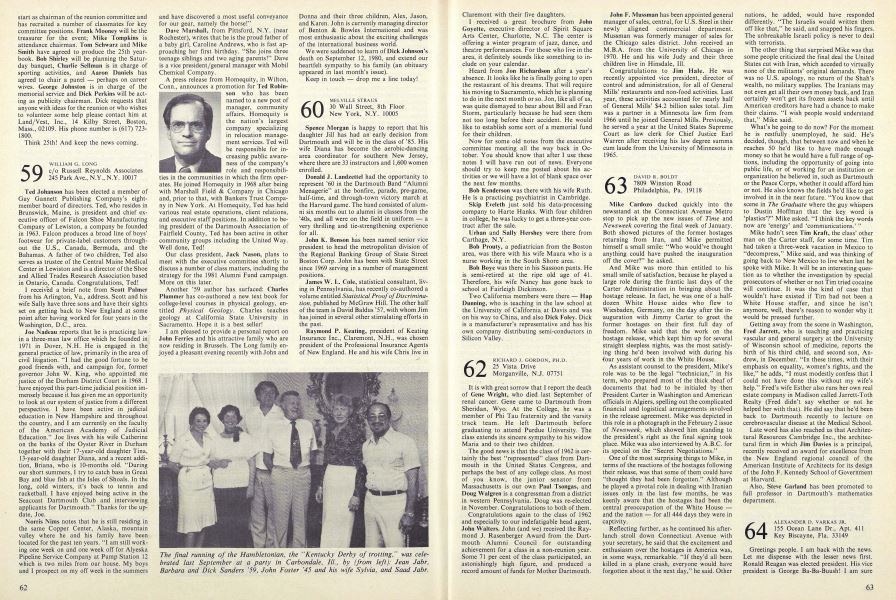
Mike Cardozo ducked quickly into the newsstand at the Connecticut Avenue Metro stop to pick up the new issues of Time and Newsweek covering the final week of January. Both showed pictures of the former hostages returning from Iran, and Mike permitted himself a small smile: "Who would've thought anything could have pushed the inauguration off the cover?" he asked.
And Mike was more than entitled to his small smile of satisfaction, because he played a large role during the frantic last days of the Carter Administration in bringing about the hostage release. In fact, he was one of a halfdozen White House aides who flew to Wiesbaden, Germany, on the day after the inauguration with Jimmy Carter to greet the former hostages on their first full day of freedom. Mike said that the work on the hostage release, which kept him up for several straight sleepless nights, was the most satisfying thing he'd been involved with during his four years of work in the White House.
As assistant counsel to the president, Mike's role was to be the legal "technician," in his term, who prepared most of the thick sheaf of documents that had to be initialed by then President Carter in Washington and American officials in Algiers, spelling out the complicated financial and logistical arrangements involved in the release agreement. Mike was depicted in this role in a photograph in the February 2 issue of Newsweek, which showed him standing to the president's right as the final signing took place. Mike was also interviewed by A.B.C. for its special on the "Secret Negotiations."
One of the most surprising things to Mike, in terms of the reactions of the hostages following their release, was that some of them could have "thought they had been forgotten." Although he played a pivotal role in dealing with Iranian issues only in the last few months, he was keenly aware that the hostages had been the central preoccupation of the White House and the nation for all 444 days they were in captivity.
Reflecting further, as he continued his afterlunch stroll down Connecticut Avenue with your secretary, he said that the excitement and enthusiasm over the hostages in America was, in some ways, remarkable. "If they'd all been killed in a plane crash, everyone would have forgotten about it the next day," he said. Other nations, he added, would have responded differently. "The Israelis would written them off like that," he said, and snapped his fingers. The unbreakable Israeli policy is never to deal with terrorists.
The other thing that surprised Mike was that some people criticized the final deal the United States cut with Iran, which acceded to virtually none of the militants' original demands. There was no U.S. apology, no return of the Shah's wealth, no military supplies. The Iranians may not even get all their own money back, and Iran certainly won't get its frozen assets back until American creditors have had a chance to make their claims. "I wish people would understand that," Mike said.
What's he going to do now? For the moment he is restfully unemployed, he said. He's decided, though, that between now and when he reaches 50 he'd like to have made enough money so that he would have a full range of options, including the opportunity of going into public life, or of working for an institution or organization he believed in, such as Dartmouth or the Peace Corps, whether it could afford him or not. He also knows the fields he'd like to get involved in in the near future. "You know that scene in The Graduate where the guy whispers to Dustin Hoffman that the key word is 'plastics'?" Mike asked. "I think the key words now are 'energy' and 'communications.' "
Mike hadn't seen Tim Kraft, the class' other man on the Carter staff, for some time. Tim had taken a three-week vacation in Mexico to "decompress," Mike said, and was thinking of going back to New Mexico to live when last he spoke with Mike. It will be an interesting question as to whether the investigation by special prosecutors of whether or not Tim tried cocaine will continue. It was the kind of case that wouldn't have existed if Tim had not been a White House staffer, and since he isn't anymore, well, there's reason to wonder why it would be pressed further.
Getting away from the scene in Washington, Fred Jarrett, who is teaching and practicing vascular and general surgery at the University of Wisconsin school of .medicine, reports the birth of his third child, and second son, Andrew, in December. "In these times, with their emphasis on equality, women's rights, and the like," he adds, "I must modestly confess that I could not have done this without my wife's help." Fred's wife Esther also runs her own real estate company in Madison called Jarrett-Toth Realty (Fred didn't say whether or not he helped her with that). He did say that he'd been back to Dartmouth recently to lecture on cerebrovascular disease at the Medical School.
Late word has also reached us that Architectural Resources Cambridge Inc., the architectural firm in which Jim Davies is a principal, recently received an award for excellence from the New England regional council of the American Institute of Architects for its design of the John F. Kennedy School of Government at Harvard.
Also, Steve Garland has been promoted to full professor in Dartmouth's mathematics department.
7809 Winston Road Philadelphia, Pa. 19118