1961
What an incredible experience, to take a sabbatical at Dartmouth in the fall!
It's been gorgeous. The leaves are turning. The mornings are crisp and foggy, but by 10:00 a.m. or so the fog has burned off, producing beautiful sunshine and warming temperatures so that by afternoon, a plethora of outdoor activites are underway.
On most afternoons, the Green is alive even more, if you can believe it, than when we were here. Of course, there's intramural football, lots of it. But there are other activities as well, including the strenuous new game of ultimate frisbee, a two-sided team game with many of the same objectives as football, except that the ball is a twisting, turning frisbee.
Benches for sitting and watching those games have multiplied, but the grass is just as inviting for many students. Today, the hill in front of Dartmouth Hall was carpeted with students, some watching the games, some just chatting, and some in clusters practicing foreign languages.
There are new features, too, including an immensely popular swing attached to a mod ern piece of art outside Sanborn.
And the joggers. My dining room window faces Wheelock and Park, and dozens of joggers pass my window in the morning before I can even pry my eyes open. The parade continues all day long and peaks between 4:00 and 7:00 p.m., when they're coming by at the rate of one every 12 seconds. Even as midnight approaches, there are ghostly figures running by. More than half the occupants of this growing community must be runners. But that's not why I'm here. I'm at Dartmouth to both learn and teach.
The learning is in biochemistry, taught in Kellogg Auditorium in the Medical School. In typical Dartmouth fashion, the course is for everyone medical students, graduate students in chemistry, and under graduates. The lectures are done once, but then the discussion sections are broken down by field. It's fast-paced, and my tongue is hanging out, but many of the problems that I have covered in medical reporting are becoming clearer as I understand the underlying chemistry.
The teaching is in policy studies, a relatively new program that in the last analysis is really a more scholarly outgrowth of our "Great Issues" program. The program systematically dissects many of the problems of the day, and the students learn how to separate the rhetoric from the facts and to arrive at reasonable solutions, using case studies ranging from local zoning problems to megaissues such as Reaganomics and hunger. It's a place where a reporter/editor can fit right in, since much of the course material is necessarily journalistic, and students need to know the good features and the faults of journalism. My colleagues include an academic, the chairman, who is Douglas Yates; a distinguished lawyer in Jonathan Brownell; an equally famous physician in David Bradley; and a well-known environmentalist and author, Dana Meadows. I've become involved in several of the courses. And policy studies is the heart of the grand, new Rockefeller Center, something you really have to see the next time you're in Hanover. I have a splendid office, 203 Rockefeller.
The students are bright perhaps brighter than we were. After being in the "real world" and making some judgments based on appearances, I've found it really uplifting to see great minds at work while wearing greasestained Harley-Davidson t-shirts, or otherwise appearing as members of the downtrodden. It has been an important reminder to me not to prejudge anything.
The women. Besides adding immeasurably to the beauty of the campus, I think they add intellectually to the classroom. They're not afraid to speak up; they're not afraid to take the lead; but the men also don't appear to be intimidated either. In short, the women fit in wonderfully and are true "Men of Dartmouth." They also appear to be just as athletic as the men, and perhaps half of those runners I described earlier are women.
The campus itself has grown substantially, with most everything in the biological sciences now taught on the medical school campus on the other side of the hospital from the main campus. Tuck has grown, Thayer has grown, and of course there are academic buildings all over the place that weren't there when we were here. And yet there are still some departments that are crying for lack of space.
I didn't mean to spend a whole column on my experiences at Dartmouth, but it's easy to get emotional about the place.
On another subject, this magazine, I can report to you that the editorial board has met and is in the process of drafting bylaws and policies that will assure Doug Greenwood of his editorial independence. The board seems congenial, and willing to work hard at making that assurance a reality.
On yet another subject, you should be receiving in the next few days a class of 1961 directory listing names, addresses, phone numbers, wives, etc. for everyone in the class who is on file with Alumni Records. It should be a big help to you in renewing acquaintances with your classmates, especially as Christmas time approaches. Your class executive committee voted overwhelmingly in favor of issuing the directory, at least this once, and we're very much interested in your reaction. If there is really the demand for it from you, we may wish to make an address list an annual event.
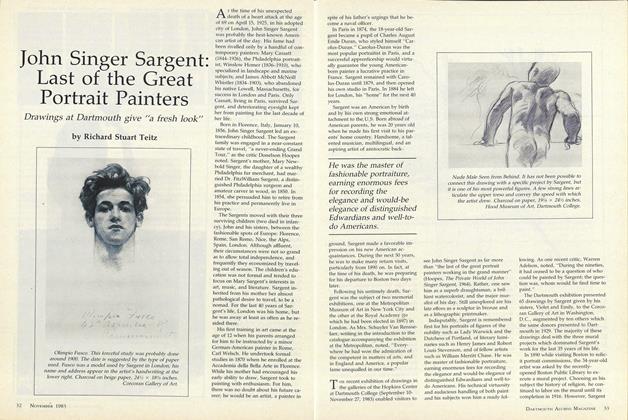
Jeffrey Brown was to have appeared at Dartmouth on Tuesday, November 8, at 4:00p.m., to talk about John Singer Sargent, an artist whose works are now on display at the Hopkins Center. (I said "was to have appeared" because magazine deadlines required me to write this in late September.) Jeffrey loaned several paintings to the College for the exhibit, including one called "The Oyster Gatherers of Cancale."
Roger McArt has joined Russell Reynolds Associates Inc., a leading international executive recruiting firm, as a vice president in Russell Reynolds' Cleveland office. Previously, Roger had held general management positions with Hines Flask Company and Erico Rail Products Company, and had served as, a management consultant with McKinsey and Company Inc. In addition to his bachelor's degree from Dartmouth, Roger also holds a master's degree in industrial engineering from Stanford University. He lives in Shaker Heights, Ohio.
Douglas Hopton has been appointed vice president for corporate strategy and development, a new department at Medtronic Inc. Doug previously had been director of international marketing and director of corporate development. He'll be responsible, among other things, for "orchestrating mergers, acquisitions, and licensing."
Be sure you drop by to see me when you are in Hanover. I should be in town through about the second week in December.
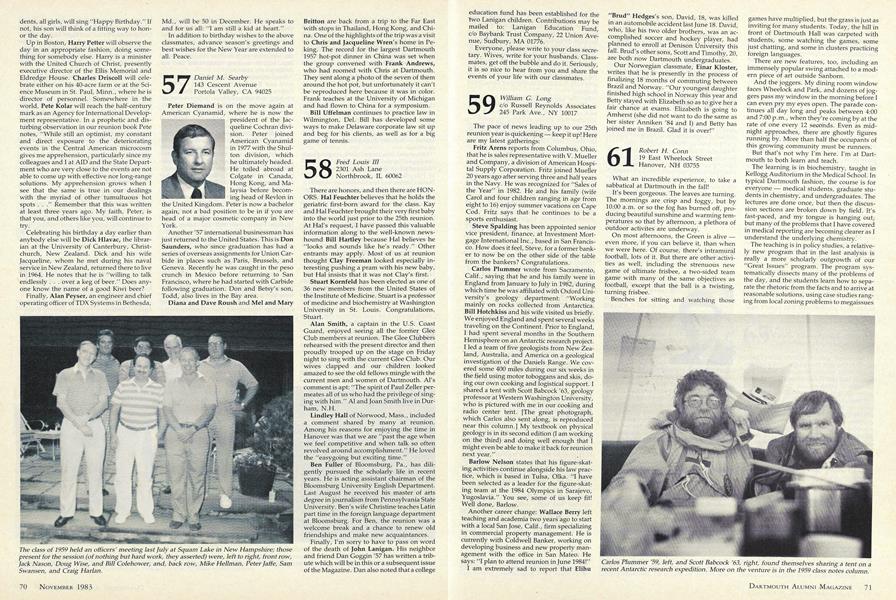
Carlos Plummer '59, left, and Scott Babcock '63, right, found themselves sharing a tent on arecent Antarctic research expedition. More on the venture is in the 1959 class notes column.
19 East Wheelock Street Hanover, NH 03755
More From This Issue
-
 Feature
"The Greatest Problem in American Biology
November 1983 -
 Feature
Giving the Rush to the Record books
November 1983 -
 Feature
John Singer Sargent: Last of the Great Portrait Painters
November 1983 -
 Sports
Sports
November 1983 -
 Books
BooksAll Biology Is Indebted . . .
November 1983 -
 Class Notes
1979
November 1983