Johannes von Trapp '63: A Man of the World in the Hills of Vermont
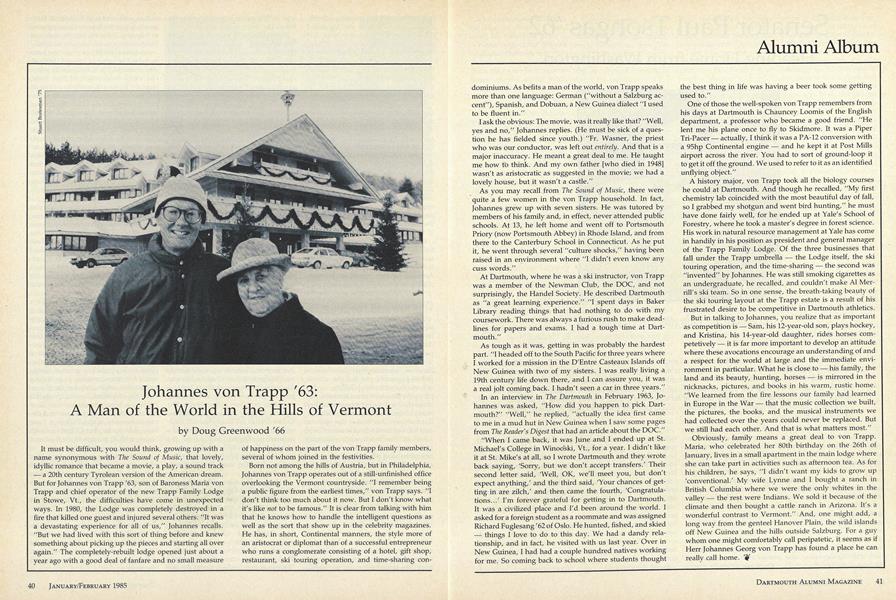
It must be difficult, you would think, growing up with a name synonymous with The Sound of Music, that lovely, idyllic romance that became a movie, a play, a sound track -a 20th century Tyrolean version of the American dream. But for Johannes von Trapp '63, son of Baroness Maria von Trapp and chief operator of the new Trapp Family Lodge in Stowe, Vt., the difficulties have come in unexpected ways. In 1980, the Lodge was completely destroyed in a fire that killed one guest and injured several others. "It was a devastating experience for all of us," Johannes recalls. "But we had lived with this sort of thing before and knew something about picking up the pieces and starting all over again." The completely-rebuilt lodge opened just about a year ago with a good deal of fanfare and no small measure of happiness on the part of the von Trapp family members, several of whom joined in the festivities.
Born not among the hills of Austria, but in Philadelphia, Johannes von Trapp operates out of a still-unfinished office overlooking the Vermont countryside. "I remember being a public figure from the earliest times," von Trapp says. "I don't think too much about it now. But I don't know what it's like not to be famous." It is clear from talking with him that he knows how to handle the intelligent questions as well as the sort that show up in the celebrity magazines. He has, in short, Continental manners, the style more of an aristocrat or diplomat than of a successful entrepreneur who runs a conglomerate consisting of a hotel, gift shop, restaurant, ski touring operation, and time-sharing con- dominiums. As befits a man of the world, von Trapp speaks more than one language: German ("without a Salzburg accent"), Spanish, and Dobuan, a New Guinea dialect "I used to be fluent in."
I ask the obvious: The movie, was it really like that? "Well, yes and no," Johannes replies. (He must be sick of a question he has fielded since youth.) "Fr. Wasner, the priest who was our conductor, was left out entirely. And that is a major inaccuracy. He meant a great deal to me. He taught me how to think. And my own father [who died in 1948] wasn't as aristocratic as suggested in the movie; we had a lovely house, but it wasn't a castle."
As you may recall from The Sound of Music, there were quite a few women in the von Trapp household. In fact, Johannes grew up with seven sisters. He was tutored by members of his family and, in effect, never attended public schools. At 13, he left home and went off to Portsmouth Priory (now Portsmouth Abbey) in Rhode Island, and from there to the Canterbury School in Connecticut. As he put it, he went through several "culture shocks," having been raised in an environment where "I didn't even know any cuss words."
At Dartmouth, where he was a ski instructor, von Trapp was a member of the Newman Club, the DOC, and not surprisingly, the Handel Society. He described Dartmouth as "a great learning experience." "I spent days in Baker Library reading things that had nothing to do with my coursework. There was always a furious rush to make deadlines for papers and exams. I had a tough time at Dartmouth."
As tough as it was, getting in was probably the hardest part. "I headed off to the South Pacific for three years where I worked for a mission in the D'Entre Casteaux Islands off New Guinea with two of my sisters. I was really living a 19th century life down there, and I can assure you, it was a real jolt coming back. I hadn't seen a car in three years."
In an interview in The Dartmouth in February 1963, Johannes was asked, "How did you happen to pick Dartmouth?" "Well," he replied, "actually the idea first came to me in a mud hut in New Guinea when I saw some pages from The Reader's Digest that had an article about the DOC."
"When I came back, it was June and I ended up at St. Michael's College in Winooski, Vt., for a year. I didn't like it at St. Mike's at all, so I wrote Dartmouth and they wrote back saying, 'Sorry, but we don't accept transfers.' Their second letter said, 'Well, OK, we'll meet you, but don t expect anything,' and the third said, 'Your chances of getting in are zilch,' and then came the fourth, 'Congratulations...' I'm forever grateful for getting in to Dartmouth. It was a civilized place and I'd been around the world. I asked for a foreign student as a roommate and was assigned Richard Fuglesang '62 of Oslo. He hunted, fished, and skied things I love to do to this day. We had a dandy relationship, and in fact, he visited with us last year. Over in New Guinea, I had had a couple hundred natives working for me. So coming back to school where students thought the best thing in life was having a beer took some getting used to."
One of those the well-spoken von Trapp remembers from his days at Dartmouth is Chauncey Loomis of the English department, a professor who became a good friend. "He lent me his plane once to fly to Skidmore. It was a Piper Tri-Pacer actually, I think it was a PA-12 conversion with a 95hp Continental engine and he kept it at Post Mills airport across the river. You had to sort of ground-loop it to get it off the ground. We used to refer to it as an identified unflying object."
A history major, von Trapp took all the biology courses he could at Dartmouth. And though he recalled, "My first chemistry lab coincided with the most beautiful day of fall, so I grabbed my shotgun and went bird hunting," he must have done fairly well, for he ended up at Yale's School of Forestry, where he took a master's degree in forest science. His work in natural resource management at Yale has come in handily in his position as president and general manager of the Trapp Family Lodge. Of the three businesses that fall under the Trapp umbrella the Lodge itself, the ski touring operation, and the time-sharing the second was "invented" by Johannes. He was still smoking cigarettes as an undergraduate, he recalled, and couldn't make A1 Merrill's ski team. So in one sense, the breath-taking beauty of the ski touring layout at the Trapp estate is a result of his frustrated desire to be competitive in Dartmouth athletics.
But in talking to Johannes, you realize that as important as competition is Sam, his 12-year-old son, plays hockey, and Krishna, his 14-year-old daughter, rides horses competetively it is far more important to develop an attitude where these avocations encourage an understanding of and a respect for the world at large and the immediate environment in particular. What he is close to his family, the land and its beauty, hunting, horses is mirrored in the nicknacks, pictures, and books in his warm, rustic home. "We learned from the fire lessons our family had learned in Europe in the War that the music collection we built, the pictures, the books, and the musical instruments we had collected over the years could never be replaced. But we still had each other. And that is what matters most."
Obviously, family means a great deal to von Trapp. Maria, who celebrated her 80th birthday on the 26th of January, lives in a small apartment in the main lodge where she can take part in activities such as afternoon tea. As for his children, he says, "I didn't want my kids to grow up 'conventional.' My wife Lynne and I bought a ranch in British Columbia where we were the only whites in the valley the rest were Indians. We sold it because of the climate and then bought a cattle ranch in Arizona. It's a wonderful contrast to Vermont." And, one might add, a long way from the genteel Hanover Plain, the wild islands off New Guinea and the hills outside Salzburg. For a guy whom one might comfortably call peripatetic, it seems as if Herr Johannes Georg von Trapp has found a place he can really call home.
More From This Issue
-
 Cover Story
Senator Paul Tsongas '62 Heading Home from Washington
January | February 1985 -
 Feature
Zen and the Art of Corporate Maintenance
January | February 1985 -
 Feature
Putting the Treasure at Risk
January | February 1985 -
 Feature
The "Greening" of the NFL
January | February 1985 -
 Sports
Sports
January | February 1985 -
 Article
"No Such Thing as Can't"
January | February 1985