Senator Paul Tsongas '62 Heading Home from Washington
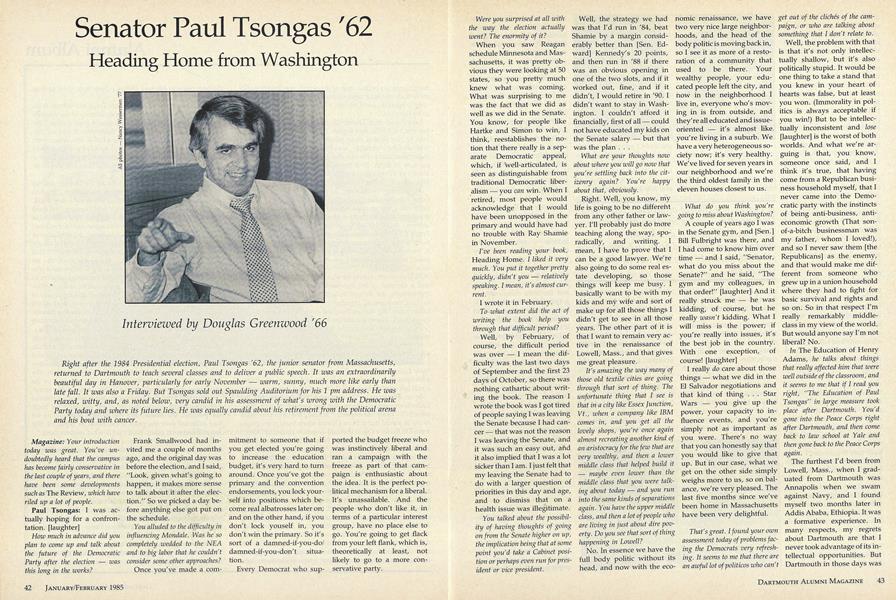
Right after the 1984 Presidential election, Paul Tsongas '62, the junior senator from Massachusetts, returned to Dartmouth to teach several classes and to deliver a public speech. It was an extraordinarily beautiful day in Hanover, particularly for early November warm, sunny, much more like early than late fall. It was also a Friday. But Tsongas sold out Spaulding Auditorium for his 1 pm address. He was relaxed, witty, and, as noted below, very candid in his assessment of what's wrong with the Democratic Party today and where its future lies. He was equally candid about his retirement from the political arena and his bout with cancer.
Magazine: Your introductiontoday was great. You've undoubtedly heard that the campushas become fairly conservative inthe last couple of years, and therehave been some developmentssuch as The Review, which haveriled up a lot of people.
Paul Tsongas: I was actually hoping for a confrontation. [laughter]
How much in advance did youplan to come up and talk aboutthe future of the DemocraticParty after the election wasthis long in the works?
Frank Smallwood had invited me a couple of months ago, and the original day was before the election, and I said, "Look, given what's going to happen, it makes more sense to talk about it after the election." So we picked a day before anything else got put on the schedule.
You alluded to the difficulty ininfluencing Mondale. Was he socompletely wedded to the NEAand to big labor that he couldn'tconsider some other approaches?
Once you've made a com- mitment to someone that if you get elected you're going to increase the education budget, it's very hard to turn around. Once you've got the primary and the convention endorsements, you lock yourself into positions which become real albatrosses later on; and on the other hand, if you don't lock youself in, you don't win the primary. So it's sort of a damned-if-you-do/ damned-if-you-don't situation.
Every Democrat who supported the budget freeze who was instinctively liberal and ran a campaign with the freeze as part of that campaign is enthusiastic about the idea. It is the perfect political mechanism for a liberal. It's unassailable. And the people who don't like it, in terms of a particular interest group, have no place else to go. You're going to get flack from your left flank, which is, theoretically at least, not likely to go to a more conservative party.
Were you surprised at all withthe way the election actuallywent? The enormity of it?
When you saw Reagan schedule Minnesota and Massachusetts, it was pretty obvious they were looking at 50 states, so you pretty much knew what was coming. What was surprising to me was the fact that we did as well as we did in the Senate. You know, for people like Hartke and Simon to win, I think, reestablishes the notion that there really is a separate Democratic appeal, which, if well-articulated, is seen as distinguishable from traditional Democratic liberalism you can win. When I retired, most people would acknowledge that I would have been unopposed in the primary and would have had no trouble with Ray Shamie in November.
I've been reading your book, Heading Home. I liked it verymuch. You put it together prettyquickly, didn't you relativelyspeaking. I mean, it's almost current.
I wrote it in February.
To .what extent did the act ofwriting the book help youthrough that difficult period?
Well, by February, of course, the difficult period was over I mean the difficulty was the last two days of September and the first 23 days of October, so there was nothing cathartic about writing the book. The reason I wrote the book was I got tired of people saying I was leaving the Senate because I had cancer that was riot the reason I was leaving the Senate, and it was such an easy out, and it also implied that I was a lot sicker than I am. I just felt that my leaving the Senate had to do with a larger question of priorities in this day and age, and to dismiss that on a health issue was illegitimate.
You talked about the possibility of having thoughts of goingon from the Senate higher on up,the implication being that at somepoint you'd take a Cabinet position or perhaps even run for president or vice president.
Well, the strategy we had was that I'd run in '84, beat Shamie by a margin considerably better than [Sen. Edward] Kennedy's 20 points, and then run in 'BB if there was an obvious opening in one of the two slots, and if it worked out, fine, and if it didn't, I would retire in '90. I didn't want to stay in Washington. I couldn't afford it financially, first of all could not have educated my kids on the Senate salary but that was the plan . . .
What are your thoughts nowabout where you will go now thatyou're settling back into the citizenry again? You're happyabout that, obviously.
Right. Well, you know, my life is going to be no different from any other father or lawyer. I'll probably just do indre teaching along the way, sporadically, and writing. I mean, I have to prove that I can be a good lawyer. We're also going to do some real estate developing, so those things will keep me busy. I basically want to be with my kids and my wife and sort of make up for all those things I didn't get to see in all those years. The other part of it is that I want to remain very active in the renaissance of Lowell, Mass., and that gives me great pleasure.
It's amazing the way many ofthose old textile cities are goingthrough that sort of thing. Theunfortunate thing that I see isthat in a city like Essex Junction,Vt., when a company like IBMcomes in, and you get all thelovely shops, you're once againalmost recreating another kind ofan aristocracy for the few that arevery wealthy, and then a lowermiddle class that helped build itmaybe even lower than themiddle class that you were talking about today and you runinto the same kinds of separationsagain. You have the upper middleclass, and then a lot of people whoare living in just about dire poverty. Do you see that sort of thinghappening in Lowell?
No. In essence we have the full body politic without its head, and now with the economic renaissance, we have two very nice large neighborhoods, and the head of the body politic is moving back in, so I see it as more of a restoration of a community that used to be there. Your wealthy people, your educated people left the city, and how in the neighborhood I live in, everyone who's moving in is from outside, and they're all educated and issueoriented it's almost like, you're living in a suburb. We have a very heterogeneous society now; it's very healthy. We've lived for seven years in our neighborhood and we're the third oldest family in the eleven houses closest to us.
What do you think you'regoing to miss about Washington?
A couple of years ago I was in the Senate gym, and [Sen.] Bill Fulbright was there, and I had come to know him over time and I said, "Senator, what do you miss about the Senate?" and he said, "The gym and my colleagues, in that order!" [laughter] And it really struck me he was kidding, of course, but he really wasn't kidding. What I will miss is the power; if you're really into issues, it's the best job in the country. With one exception, of course! [laughter]
I really do care about those things what we did in the El Salvador negotiations and that kind of thing . . . Star Wars you give up the power, your capacity to influence events, and you're simply not as important as you were. There's no way that you can honestly say that you would like to give that up. But in our case, what we get on the other side simply weighs more to us, so on balance, we're very pleased. The last five months since we've been home in Massachusetts have been very delightful.
That's great. I found your ownassessment today of problems facing the Democrats very refreshing. It seems to me that there arean awful lot of politicos who can'tget out of the cliches of the campaign, or who are talking aboutsomething that I don't relate to.
Well, the problem with that is that it's not only intellectually shallow, but it's also politically stupid. It would be one thing to take a stand that you knew in your heart of hearts was false, but at least you won. (Immorality in politics is always acceptable if you win!) But to be intellectually inconsistent and lose [laughter] is the worst of both worlds. And what we're arguing is that, you know, someone once said, and I think it's true, that having come from a Republican business household myself, that I never came into the Democratic party with the instincts of being anti-business, antieconomic growth (That sonof-a-bitch businessman was my father, whom I loved!), and so I never saw them [the Republicans] as the enemy, and that would make me different from someone who grew up in a union household where they had to fight for basic survival and rights and so on. So in that respect I'm really remarkably middleclass in my view of the world. But would anyone say I'm not liberal? No.
In The Education of Henry Adams, he talks about thingsthat really affected him that werewell outside of the classroom, andit seems to me that if I read youright, "The Education of PaulTsongas" in large measure tookplace after Dartmouth. You'dgone into the Peace Corps rightafter Dartmouth, and then comeback to law school at Yale andthen gone back to the Peace Corpsagain. .
The furthest I'd been from Lowell, Mass., when I graduated from Dartmouth was Annapolis when we swam against Navy, and I found myself two months later in Addis Ababa, Ethiopia. It was a formative experience. In many respects, my regrets about Dartmouth are that I never took advantage of its intellectual opportunities. But Dartmouth in those days was different if you took someone without any intellectual moorage, someone who had no intellectual momentum of his own, Dartmouth in that era probably wouldn't give it to you. So I came without those instincts, and basically became a remarkably average student who wasted the opportunity, the advantage I had as a skinny kid who came up here. I ended up learning how to swim, though, eventually making the swimming team and earning my letter.
Karl Michael was here then,wasn't he?
He was the coach, yes. And that did wonders for my selfconfidence. If I hadn't been on the swimming team, I never would have thought of going to Africa; I never would have had the confidence to do it. But I really regret that I could have spent four years becoming conversant in another language, and learning more about philosophy, and music, and art.
The Hopkins Center was justbecoming a reality when you left,wasn't it?
I think there were holes in the ground. You know, it was all fraternities and drinking and macho and I wasn't in a fraternity and I didn't drink.
I lived with the former swimming coach before Karl Michael. I think his name was Sid "Papa" Hazleton; he taught me how to swim. And so we became pretty close, and I rented a room from him at the end. You know, it's really funny to leave a college vowing that you'll never send your kids there, and then get to the point where you want your kids to go there. I think Dartmouth is such a healthier place now than it was in my day.
It's funny, you know. I've received several honorary degrees, but the one I got from Dartmouth really moved me. It was funny. I mean, I didn't expect it to. It's going to be in my office, in my law office. It's going to be there by itself.
That's very nice. I felt, whenI heard you speak at the DartmouthClub of Washington Iremember it was up at the GeorgeWashington University Ithought I was in the wrong placewhen I got there because therewere so many people there.Hundreds and hundreds theplace was packed.
Yeah, it was a good crowd.
And I detected that even in theremarks you made there andthis was some years ago thatyou really didn't feel too comfortable about the College. Itseemed to me that you were stillin a begrudging mood.
Well, you know, when I hear stories about Dartmouth students having lobster buffets and champagne at the Hanover Inn while they're raising money for Oxfam . . . that type of personality is ultimately destructive to oneself.
What do you think of what'shappening with Minimum Standards ?
Well, I happen to support the notion of trying to put limits on fraternities. Dartmouth is a unique school and you don't have to have fraternities without bounds. You have to have a school people can be loyal to. If one's remembrances of Dartmouth are behavioral excess, that's a hell of a basis for alumni.
Yes, I agree. What did youthink of the students that you hada chance to talk to today?
In the ten years I've been involved in Congress, we've had a lot of Dartmouth students, and I've yet to meet a clunker along the way. They're very bright. A part of my change of attitude towards Dartmouth, obviously, was meeting all these students, and having a stereotype in my mind from '62, and seeing all these students who did not fit that stereotype. It was both surprising and refreshing.
What did you study at Dartmouth. What was your major? Swimming, [laughter]
I'd like to go back and talk aboutyour book for a second. I thoughtthat one of the points that youmade in Heading Home thatwas really worth making washow, philosophically, you hadtaken a new turn as a result ofthis whole experience. What ifyou hadn't gotten sick? Wouldthere have been something downthe line, do you think, that mighthave made you aware of what youfelt you might be missing withyour kids and your wife?
No. If I hadn't gotten sick, I'd still be an ambitious young Paul who wanted to get to the White House. But I never abandoned my kids. I probably spent more time with them than anybody else in the Senate, but it's still not enough. I was very ambitious.
They sound like, and look like,a very lovely family.
Yeah, they are.
I think you're going to do wellwith this book.
It's gotten good reviews. Three for three so far. I know it will sell well . . .
My father died when-1 was seven, and I always assumed that that would be my problem someday, you know, in sort of a theoretical sense, but it's facing the reality of being sick. I have not been treated in some time and I feel fine, but you never know.
That's right. Before I cameback to Dartmouth, I was teaching English at Georgetown andworking as Senior Editor in theDevelopment Office. I wrotesome grant proposals for theLombardi Cancer Research Center at Georgetown, and I was astounded at the progress that hasbeen made in cancer research overthe last eight or ten years.
That's true.
Things that were untreatable,say in 1972, have very, very positive survival rates today. I wasalso astounded to find out howmuch guinea-pigging was goingon with various cancer patients.
Well, I'm going to be one of them. There's a new technique they use at Dana-Farber which at some point they're going to use on me. But their attitude is, "Look, as long as you feel fine and it looks as if things are going all right . . . It's been over a year now, so.
I haven't been checked in seven months. If anybody had said to me back in those dark days that I'd go seven months without being checked, I would probably have not thought it was a possibility. I've certainly lived a thoroughly marvelous 43 years, pursuing my career, and the little things always got left behind in the process. I get so much enjoyment out of the little things in life now. It's hard to describe.
Yes. 1 know what you mean.Tell me, will you become the athome person in a way, when yourwife is back in law school? Yourkids are old enough now so thatthey'll be in school, won't they?
Well, they are three, seven, and ten. We have someone who comes in and helps out. But what will happen is that now I'll be home on the weekends. They've never seen me on the weekends, [laughter]
Will they know who you are?
I've been to five or six soccer games this one fall, and I went to two in two years in Washington.
That's wonderful. Where'dyou meet your wife? I read thatyou met her in Washington.
I was an intern for a Congressman, and I was at Yale Law School. She was at Smith. One of her friends at Smith who worked in our office as an intern invited us to this party. I don't go much to parties. I'm not the party going type. . . and it's rather ironic, because normally I wouldn't go to something like that; to sit around with a drink in your hand is my idea of purgatory. Why I went I have no idea, but that's where I met her. Our first date was in a canoe. I invited her to canoe the Potomac.
She accepted, so I picked her up and we went down to that place where they rent the canoes, which I'd never done before, and headed down river. It was all very nice, until it came time to turn around and go back up. I couldn't figure out how to get the damned thing to move! [laughter] And this was the first date, and I couldn't say "Help!" So there I am in the stern, breaking my back, and I finally got us back to the dock. It took me about three weeks to recover. She never knew I was in such difficulty!
I hope your second date wasless exhausting than that one?
Yeah, we can laugh about it now. You know, she thought it was odd that I couldn't carry on a conversation; but I was sweating, staring straight ahead, pretty much out of breath!
I notice yon said in Heading Home that in all your years inWashington you never gave adinner party.
We never did. Kind of odd. It is, especially in Washington.
Well, we had neighbors in, and that kind of thing. In fact, one of the reasons we moved from Alexandria to Washington was to get a bigger living room so we could do it. We were there for two years and never did there, either. It just wasn't our style. And we owed so many people, my God, it was awful, but . . .
Do you think you'll write another book at some point?
I can't imagine that I would write one that anyone would want to read.
Well, you've made a nice stepin this one, in this political memoir, here; it's more than that, too. Well, I suppose I could arrange to come down with a heart condition and write about that, too.
[Laughter] I don't think it'd beworth it. What about Bob Reich'6B? He probably would havebeen headed for some kind of government slot had Mondale beenelected. I think it's kind of ashame to have a guy who's asbright and as talented as he iswho doesn't have direct access tothe corridors of power although I suppose he does on thesidelines.
Yes, in this administration. You know, The WashingtonPost recently did a piece after the meeting re: Panama that described in reasonable detail the role that I played in helping to provide the environment for those negotiations. In normal times, I would have gotten a phone call from the State Department or the White House or whomever, saying, "Come over and tell us what happened." But no, nothing. I'm a Democrat, so therefore I'm the enemy . . .
Doesn't make sense, does it ?
You know, it is putting partisanship over logical decision-making.
Yes. What do you foresee inCentral America? Are you worried that we're getting ourselvesin too deep?
I happen to oppose our policies down in Nicaragua in support of the Contras, but I must say that the Sandinistas border on being hopelessly ideological. I think that a lot of them are just hard-liners, and they reinforce the hardliners in our administration, so they end up in this downward spiral. The reason I think there was progress in El Salvador was the fact that you had on both sides people who were nationalists before they were ideologues, and really put El Salvador before any philosophical inclinations they had.
This latest development with the reported shipment ofMIG fighters is a scary one.
Well, I mean, we're in a bad position because we've cut our defense capacity to negotiate with people in Central America generally. Honduras, as you know, has cut back our military presence, and Duarte gives his UN speech without anybody in the administration knowing it was going to happen. But, the fact is you cannot allow MIGs to be introduced into Nicaragua. And if I feel that way, you can imagine what the Reagan people feel, [laughter] You know, they must be drooling. I sent word and this person came up and said that they were going to be in contact with the Sandinistas, and she was leaving the next day, and asked me if there was anything, any message I wanted to send to them. I said, "Yes. Tell them that they're doing so well in this refusal to put off the election that they should apply to get paid as a consultant to the Reagan/Bush campaign." [laughter] And they said, "You don't expect to say that to Daniel Ortegas, do you?" And I said, "I sure do." Hard line ideology, either right or left, is so destructive.
I heard one of the news commentators say the other day thatwe had been in the throes of liberalism beginning in the 60's andinto the 70's, and now things arereally coming back hard. Do youbuy that kind of assessment, and,if so, will there be a sharp swingback? I'm not so sure that thiswhole movement was as conservative as many people think it was.
Well, I think that the times are more conservative. You don't have Vietnam; you don't have Watergate; so there's nothing propelling you in a certain direction. Look at the students. The student body at Dartmouth is certainly more conservative or more indifferent than in the 60s. But the disturbing figure to me is what's happening to young registrants who vote Republican. You can argue that all they know is Carter-Reagan, so that's to be expected. I don't mind being a minority party for a while, but it is frightening to think that the future is not yours. I mean you grow up with the notion that people begin as Democrats and that as they get old and cynical they become Republicans [laughter], and that's how we've always viewed the world in our smug way. [laughter] But to think that people are actually bom Republicans ... it seems like a contradiction in terms!
Let me ask you one questionabout Reagan that you mentionedin your afternoon lecture. Whatdid Reagan say that he had saidabout you?
Apparently, he was told that I had announced my retirement. I gave a speech in the Senate floor where I said, well, essentially what I said here, that you know we're very good at all these other things, but that we're basically anti-business and antieconomic growth and antieconomic development, and that if we could not prove to the country that we could deal with economics, we deserved to lose. And we just had these instincts that were at cetera, at cetera, at cetera. Well, it was all off the cuff I don't know what the hell I was talking about, but somehow I got off into that issue. And it got a lot of attention. There were a lot of columns about it and so forth and so on. But he read one of these columns, and the particular column pointed out that I was leaving and that the Senate was going to miss someone with this insight; you know, the normal kind of baloney. Well, he gave a speech in which he said that when Democrats leave politics is when they have the courage to tell the truth, and the Republicans that I served with went up to him and said, "Mr. President, let me tell you why he's really leaving." And he felt bad, so he called me up, and I said, "Mr. President, I don't know what you're talking about."
Well, it was a nice gesture onhis part, wasn't it?
Well, he assumed, and rightly so, that his comment about me would get back to me right away, and I'd be sitting around fuming, [laughter] It must have been irritating to think that the President could criticize a member of the Senate and no one bothers to tell him! [laughter]
Do you think that GeraldineFerraro was a wise choice to puton the ticket? She came across inher concession speech boiling;there was a lot of anger not veryfar underneath the surface, andhere's a woman who's had evidently a very successful careerand seems to have a lovely familyand so on, and here she was almost seething with anger.
I always felt that all this business about the Mafia so reflected a societal prejudice, that if you're Italian somehow there's gotta be that connection. And as an ethnic American, well, maybe I'm just sensitive to it. But if I'm sensitive to it I'm not Italian, I'm Greek imagine what it means to be Italian and have all that sort [of stuff] come out.
As to whether she was a good appointment, there are two possible answers. One, was she a successful appointee in the sense of helping the national ticket? The answer is, "No." There is no evidence that that is the case. Two, was she a successful appointee in the sense of that appointment being a legacy which is probably the most important thing of the campaign for the Democrats? And the answer is, "She sure was," I don't think you can blame the loss on her.
No, I don't either.
But for someone to be the prototypical person to break through- I think it was more important to show that women can be tough. And she certainly did that.
Where are your heroes now?You've been inside Washingtonand you've seen people with theirflaws; I suspect that that kind ofpower that you've been talkingabout must really go to your headat some point, you know, havingeverybody wanting to come upand shake your hand, and callyou "Senator" and wine you anddine you. It must be a bit disillusioning to see that some of thepeople that you go in thinking arepretty terrific people come outlooking a little bit different.
Heroes are people who either are not your contemporaries or they're dead. It's kind of hard to view someone you serve with as a hero, because you're on the same level. But I guess the person that I admire the most is [Sen.] Howard Baker. It's quite ironic he's a Republican.
I agree with yon. I met himonce and there's something abouthim. I don't know if it's a moraldepth or what it is, but you senseimmediately that this is a trustworthy fellow. Whether youagree with his views or not is notat issue.
You know, there's so much of the person that you just don't see on the surface, and you have to see him day in and day out in situation after situation to ever really pick it up. Robert Kennedy was my hero, politically. And I still feel that way.
Do you ever worry about anybody pulling a gun or a knife onyou? I guess you must get overthat very soon or you'd kind ofbe neurotic.
I don't consider myself important enough to assasinate. [laughter] I mean, why would anybody bother?!
Where do you think the -poweris going to go? It looks like thingsare really shifting, doesn't it,with the demographics changingso much in America. Minoritiesare becoming an increasingly important part and not just inthe numbers alone of theAmerican population. It woiddseem that the Democrats wouldbe ripe from the ideological heritage of FDR to really take advantage of this.
If you can put the middle class in your existing constituency, you're home free. I mean the Democrats running against George Bush or Jack Kemp will be a lot easier than running against Ronald Reagan.
What about Jesse Jackson? Heregistered a lot of people thatnever registered before, andthat's a real plus.
I think there are people who play roles. Now, Jesse Jackson's role, sort of going out and competing and registering people and making people feel they're part of the system, he did very well. But if the role is that of a "serious contender" in the sense of being acceptable across the board, he's not the person. There are a lot of black candidates who I think would have been more appropriate to that second role than him. The Farakan example is the case in point. But Jesse is sort of like a point man, a blocking back he's not going to be the guy that carries the ball.
I was just wondering if youhad any expectation to come upto spend a term as a lecturer atthe Rockefeller Center. Is that inthe works ?
No, Frank Small wood and I have had some discussion about a much more limited period of time, but I'm going to be really caught up in being a lawyer and a developer.
Where's your developing goingto take place?
Basically Rt. 495, Lowell; you know, that's the area we know best, so we're starting off with a piece of land for industrial development.
That should be interesting. Itwill bring some of your ethicalvalues into conflict with yourfinancial plans, I would think,and very quickly.
Well, in this particular case, we've actually had to deal with conservation land, and putting together a package that will leave the town with more conservation values left intact than at the start, so actually it's not been a problem. We've been able to work it out. I've done a good deal of development work in many cities, particularly in Lowell, and I think we know something about the process.
Good luck, Senator, and manythanks for taking time to talk withus.
My pleasure.
A part of my change of attitude towardsDartmouth . . . was meeting all theseDartmouth students, and having astereotype in my mind from '62 and seeingall these students who did not fit thatstereotype.
More From This Issue
-
 Feature
Zen and the Art of Corporate Maintenance
January | February 1985 -
 Feature
Putting the Treasure at Risk
January | February 1985 -
 Feature
The "Greening" of the NFL
January | February 1985 -
 Sports
Sports
January | February 1985 -
 Article
"No Such Thing as Can't"
January | February 1985 -
 Article
Johannes von Trapp '63: A Man of the World in the Hills of Vermont
January | February 1985