1951
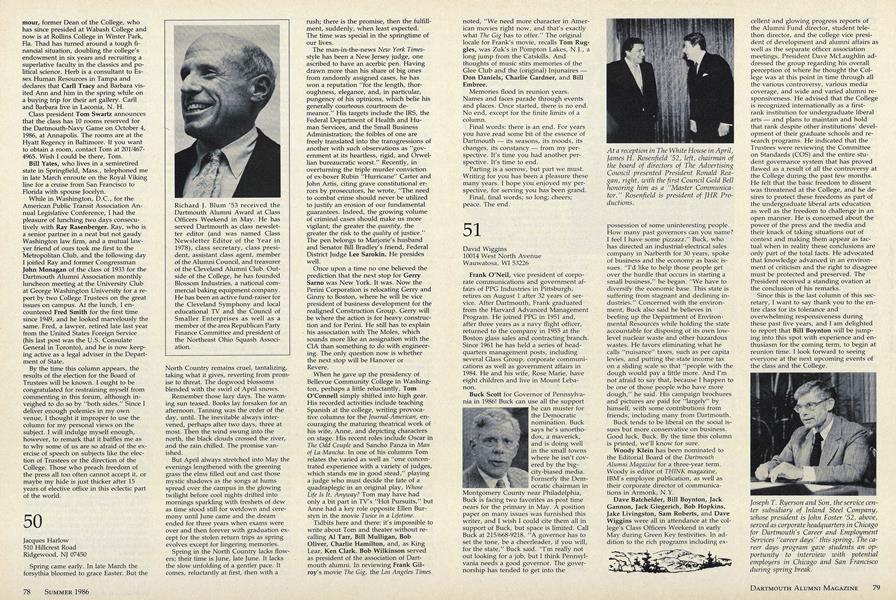
Frank O'Neil, vice president of corporate communications and government affairs of PPG Industries in Pittsburgh, retires on August 1 after 32 years of service. After Dartmouth, Frank graduated from the Harvard Advanced Management Program. He joined PPG in 1951 and, after three years as a navy flight officer, returned to the company in 1955 at the Boston glass sales and contracting branch. Since 1961 he has held a series of headquarters management posts, including several Glass Group, corporate communications as well as government affairs in 1984. He and his wife, Rose Marie, have eight children and live in Mount Lebanon.
Buck Scott for Governor of Pennsylvania in 1986! Buck can use all the support he can muster for the Democratic nomination. Buck says he's unorthodox, a maverick, and is doing well in the small towns where he isn't covered by the bigcity-biased media. Formerly the Democratic chairman in Montgomery County near Philadelphia, Buck is facing two favorites as post time nears for the primary in May. A position paper on many issues was furnished this writer, and I wish I could cite them all in support of Buck, but space is limited. Call Buck at 215/668-9218. "A governor has to set the tone, be a cheerleader, if you will, for the state," Buck said. "I'm really not out looking for a job, but I think Pennsylvania needs a good governor. The governorship has tended to get into the possession of some uninteresting people. How many past governors can you name? I feel I have some pizzazz." Buck, who has directed an industrial-electrical sales company in Narb'erth for 30 years, spoke of business and the economy as basic issues. "I'd like to help those people get over the hurdle that occurs in starting a small business," he began. "We have to diversify the economic base. This state is suffering from stagnant and declining industries." Concerned with the environment, Buck also said he believes in beefing up the Department of Environmental Resources while holding the state accountable for disposing of its own lowlevel nuclear waste and other hazardous wastes. He favors eliminating what he calls "nuisance" taxes, such as per capita levies, and putting the state income tax on a sliding scale so that "people with the dough would pay a little more. And I'm not afraid to say that, because I happen to be one of those people who have more dough," he said. His campaign brochures and pictures are paid for "largely" by himself, with some contributions from friends, including many from Dartmouth.
Buck tends to be liberal on the social issues but more conservative on business. Good luck, Buck. By the time this column is printed, we'll know for sure.
Woody Klein has been nominated to the Editorial Board of the DartmouthAlumni Magazine for a three-year term. Woody is editor of THINK magazine, IBM's employee publication, as well as their corporate director of communications in Armonk, N.Y.
Dave Batchelder, Bill Boynton, JackGannon, Jack Giegerich, Bob Hopkins,Jake Livingston, Sam Roberts, and DaveWiggins were all in attendance at the college's Class Officers Weekend in early May during Green Key festivities. In addition to the rich programs including excellent and glowing progress reports of the Alumni Fund director, student telethon director, and the college vice president of development and alumni affairs as well as the separate officer association meetings, President Dave McLaughlin addressed the group regarding his overall perception of where he thought the College was at this point in time through all the various controversy, various media coverage, and wide and varied alumni responsiveness. He advised that the College is recognized internationally as a firstrank institution for undergraduate liberal arts and plans to maintain and hold that rank despite other institutions' development of their graduate schools and research programs. He indicated that the Trustees were reviewing the Committee on Standards (COS) and the entire.student governance system that has proved flawed as a result of all the controversy at the College during the past few months. He felt that the basic freedom to dissent was threatened at the College, and he desires to protect these freedoms as part of the undergraduate liberal arts education as well as the freedom to challenge in an open manner. He is concerned about the power of the press and the media and their knack of taking situations out of context and making them appear as factual when in reality these conclusions are only part of the total facts. He advocated that knowledge advanced in an environment of criticism and the right to disagree must be protected and preserved. The President received a standing ovation at the conclusion of his remarks.
Since this is the last column of this secretary, I want to say thank you to the entire class for its tolerance and overwhelming responsiveness during these past five years, and I am delighted to report that Bill Boynton will be jumping into this spot with experience and enthusiasm for the coming term, to begin at reunion time. I look forward to seeing everyone at the next upcoming events of the class and the College.
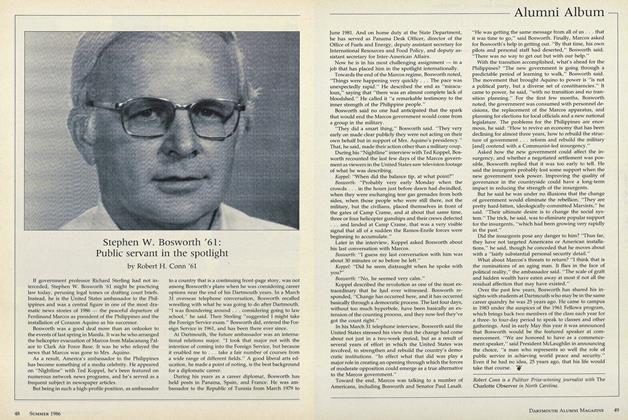
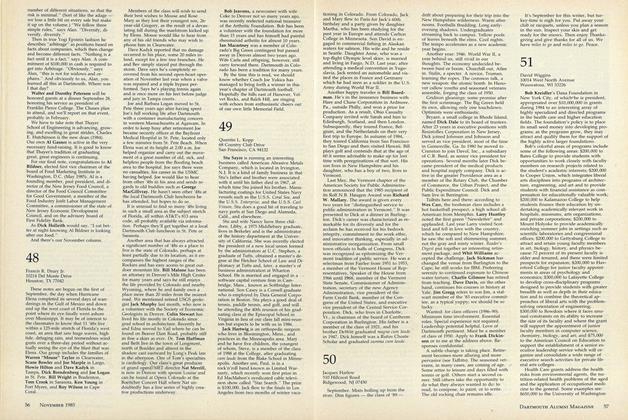
At a reception in The White House in April,James H. Rosenfield '52, left, chairman ofthe board of directors of The AdvertisingCouncil presented President Ronald Reagan, right, with the first Council Gold Bellhonoring him as a "Master Communicator." Rosenfield is president of JHR Pro-ductions.
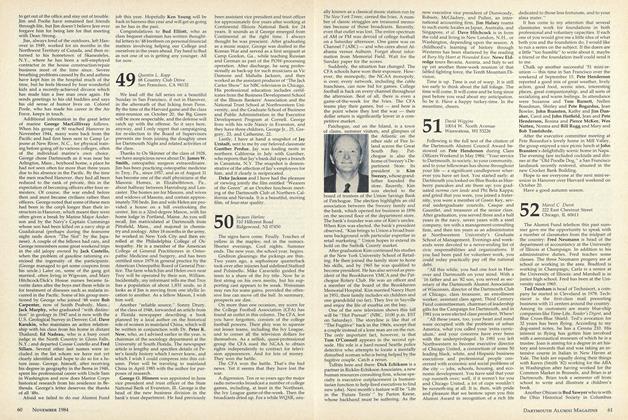
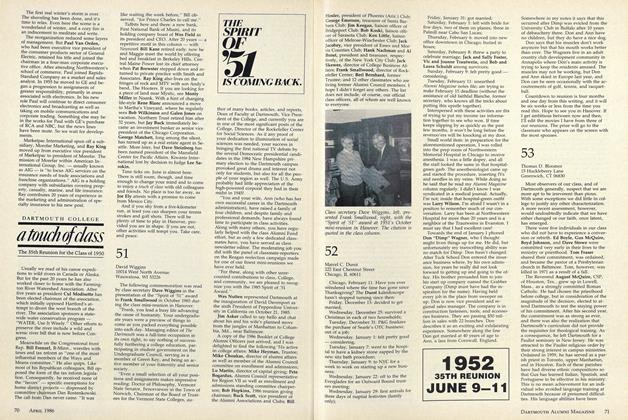
Joseph T. Ryerson and Son, the service center subsidiary of Inland Steel Company,whose president is John Foster '52, above,served as corporate headquarters in Chicagofor Dartmouth's Career and EmploymentServices "career days" this spring. The career days program gave students an opportunity to interview with potentialemployers in Chicago and San Franciscoduring spring break.
10014 West North Avenue Wauwatosa, WI 53226