1970
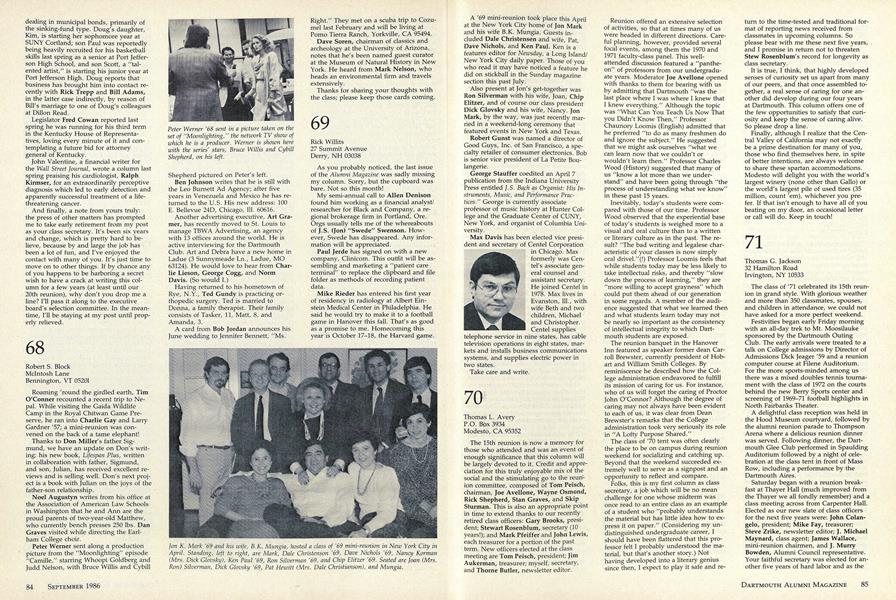
The 15th reunion is now a memory for those who attended and was an event of enough significance that this column will be largely devoted to it. Credit and appreciation for this truly enjoyable mix of the social and the stimulating go to the reunion committee, composed of Tom Peisch, chairman, Joe Avellone, Wayne Osmond,Rick Shepherd, Stan Graves, and SkipSturman. This is also an appropriate point in time to extend thanks to our recently retired class officers: Gary Brooks, president; Stewart Rosenblum, secretary (10 years!); and Mark Pfeiffer and John Lewis, each treasurer for a portion of the past term. New officers elected at the class meeting are Tom Peisch, president; JimAukerman, treasurer; myself, secretary, and Thome Butler, newsletter editor.
Reunion offered an extensive selection of activities, so that at times many of us were headed in different directions. Careful planning, however, provided several focal events, among them the 1970 and 1971 faculty-class panel. This well-attended discussion featured a "pantheon" of professors from our undergraduate years. Moderator Joe Avellone opened with thanks to them for bearing with us by admitting that Dartmouth "was the last place where I was where I knew that I knew everything." Although the topic was "What Can You Teach Us Now That you Didn't Know Then," Professor Chauncey Loomis (English) admitted that he preferred "to do as many freshmen do and ignore the subject." He suggested that we might ask ourselves "what we can learn now that we couldn't or wouldn't learn then." Professor Charles Wood (History) suggested that many of us "know a lot more than we understand" and have been going through "the process of understanding what we know" in these past 15 years.
Inevitably, today's students were compared with those of our time. Professor Wood observed that the experiential base of today's students is weighed more to a visual and oral culture than to a written or literary culture as in the past. The result? "The bad writing and legalese characteristic of your classes is now simply oral drivel."(!) Professor Loomis feels that while students today may be less likely to take intellectual risks, and thereby "slow down the process of learning," they are "more willing to accept grayness" which could put them ahead of our generation in some regards. A member of the audience suggested that what we learned then and what students learn today may not be nearly so important as the consistency of intellectual integrity to which Dartmouth students are exposed.
The reunion banquet in the Hanover Inn featured as speaker former dean Carroll Brewster, currently president of Hobart and William Smith Colleges. By reminiscence he described how the College administration endeavored to fulfill its mission of caring for us. For instance, who of us will forget the caring of Proctor John O'Connor? Although the degree of caring may not always have been evident to each of us, it was clear from Dean Brewster's remarks that the College administration took very seriously its role in "A Lofty Purpose Shared."
The class of '7O tent was often clearly the place to be on campus during reunion weekend for socializing and catching up. Beyond that the weekend succeeded extremely well to serve as a signpost and an opportunity to reflect and compare.
Folks, this is my first column as class secretary, a job which will be no mean challenge for one whose midterm was once read to an entire class as an example of a student who "probably understands the material but has little idea how to express it on paper." (Considering my undistinguished undergraduate career, I should have been flattered that this professor felt I probably understood the material, but that's another story.) Not having developed into a literary genius since then, I expect to play it safe and return to the time-tested and traditional format of reporting news received from classmates in upcoming columns. So please bear with me these next five years, and I promise in return not to threaten Stew Rosenblum's record for longevity as class secretary.
It is true, I think, that highly developed senses of curiosity set us apart from many of our peers, and that once assembled together, a real sense of caring for one another did develop during our four years at Dartmouth. This column offers one of the few opportunities to satisfy that curiosity and keep the sense of caring alive. So please drop a line.
Finally, although I realize that the Central Valley of California may not exactly be a prime destination for many of you, those who find themselves here, in spite of better intentions, are always welcome to share these spartan accommodations. Modesto will delight you with the world's largest winery (none other than Gallo) or the world's largest pile of used tires (35 million, count 'em), whichever you prefer. If that isn't enough to have all of you beating on my door, an occasional letter or call will do. Keep in touch!
P.O. Box 3934 Modesto, CA 95352
More From This Issue
-
 Feature
Late Afternoon Thoughts On the Twentieth Century
September 1986 -
 Cover Story
"The Art of Making Things Right"
September 1986 -
 Sports
Sports
September 1986 -
 Article
Dartmouth Authors
September 1986 -
 Article
Ready for Lift Off
September 1986 -
 Article
Sandy Apgar '62 A books and mortar man
September 1986