DARTMOUTH UNDYING
Spring 1892
The San Francisco-born Frost plans to enter Harvard as a freshman—he has already taken several entrance exams—but his grandmother worries about rumors of alcohol consumption at the Cambridge school. One of the boy's high school teachers, a Dartmouth alumnus, recommends the College.
Fall 1892
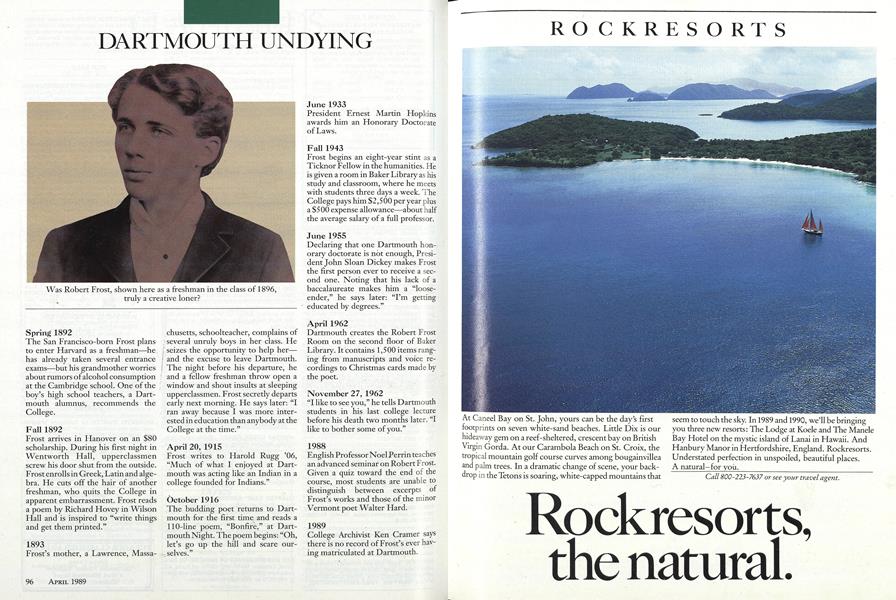
Frost arrives in Hanover on an $80 scholarship. During his first night in Wentworth Hall, upperclassmen screw his door shut from the outside. Frost enrolls in Greek, Latin and algebra. He cuts off the hair of another freshman, who quits the College in apparent embarrassment. Frost reads a poem by Richard Hovey in Wilson Hall and is inspired to "write things and get them printed."
1893
Frost's mother, a Lawrence, Massachusetts, schoolteacher, complains of several unruly boys in her class. He seizes the opportunity to help her— and the excuse to leave Dartmouth. The night before his departure, he and a fellow freshman throw open a window and shout insults at sleeping upperclassmen. Frost secretly departs early next morning. He says later: "I ran away because I was more interested in education than anybody at the College at the time."
April 20, 1915
Frost writes to Harold Rugg '06, "Much of what I enjoyed at Dartmouth was acting like an Indian in a college founded for Indians."
October 1916
The budding poet returns to Dartmouth for the first time and reads a 110-line poem, "Bonfire," at Dartmouth Night. The poem begins: "Oh, let's go up the hill and scare ourselves."
June 1933
President Ernest Martin Hopkins awards him an Honorary Doctorate of Laws.
Fall 1943
Frost begins an eight-year stint as a Ticknor Fellow in the humanities. He is given a room in Baker Library as his study and classroom, where he meets with students three days a week. The College pays him $2,500 per year plus a $500 expense allowance—about half the average salary of a fall professor.
June 1955
Declaring that one Dartmouth honorary doctorate is not enough, President John sloan Dickey makes Frost the first person ever to receive a second one. Noting that his lack of a baccalaureate makes him a "looseender," he says later: "I'm getting educated by degrees."
April 1962
Dartmouth creates the Robert Frost Room on the second floor of Baker Library. It contains 1,500 items ranging from manuscripts and voice recordings to Christmas cards made by the poet.
November 27, 1962
"I like to see you," he tells Dartmouth students in his last college lecture before his death two months later. "I like to bother some of you."
1988
English Professor Noel Perrin teaches an advanced seminar on Robert Frost. Given a quiz toward the end of the course, most students are unable to distinguish between excerpts of Frost's works and those of the minor Vermont poet Walter Flard.
1989
College Archivist Ken Cramer says there is no record of Frost's ever having matriculated at Dartmouth.
Was Robert Frost, shown here as a freshman in the class of 1896, truly a creative loner?