Prof's Choice
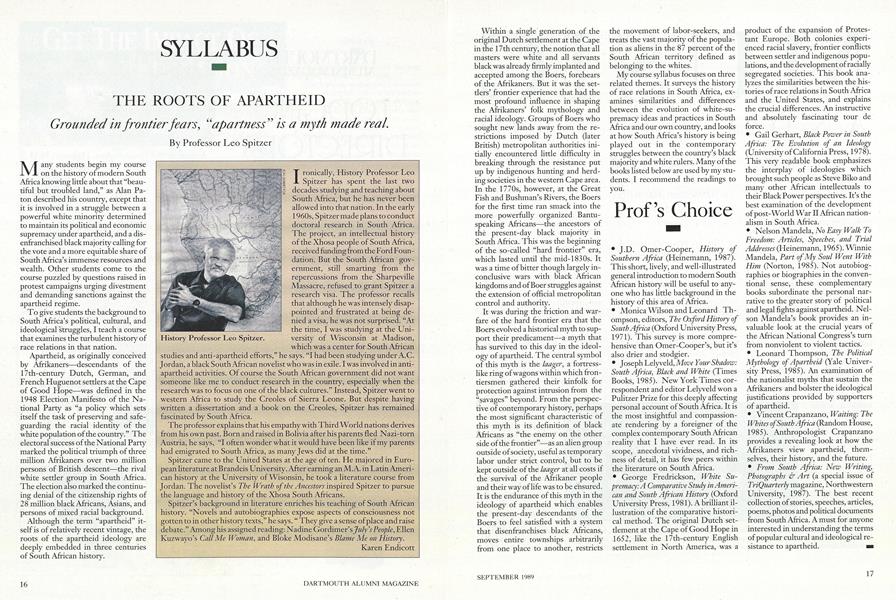
J.D. Omer-Cooper, History of Southern Africa (Heinemann, 1987). This short, lively, and well-illustrated general introduction to modern South African history will be useful to anyone who has little background in the history of this area of Africa.
• Monica Wilson and Leonard Thompson, editors, The Oxford History of South Africa (Oxford University Press, 1971). This survey is more comprehensive than Omer-Cooper's, but it's also drier and stodgier.
• Joseph Lelyveld, Move Your Shadow:South Africa, Black and White (Times Books, 1985). New York Times correspondent and editor Lelyveld won a Pulitzer Prize for this deeply affecting personal account of South Africa. It is the most insightful and compassionate rendering by a foreigner of the complex contemporary South African reality that I have ever read. In its scope, anecdotal vividness, and richness of detail, it has few peers within the literature on South Africa.
• George Fredrickson, White Supremacy: A Comparative Study in American and South African History (Oxford University Press, 1981). A brilliant illustration of the comparative historical method. The original Dutch settlement at the Cape of Good Hope in 1652, like the 17th-century English settlement in North America, was a product of the expansion of Protestant Europe. Both colonies experienced racial slavery, frontier conflicts between settler and indigenous populations, and the development of racially segregated societies. This book analyzes the similarities between the histories of race relations in South Africa and the United States, and explains the crucial differences. An instructive and absolutely fascinating tour de force.
• Gail Gerhart, Black Power in SouthAfrica: The Evolution of an Ideology (University of California Press, 1978). This very readable book emphasizes the interplay of ideologies which brought such people as Steve Biko and many other African intellectuals to their Black Power perspectives. It's the best examination of the development of post-World War II African nationalism in South Africa.
• Nelson Mandela, No Easy Walk ToFreedom: Articles, Speeches, and TrialAddresses (Heinemann, 1965). Winnie Mandela, Part of My Soul Went WithHim (Norton, 1985). Not autobiographies or biographies in the conventional sense, these complementary books subordinate the personal narrative to the greater story of political and legal fights against apartheid. Nelson Mandela's book provides an invaluable look at the crucial years of the African National Congress's turn from nonviolent to violent tactics.
• Leonard Thompson, The PoliticalMythology of Apartheid (Yale University Press, 1985). An examination of the nationalist myths that sustain the Afrikaners and bolster the ideological justifications provided by supporters of apartheid.
• Vincent Crapanzano, Waiting: TheWhites of South Africa (Random House, 1985). Anthropologist Crapanzano provides a revealing look at how the Afrikaners view apartheid, themselves, their history, and the future.
• From South Africa: New Writing,Photographs & Art (a special issue of TriQuarterly magazine, Northwestern University, 1987). The best recent collection of stories, speeches, articles, poems, photos and political documents from South Africa. A must for anyone interested in understanding the terms of popular cultural and ideological resistance to apartheid.
More From This Issue
-
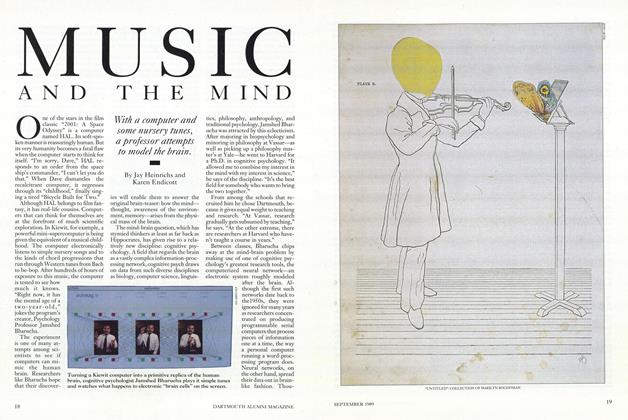 Cover Story
MUSIC AND THE MIND
September 1989 -
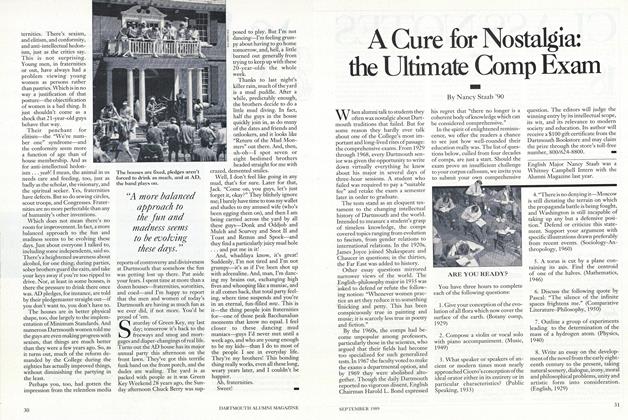 Feature
A Cure for Nostalgia: the Ultimate Comp Exam
September 1989 -
 Feature
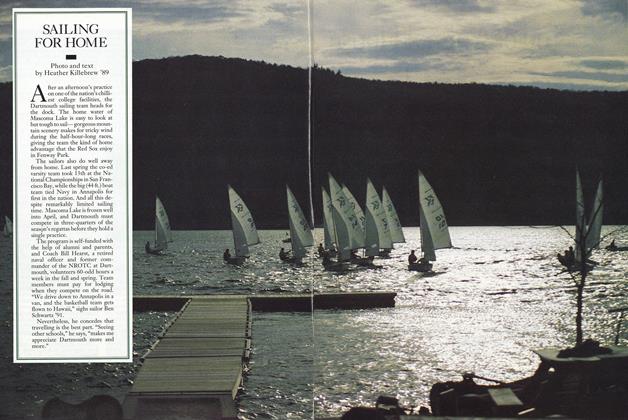
SAILING FOR HOME
September 1989 -
 Feature
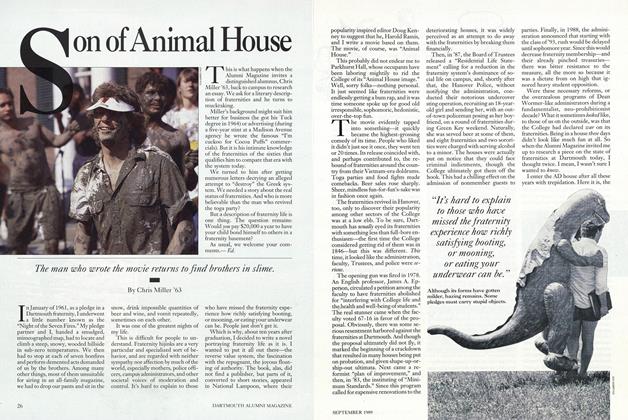
Son of Animal House
September 1989 -
Article
The man who wrote the movie returns to find brothers in slime.
September 1989 -
 Article
DR WHEELOCK'S JOURNAL
September 1989
Article
-
 Article
GIFT TO THE SHATTUCK OBSERVATORY
November, 1912 -
 Article
TOWN TO SPEND $12,000 ON IMPROVEMENT FOR BRIDGE
NOVEMBER, 1926 -
 Article
Quotes from Alumni
December 1938 -
 Article
IT IS NOT LIMITED TO FLAG-WAVING
DECEMBER 1929 -
 Article
Third Decade of Dartmouth-at-Moosilauke
April 1950 -
 Article
A Universal Concern
APRIL 1983
