1945
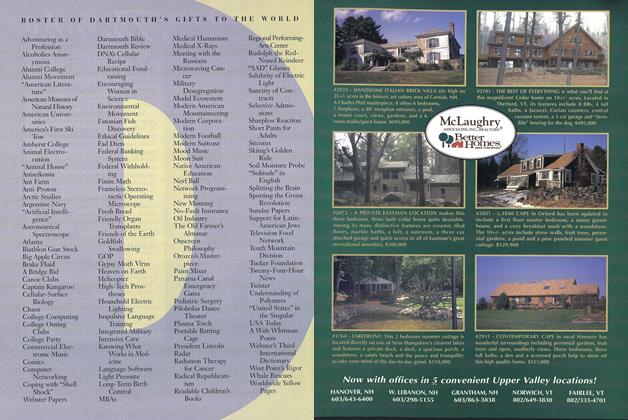
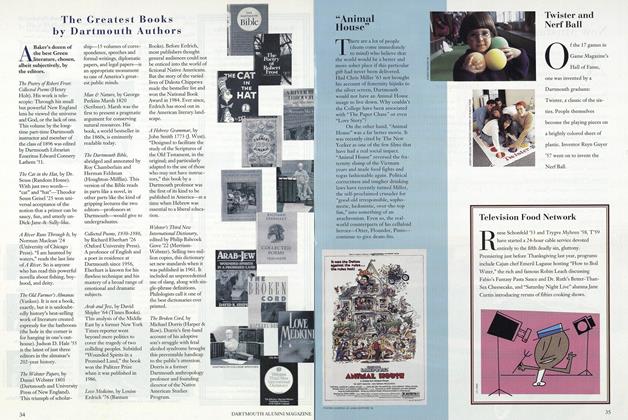
This issue of the DAM features "Dartmouth's Gifts to the World." A few of you were kind enough to send me some items on your contributions to society, and I'm happy to record them here.
For the past six years, Stanford Luce has been very active in PUSH, a local organization to help the needy maintain their trailers or homes. From leaking roofs and plumbing to sagging floors or non-functioning furnaces, these volunteers fix it for free. Also, he assisted in establishing a chapter of Habitat for Humanity. Finally, he volunteered to re-cane 50 chairs at $5O each, proceeds to go to local institutions. In short, he's tried to make Oxford, Ohio, a better place.
Bob Cate finalized 14 years of effort by gaining U.S. Patent No. 5,089,976 for his "Color Normalization Process." More astoundingly, he handled all the complex paperwork himself, without a patent lawyer!
I U.S. District Judge Richard Owen continues his two careers: law and music composition. His opera Mary Dyer was produced at New York State University, with his wife, Lynn, in the title role. It received good reviews from the New York critics.
From Dexter, Maine, Dave Kendall writes, "So here's to us who never made the Alumni Magazine's 'Give a Rouse' column, but who plugged away doing what has to be done." After a career as a geologist with New Jersey Zinc Co., Dave switched to science teaching in response to the great cry for help following the launch of Russia's Sputnik. Along the way, he set up curricula, contributed to textbooks, and became a charter member of the Dartmouth Environmental Network.
Another geologist, John Foster, was on the air force team to locate precisely the sites of 36 of the 144 hardened Atlas Missile silos. Another successful project, in 1959, was a mission to explore for fresh groundwater in Kuwait; the team procured three million gallons per day for Kuwait City, the first ever produced from the subsurface there. Lastly, he was the principal author of two patents in the field of geological instruments.
Our class boasts a number of physicians, and John Van Buren is a good example. From his beginnings at Dartmouth Med School, John went on to earn a M.Sc. in neurophysiology and a Ph.D. in neuroanatomy. He was a neurological surgeon, and, as the best of them do, became a professor, finishing his career as clinical professor of neurosurgery at the University of North Carolina School of Medicine. He wrote, sometimes with others, five books dealing with his specialty and 103 articles for medical journals.
Finally, I have to say that, collectively, our most significant gift to the world was our participation in World War II. All of us were in it, one way or another. Twenty-six of our classmates gave their lives so that the world might be a better place. Surely, that was the ultimate gift. We salute them!
The next '45 Class Notes will be written by Sylvia Reed, widow of John. I've asked her to use the forum as she sees fit. Don't miss it.
Thought for the month: "If the world were a logical place, men would ride side-saddle." Rita Mae Brown.
5015 Edinborough Rd., Greensboro, NC 27406