1960
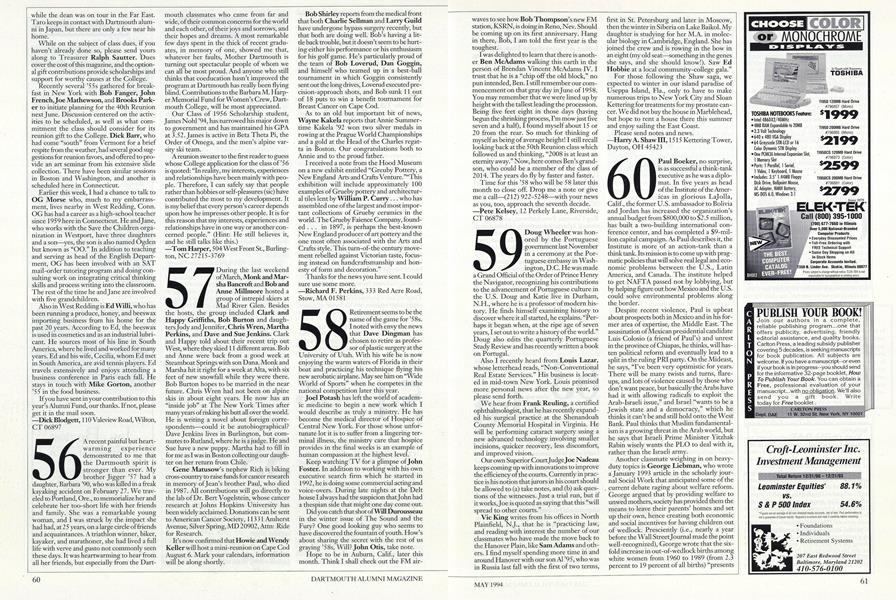
Paul Boeker, no surprise, is as successful a think-tank executive as he was a diplomat. In five years as head of the Institute of the Americas in glorious LaJolla, Calif., the former U.S. ambassador to Bolivia and Jordan has increased the organization's annual budget from $800,000 to $2.5 million, has built a two-building international conference center, and has completed a $9-million capital campaign. As Paul describes it, the Institute is more of an action-tank than a think tank. Its mission is to come up with pragmatic policies that will solve real legal and economic problems between the U.S., Latin America, and Canada. The institute helped to get NAFTA passed not by lobbying, but by helping figure out how Mexico and the U.S. could solve environmental problems along the border.
Despite recent violence, Paul is upbeat about prospects both in Mexico and in his former area of expertise, the Middle East. The assasination of Mexican presidential candidate Luis Colosio (a friend of Paul's) and unrest in the province of Chiapas, he thinks, will hasten political reform and eventually lead to a split in the ruling PRI party. On the Mideast, he says, "I've been very optimistic for years. There will be many twists and turns, flareups, and lots of violence caused by those who don't want peace, but basically the Arabs have had it with allowing radicals to exploit the Arab-Israeli issue," and Israel "wants to be a Jewish state and a democracy," which he thinks it can't be and still hold onto the West Bank. Paul thinks that Muslim fundamentalism is a growing threat in the Arab world, but he says that Israeli Prime Minister Yitzhak Rabin wisely wants the PLO to deal with it, rather than the Israeli army.
Another classmate weighing in on heavyduty topics is George Liebman, who wrote a January 1993 article in the scholarly journal Social Work that anticipated some of the current debate raging about welfare reform. George argued that by providing welfare to unwed mothers, society has provided them the means to leave their parents' homes and set up their own, hence creating both economic and social incentives for having children out of wedlock. Presciently (i.e., nearly a year before the Wall Street Journal made the point well-recognized), George wrote that the sixfold increase in out-of-wedlock births among white women from 1960 to 1989 (from 2.3 percent to 19 percent of all births) "presents a great unrecognized social problem of our time." (Everyone recognizes that the fact that 65 percent of all black babies are born out of wedlock is social dynamite.) Instead of Bill Clinton's proposed work requirements, George argues that welfare reform should concentrate on creating incentives for teenagers of all races not to have illegitimate babies. He favors re-establishing homes for unwed mothers.
Other news: Rey Moulton and KenJohansen are hard at work planning our 35th (think of it!) Reunion. Mark your calender: June 12-15, 1995. We established the world record for 30th reunions with 139 in attendance. Thus far, tire class of 1953 has die 35th-year record, with 149. Records or no records, plan on coming. And plan on contributing to the Class of 1960 scholarship fund, which thus far contains $64,000 in cash and $53,000 in pledges, mainly from Marty Lower and just a few other classmates. The rest of us need to cough.
7405 Rigewood Ave., Chevy Chase., MD 20815