BOOK REVIEW
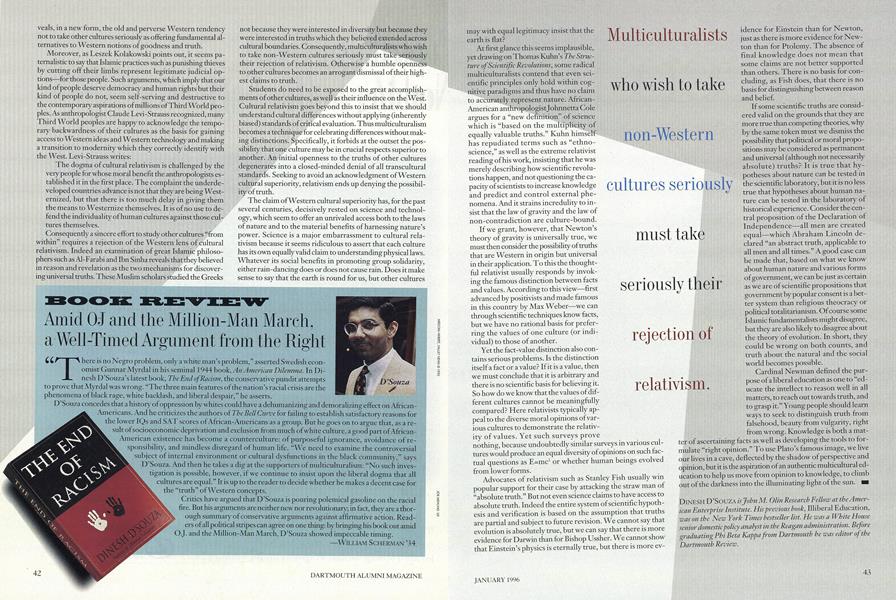
Amid OJ and the Million-Man March, a Well-Timed Argument from the Right
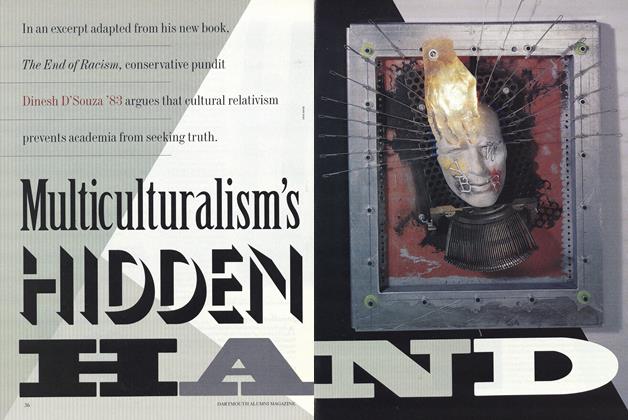
There is no Negro problem, only a white man's problem," asserted Swedish economist Gunnar Myrdal in his. seminal 1944 book, An American Dilemma. In Dinesh D'Souza's latest book, The End of Racism, the conservative pundit attempts to prove that Myrdal was wrong. "The three main features of the nation's racial crisis are the phenomena of black rage, white backlash, and liberal despair," he asserts.
D'Souza concedes that a history of oppression by whites could have a dehumanizing and demoralizing effect on African-Americans. And he criticizes the authors of The Bell Curve for failing to establish satisfactory reasons for the lower IQs and SAT scores of African-Americans as a group. But he goes on to argue that, as a result of socioeconomic deprivation and exclusion from much of white culture, a good part of African- American existence has become a counterculture: of purposeful ignorance, avoidance of responsibility, and mindless disregard of human Life. "We need to examine the controversial subject of internal environment or cultural dysfunctions in the black community," says D'Souza. And then he takes a dig at the supporters of multiculturalism: "No such investigation is possible, however, if we continue to insist upon the liberal dogma that all cultures are equal." It is up to the reader to decide whether he makes a decent case for the "truth" of Western concepts.
Critics have argued that D'Souza is pouring polemical gasoline on the racial fire. But his arguments are neither new nor revolutionary, in fact, they are a thory ough summary of conservative arguments against affirmative action. Readers of all political stripes can agree on one thing: by bringing his book out amid O.J. and the Alillion-Man March, D'Souza showed impeccable timing.
D'Souza