Restructuring the Alumni Council
An every-issue guide to staying in touch with Dartmouth
During two days of meetings last December the Alumni Council evaluated strategies for strengthening the body and making itself more productive. At the previous semi-annual meeting in May 1995 it had voted to undertake just such an examination in view of the major changes that have taken place in the wider alumni body since its last self-study of functions and purpose. The Council's basic options as its members saw them: to continue unchanged; to adapt in form and size to become more productive, more efficient, more representative; or to disband. Following months of deliberations, : the consensus; was don't end it, mend it.
Among the challenges considered in December—Stimulated by the recommendations of an ad hoc committee led by recent Council president Emily Bakemeier '82—were four key questions: • What is the single most important thing the Council should do? • What are its major strengths? • What are its weaknesses? • Whom does, or should, the Council serve?
Among the answers: the Council's two most important functions are to provide nominations for Alumni Trustees and to serve as a two-way communications vehicle; between:alumni/ae and the institution.
The strengths of the Council are the considerable talents of the representatives elected to it by the College's many member organizations.
Its weaknesses: despite their manifold talents, Councilors within the unwieldy structure of more than 100 members do not always have the time and ability to fulfill their communication assignments. And there:are frustrating redundancies, with alumni functions being duplicated elsewhere in the College. Further, there arc ambiguities surrounding the Council's key responsibilities: does; it advise with or without the-prerogative of consent? How should the College and the Council distinguish among control, ownership, governance, and stewardship?
The best answer was deemed the statement made three years ago by former Council president; Curt Welling '71: "If you see yourself as an owner you will want to control and possess," he said. "If you see.yourself as a steward you will see yourself as having an entitlement, but that entitlement is to a seat at the table, to be part of a group... the right to make those decisions for which you are best qualified-after due consultation with others—to inform the debate, and to influence those decisions that are better left to others."
The upshot? Resolutions were passed that will result in a 96-meniber Council, with fewer and streamlined committee structures. At the heart of it will be a new standing committee, of 20-plus members, representing organizations integrally involved in alumni activities, Class Officers, Club Officers, etc;—the Committee on Alumni Organizations. A new constitution is being drafted for approval at the May meeting.
President Freedman takes to the information highway—in person. This month, on a West Coast trip, he will speak at Dartmouth club events in Seattle (3/25), Portland (3/26), San Francisco (3/28), and Los Angeles (3/29). In April he will address the Chicago club (4/24) and the Boston club (4/25).
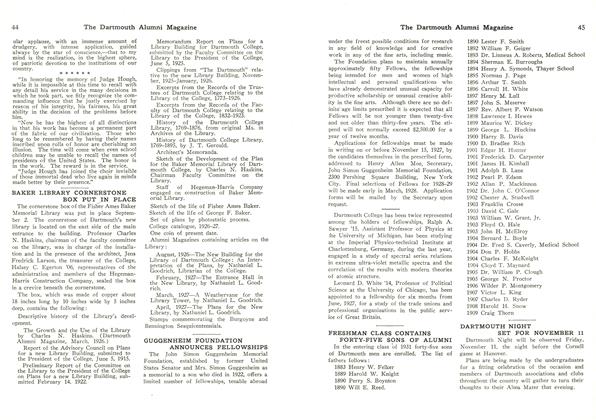
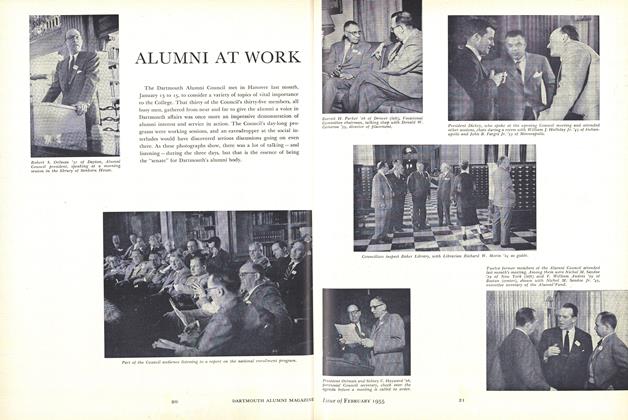
Councilors in 1950. After years of self-examination, the group is giving itself a new face.