A Piece of My Soul
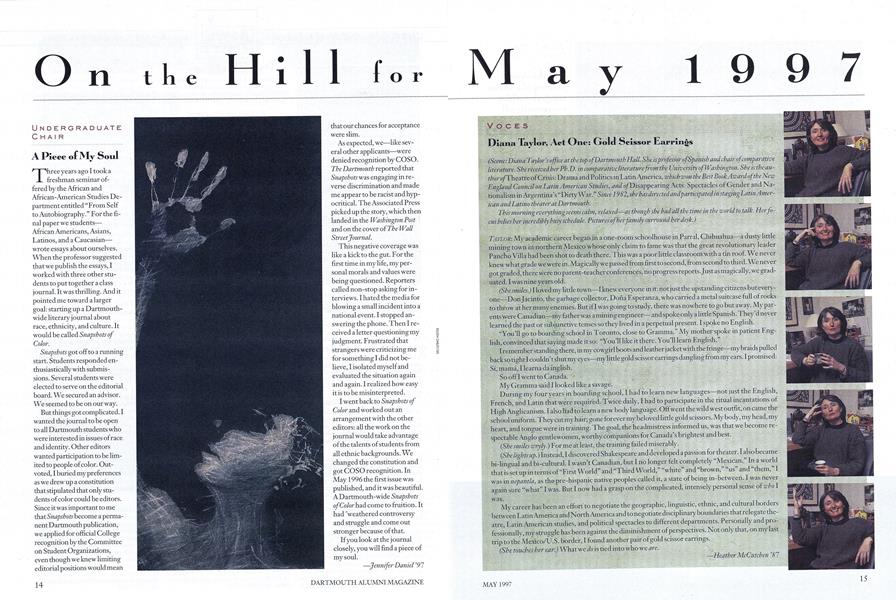
Three years ago I took a freshman seminar offered by the African and African-American Studies Department entitled "From Self to Autobiography." For the final paper we students African Americans, Asians, Latinos, and a Caucasianwrote essays about ourselves. When the professor suggested that we publish the essays, I worked with three other students to put together a class journal. It was thrilling. And it pointed me toward a larger goal: starting up a Dartmouthwide literary journal about race, ethnicity, and culture. It would be called Snapshots ofColor.
Snapshots got off to a running start. Students responded enthusiastically with submissions. Several students were elected to serve on the editorial board. We secured an advisor. We seemed to be on our way.
But things got complicated. I wanted the journal to be open to all Dartmouth students who were interested in issues of race and identity. Other editors wanted participation to be limited to people of color. Outvoted, I buried my preferences as we drew up a constitution that stipulated that only students of color could be editors. Since it was important to me that Snapshots become a permanent Dartmouth publication, we applied for official College recognition by the Committee on Student Organizations, even though we knew limiting editorial positions would mean that our chances for acceptance were slim.
As expected, we—like several other applicants—were denied recognition by COSO. The Dartmouth reported that Snapshots was engaging in reverse discrimination and made me appear to be racist and hypocritical. The Associated Press picked up the story, which then landed in the Washington Post and on the cover of The WallStreet Journal.
This negative coverage was like a kick to the gut. For the first time in my life, my personal morals and values were being questioned. Reporters called non-stop asking for interviews. I hated the media for blowing a small incident into a national event. I stopped answering the phone. Then I received a letter questioning my judgment. Frustrated that strangers were criticizing me for something I did not believe, I isolated myself and evaluated the situation again and again. I realized how easy it is to be misinterpreted.
I went back to Snapshots ofColor and worked out an arrangement with die other editors: all the work on the journal would take advantage of the talents of students from all ethnic backgrounds. We changed the constitution and got COSO recognition. In May 1996 the first issue was published, and it was beautiful. A Dartmouth-wide Snapshotsof Color had come to fruition. It had "weathered controversy and struggle and come out stronger because of that.
If you look at the journal closely, you will find a piece of my soul.