Intrigue, Moral Ambiguity, and Saving the World
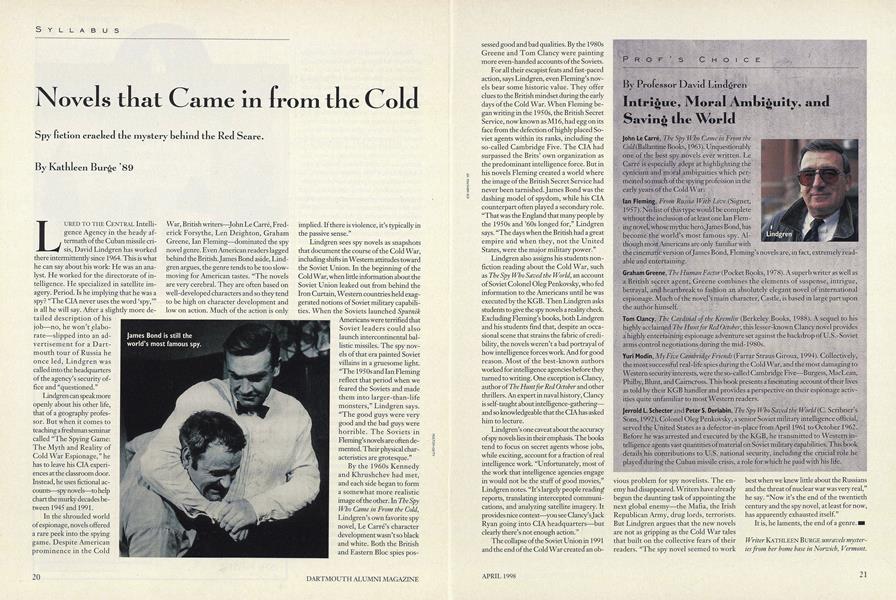
John Le Carre, The Spy Who Came , From the Cold (Ballantine Books, 1963). Unquestionably one of the best spy novels ever written. Le Can e is especially adept at highlighting the cynicism and moral ambiguities which permeated so much of the spying profession in the early years of the Cold War.
San Fleming, From Russia With Love, (Signet, 1957). No list of list of this type would be complete without die inclusion of at least one Ian Fleming novel, whose mythic hero, James Bond, has become the world's most famous spy. Al though most Americans are only familiar with the cinematic version of James Bond, Fleming's novels are, in face, extremely readable and entertaining.
Graham Greene, The Human Factor (Pocket Books, 1978). A superb writer as well as a British secret agent, Greene combines the elements of suspense, intrigue, betrayal, and heartbreak to fashion an absolutely elegant novel of international: espionage. Much of the novel's main character, Castle, is based in large part upon the author himself.
Tom Clancy, The Cardinal of the Kremlin (Berkeley Books, 1988). A sequel to his highly acclaimed The Hunt for Red October, this lesser-known Clancy novel provides espionage. Much of the novel's main character, Castle, is based in large part upon the author himself.
Yuri Modin, My Fie Cambridge Friends (Farrar Straus Giroux, 1994). Collectively, the most successful real-life spies during the Cold War, and the most damagaing to Western security interests, were the so-called Cambridge Five-Burgess, MacLean, Philby, Blunt, and Cairncross. This book presents a fascinating account of their lives as told b their KGB handler and provides a perspective n their espionage activeities quite unfamiliar o most Wesern readers.
Jerrold L. Schector and Peter S. Deriabin, The Spy Who Saved the World (C. Scribner's Sons, 1992). Colonel Oleg Penkovsky, a senior Soviet military intelligence official, Served the United States as a defector-in-place from April 1961 to October 1962. Before he was arrested and executed by the KGB, he transmitted to Western in telligence agents vast quantities of material on Soviet military capabilities. This book details his to U.S. national security, including the crucial role he played during the Cuban missile crisis, a role for which he paid with his life.