1960
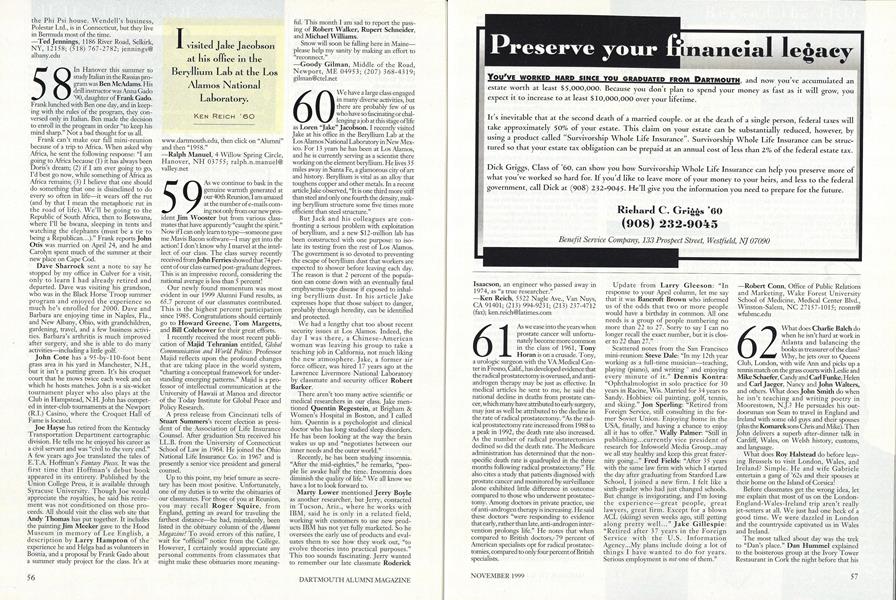
We have a large class engaged in many diverse activities, but there are probably few of us who have so fascinating or challenging a job at this stage of life as Loren "Jake" Jacobson. I recently visited Jake at his office in the Beryllium Lab at the Los Alamos National Laboratory in New Mexico. For 13 years he has been at Los Alamos, and he is currently serving as a scientist there working on the element beryllium. He lives 35 miles away in Santa Fe, a glamorous city of art and history. Beryllium is vital as an alloy that toughens copper and other metals. In a recent article Jake observed, "It is one third more stiff than steel and only one fourth the density, making beryllium structure some five times more efficient than steel structure."
But Jack and his colleagues are confronting a serious problem with exploitation of beryllium, and a new $12-million lab has been constructed with one purpose: to isolate its testing from the rest of Los Alamos. The government is so devoted to preventing the escape of beryllium dust that workers are expected to shower before leaving each day. The reason is that 2 percent of the population can come down with an eventually fatal emphysema-type disease if exposed to inhaling beryllium dust. In his article Jake expresses hope that those subject to danger, probably through heredity, can be identified and protected.
We had a lengthy chat too about recent security issues at Los Alamos. Indeed, the day I was there, a Chinese-American woman was leaving his group to take a teaching job in California, not much liking the new atmosphere. Jake, a former air force officer, was hired 17 years ago at the Lawrence Livermore National Laboratory by classmate and security officer Robert Barker.
There aren't too many active scientific or medical researchers in our class. Jake mentioned Quentin Regestein, at Brigham & Women's Hospital in Boston, and I called him. Quentin is a psychologist and clinical doctor who has long studied sleep disorders. He has been looking at the way the brain wakes us up and "negotiates between our inner needs and the outer world."
Recently, he has been studying insomnia. "After the mid-eighties," he remarks, "people lie awake half the time. Insomnia does diminish the quality of life." We all know we have a lot to look forward to.
Marty Lower mentioned Jerry Boyle as another researcher, but Jerry, contacted in Tucson, Ariz., where he works with IBM, said he is only in a related field, working with customers to use new products IBM has not yet fully marketed. So he oversees the early use of products and evaluates them to see how they work out, "to evolve theories into practical purposes." This too sounds fascinating. Jerry wanted to remember our late classmate Roderick Isaacson, an engineer who passed away in 1974, as "a true researcher."
5522 Nagle Ave., Van Nuys, CA 91401; (213) 994-9231; (213) 237-4712 (fax); ken.reich@latimes.com