"I NEEDED TO INVESTIGATE"
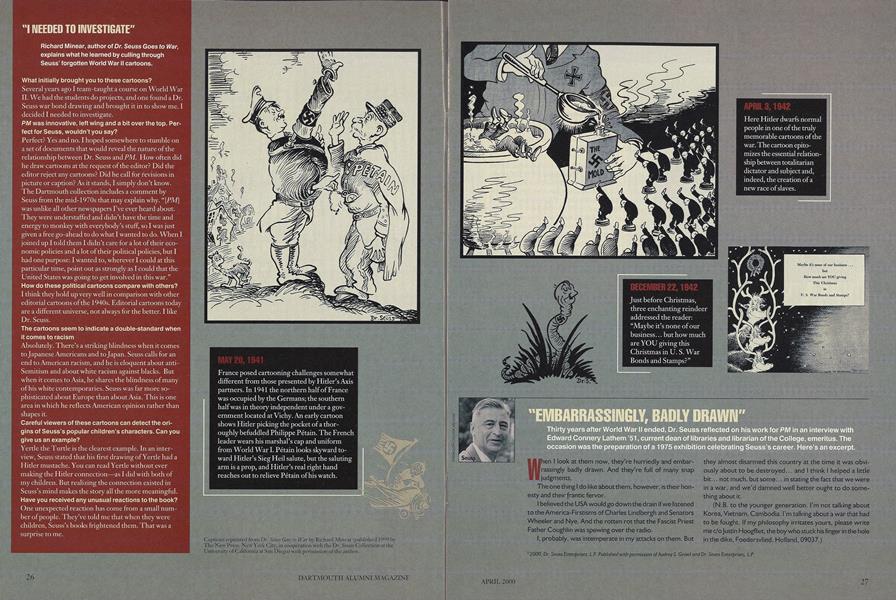
Richard Minear, author of Dr. Seuss Goes to War,explains what he learned by culling throughSeuss' forgotten World War II cartoons.
What initially brought you to these cartoons? Several years ago I team-taught a course on World War II. We had the students do projects, and one found a Dr. Seuss war bond drawing and brought it in to show me. I decided I needed to investigate.
PM was innovative, left wing and a bit over the top. Perfect for Seuss, wouldn't you say? Perfect? Yes and no. I hoped somewhere to stumble on a set of documents that would reveal the nature of the relationship between Dr. Seuss and PM. How often did he draw cartoons at the request of the editor? Did the editor reject any cartoons? Did he call for revisions in picture or caption? As it stands, I simply don't know. The Dartmouth collection includes a comment by Seuss from the mid-1970s that may explain why. "[PM] was unlike all other newspapers I've ever heard about. They were understaffed and didn't have the time and energy to monkey with everybody's stuff, so I was just given a free go-ahead to do what I wanted to do. When I joined up I told them I didn't care for a lot of their economic policies and a lot of their political policies, but I had one purpose: I wanted to, wherever I could at this particular time, point out as strongly as I could that the United States was going to get involved in this war." How do these political cartoons compare with others? I think they hold up very well in comparison with other editorial cartoons of the 1940s. Editorial cartoons today are a different universe, not always for the better. I like Dr. Seuss.
The cartoons seem to indicate a double-standard whenit comes tq racism Absolutely. There's a striking blindness when it comes to Japanese Americans and to Japan. Seuss calls for an end to American racism, and he is eloquent about anti- Semitism and about white racism against blacks. But when it comes to Asia, he shares the blindness of many of his white contemporaries. Seuss was far more sophisticated about Europe than about Asia. This is one area in which he reflects American opinion rather than
Careful viewers of these cartoons can detect the origins of Seuss's popular children's characters. Can yougive us an example? Yertle the Turtle is the clearest example. In an interview, Seuss stated that his first drawing of Yertle had a Hitler mustache. You can read Yertle without ever making the Hitler connection—as I did with both of my children. But realizing the connection existed in Seuss's mind makes the story all the more meaningful.
Have you received any unusual reactions to the book? One unexpected reaction has come from a small number of people. They've told me that when they were children, Seuss's books frightened them. That was a surprise to me.
Article
-
 Article
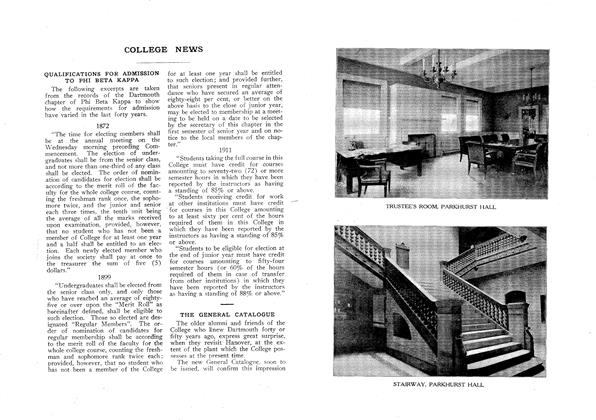
THE GENERAL CATALOGUE
January, 1912 -
 Article
WASHINGTON'S BIRTHDAY PARTY AT THE INN
March 1917 -
 Article
GIFTS TO THE COLLEGE DURING THE PAST YEAR
July 1920 -
 Article
EIGHTY FIVE MILE WALK ESTABLISHES NEW RECORD
December 1920 -
 Article
THE UNDERGRADUATE CHAIR
JANUARY, 1927 -
 Article
Nominees for Alumni Trustee
FEBRUARY 1968
