The Answers Are Blowin’ in the Wind
An English seminar rocks and rolls with the poetry of Bob Dylan.
FLIP THROUGH THE English departments course offerings and you'll find the usual suspects: Chaucer, Shakespeare, Milton, Joyce. Then there's English 73: "Lyrics of Bob Dylan." Bob Dylan? A whole course on a barely comprehensible singer-songwriter?
"Yeah, I know," says professor Lou Renza. He's heard the doubts before: Dylan belongs on MTV, not in the classroom. "A lot of places have courses in pop culture," says Renza. "Some people take that as evidence that multiculturalism is taking over the humanities. I don't have an agenda except that Dylan has composed a body of work that can sustain critical attention like any other modern poet. He poses provocative themes that require probing. A lot of his songs don't make instant sense to people."
Well, yeah. Dylan is impossible to understand when he's mumbling or stoned—or both. But in nearly 40 years of writing and performing songs in his idiosyncratic way, Dylan has gained overwhelming respect for transforming the way people think about music, society and themselves. Since his 1962 hit "Blowin' in the Wind" became an anthem for the civil rights movement and the anti-war protests, people have looked to Dylan for inspiration. Fans view him as a philosopher as well as a musical leader, despite his insistence that he can't answer life's big questions and his re- peated refusals to explain himself or his songs. Hailed nonetheless as the voice of his generation, he has won honors from across the cultural spectrum. In addition to his 1988 induction into the Rock and Roll Hall of Fame, 1991 Grammy Life- time Achievement Award and 1997 Kennedy Center Honor, he has been nominated four times for the Nobel Prize in Literature (he lost out to such exalted company as Gunter Grass).
Compared to those laurels, academic recognition for Dylan—including the first major scholarly conference on the songwriter, held at Stanford in 1998— doesn't seem earth-shattering. Renza, a fan since Dylan burst on to the folk scene in 1961, has been teaching the subject for years. He offered a few freshman seminars in the 1970s, then reworked the course into an upper-level seminar two years ago. Still, regarding Dylan's lyrics as literature crosses a long-maintained but increasingly disputed academic boundary between so-called high and low culture. But then Dylan himself crosses that boundary, according to the professor. "He is never quite literary enough or popular enough to be only one or the other," Renza says. "He has constructed a medium for himself that eludes judgment. He can't be judged as a poet or as a simple songwriter.That unleashes a considerable amount of imaginative energy." Despite Dylans blurring of categories, Renza expects his students, all of whom are English majors, to give Dylans lyrics the same kind of close, critical reading they would bring to any other literary work.
So in the leaded-glass elegance of the Tudor-style Rupert Brooke Room in Sanborn House, Renza's 12 students sit in leather chairs around a massive oak seminar table. The place stinks of old cigarette smoke exuding from leather-bound books in the room's wooden bookcases. There is no music. This is, after all, a literature class, with a traditional emphasis on the written text. Not that the music is unimportant. Renza clearly states in the course description that he expects students to listen to it before class; all of Dylans songs are available in Dartmouths Paddock Music Library.
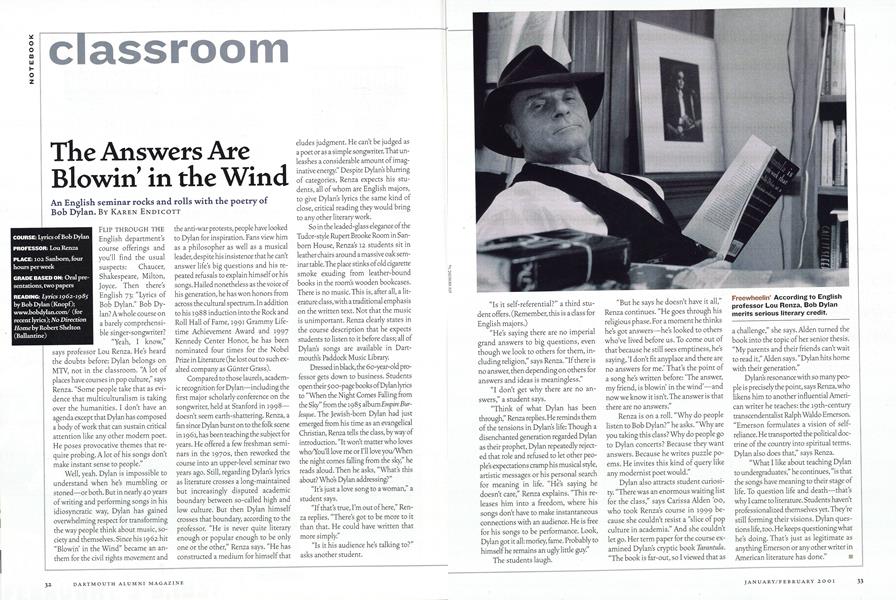
Dressed in black, the 60-year-old professor gets down to business. Students open their 500-page books of Dylan lyrics to "When the Night Comes Falling from the Sky" from the 1985 album Empire Burlesque. The Jewish-born Dylan had just emerged from his time as an evangelical Christian, Renza tells the class, by way of introduction. "It won't matter who loves who/You'll love me or I'll love you/When the night comes falling from the sky," he reads aloud. Then he asks, "What's this about? Who's Dylan addressing?"
"It's just a love song to a woman," a student says.
"If that's true, I'm out of here," Renza replies. "There's got to be more to it than that. He could have written that more simply."
"Is it his audience he's talking to?" asks another student.
"Is it self-referential?" a third student offers. (Remember, this is a class for English majors.)
"He's saying there are no imperial grand answers to big questions, even though we look to others for them, including religion," says Renza. "If there is no answer, then depending on others for answers and ideas is meaningless."
"I don't get why there are no answers," a student says.
"Think of what Dylan has been through," Renza replies. He reminds them of the tensions in Dylans life: Though a disenchanted generation regarded Dylan as their prophet, Dylan repeatedly rejected that role and refused to let other people's expectations cramp his musical style, artistic messages or his personal search for meaning in life. "He's saying he doesn't care," Renza explains. "This releases him into a freedom, where his songs don't have to make instantaneous connections with an audience. He is free for his songs to be performance. Look, Dylan got it all: money, fame. Probably to himself he remains an ugly little guy."
The students laugh.
"But he says he doesn't have it all," Renza continues. "He goes through his religious phase. For a moment he thinks he's got answers—he's looked to others who've lived before us. To come out of that because he still sees emptiness, he's saying, 'I don't fit anyplace and there are no answers for me.' That's the point of a song he's written before: 'The answer, my friend, is blowin' in the wind'—and now we know it isn't. The answer is that there are no answers."
Renza is on a roll. "Why do people listen to Bob Dylan?" he asks. "Why are you taking this class? Why do people go to Dylan concerts? Because they want answers. Because he writes puzzle poems. He invites this kind of query like any modernist poet would."
Dylan also attracts student curiosity. "There was an enormous waiting list for the class," says Carissa Alden '00, who took Renza's course in 1999 because she couldn't resist a "slice of pop culture in academia." And she couldn't let go. Her term paper for the course examined Dylans cryptic book Tarantula. "The book is far-out, so I viewed that as a challenge," she says. Alden turned the book into the topic of her senior thesis. "My parents and their friends can't wait to read it," Alden says. "Dylan hits home with their generation."
Dylans resonance with so many people is precisely the point, says Renza, who likens him to another influential American writer he teaches: the 19th-century transcendentalist Ralph Waldo Emerson. "Emerson formulates a vision of self- reliance. He transported the political doctrine of the country into spiritual terms. Dylan also does that," says Renza.
"What I like about teaching Dylan to undergraduates," he continues, "is that the songs have meaning to their stage of life. To question life and death—that's why I came to literature. Students haven't professionalized themselves yet. They're still forming their visions. Dylan questions life, too. He keeps questioning what he's doing. That's just as legitimate as anything Emerson or any other writer in American literature has done."
Freewheelin' According to Englishprofessor Lou Renza, Bob Dylanmerits serious literary credit.
COURSE: Lyrics of Bob Dylan PROFESSOR: Lou Renza PLACE: 102 Sanborn, four hours per week GRADE BASED ON: Oral pre- sentations, two papers READING: Lyrics 1962-1985 by Bob Dylan (Knopf); www.bobdylan.com/ (for recent lyrics); No DirectionHome by Robert Shelton (Ballantine)
Karen Endicott
Classroom
-
 CLASSROOM
Optimus Maximus
May/June 2008 -
 CLASSROOM
The Risk of Regulation
July/August 2012 -
 CLASSROOM
When Rights Encourage Wrongs
SEPTEMBER | OCTOBER 2014 -
 CLASSROOM
Code of Life, Codes of Conduct
Sept/Oct 2000 -
 Classroom
The Art and Science of Group Dynamics
Nov/Dec 2002 -
 CLASSROOM
Inspired by Salvador
JULY | AUGUST 2015

