Mountain Men
Sixty years ago the U.S. Army activated it’s famed 10th Mountain Division, and Dartmouth outdoorsman eagerly signed up.
Sixty years ago the U.S. Army activated it’s famed 10th Mountain Division, and Dartmouth outdoorsman eagerly signed up.
SIXTY YEARS AGO THE U.S. ARMY ACTIVATED ITS FAMED 10TH MOUNTAIN DIVISION, AND DARTMOUTH OUTDOORSMEN EAGERLY SIGNED UP. THEIR MISSION: TO DRIVE GERMAN SOLDIERS OUT OF THE RUGGED PEAKS OF THE ITALIAN APENNINES.
The first week of December 1941, just months after graduation and on the eve of Pearl Harbor, Charles McLane '41 arrived at Fort Lewis, Washington, to report for duty. Wearing his "D" sweater, carrying skis and eager to train on nearby Mount Rainier, the former Dartmouth ski team captain asked a sergeant where the mountain infantry was. "Son," came the reply, "you are the mountain infantry."
The U.S. Army was just beginning to produce a new kind of soldier, one who could ski, climb and fight in the harshest of wintry, mountainous conditions. Two years earlier, Finnish soldiers on skis had demonstrated the might of alpine troops when they destroyed two invading Russian tank divisions. Germany, Italy and Austria also had well-trained mountain troops. The U.S. Army needed to catch up.
The fledgling mountain troops welcomed Dartmouth men and their winter expertise. At a time when skiing was relatively new in America, Dartmouth stood out for the ski competitions it had been holding since 1910. And Dartmouth men had written the book on skiing: Modern Ski Technique, penned by College ski coach and former German mountain trooper Otto Schniebs and John McCrillis '19, had become the beginners' bible on the sport.
McLane did not have to wait long for other Dartmouth men to arrive at Fort Lewis. The Colleges next ski coach, former Swiss champion Walter Prager, joined the mountain training group at Fort Lewis. Along with Lawrence Jump '36, Robert Niss '40 Jacob Nunnemacher '42 and Robert Meservey '43, Prager tested equipment, tried out alpine warfare tactics and instructed soldiers and officers alike in the "shtem" turn he and Schniebs had taught every Dartmouth skier. Eventually 119 Dartmouth men joined the new outfit. The white-clad ski troopers became a fast favorite for news- reels and magazines, and their camaraderie became instant legend. "It was like a college reunion, with very little distinction between officers and enlisted men," recalls Pvt. Joseph F. Shaw '39.
Within two years, 8,600 men—from ranch hands to carpenters and lumberjacks—swelled the ranks of the 87th, 86th and 85th mountain infantry regiments. In 1943 the three regiments were united into the 10th Mountain Division. Camp Hale, Colorado, in the heart of the Rockies, became its new training ground.
In February 1945, the division, commanded by the aggressive Maj. Gen. George P. Hays, was deployed to the stalled front in Italy's Apennine Mountains, some 40 miles northwest of Florence. Its first assignment was to capture Mount Belvedere, from which the Germans controlled a key highway running north from Florence. The Fifth U.S. Army had tried to take Belvedere three times but had been repelled by German artillery fire that was controlled from observation posts along the snow-covered peaks of nearby Riva Ridge. Two things were clear: Before the 10th could take Belvedere, the men would have to knock the Germans off Riva Ridge. And because the Germans could watch their every move, they would have to capture the 2,300-foot-high ridge at night.
Under cover of darkness on February 17, troops from the 10th entered the valley below Riva Ridge and hid in abandoned buildings. The next night they climbed the nearly vertical, frigid slopes. "The cliffs didn't hold snow—they held ice," recalls Percy Ride out '40, who led one of five companies in the assault. Though their daring caught the Germans off-guard—"We didn't believe your men could climb anything that awkward," a German officer later admitted—the enemy unleashed seven counterattacks before surrendering the ridge.
Now poised to assault the heavily mined Mount Belvedere, the 10th again waited until nightfall to begin climbing the 3,876- foot massif. Again their daring surprised the Germans, who counter- attacked repeatedly as the 10th pushed along the ridge line for several miles. The battle lasted three days. The 10th finally triumphed, but not without a heavy price: More than 500 soldiers were wounded; 203 soldiers lay dead.
One of the wounded, company commander C. Page Smith '40, later wrote about being carried down the mountain on a stretcher as more troops headed up. "The expressions on the faces of the men in the platoon were a strange mixture of regret and envy: sorry that I was wounded but envious of me for being still alive and out of it all while they had to continue to face death," he recalled. Survivor guilt haunted him for years. "Then one night I dreamed that the men of C Company who had died in subsequent fighting gathered around me and assured me that they understood; they forgave me. I began to weep, and I awoke weeping. I was cured of my guilt."
As costly as Belvedere had been, the worst lay ahead for the loth. The division was assigned to breakout of the mountains and into the Po Valley so the Fifth Army could advance northward. The assault against the Germans along a line of steep slopes began April 14, 1945. The battle "made Belvedere look like kindergarten," Staff Sgt. Murray Mondschein '44 later wrote to a friend. "The fellows died everywhere, beneath the blooming apple blossom trees, along the ridges, the peaks, in their foxholes, on the trails." By the end of the first day, 553 members of the 10th were already dead, wounded or missing.
Platoon Sgt. Kenneth MacDonald '39 was among the wounded. "I don't know what hit us, perhaps a grenade," MacDonald later wrote in a memoir. "I couldn't hold my rifle because my left arm wouldn't work." He managed to crawl to the safety of a shell hole, then lay there for hours. When the gunshots stopped, he ran downhill through the minefield toward the battalion aid station. On his way, he saw Pfc. H. Newcomb Eldredge '50, who had been wounded in the legs and temporarily blinded by a mortar shell. MacDonald helped him up. Relying on MacDonald s eyes and legs and Eldredge's arms, the two guided each other to safety.
After seven days of fighting, the loth finally broke the German mountain defenses. Under heavy fire, the 10th crossed the Po and gained control of the river valley all the way to Lake Garda in the Alps. The mountain troopers had cut off the Germans' escape route and cleared the way for the Fifth Army to advance northward.
With victory in sight, the final days of the war were exhilarating. "Practically everybody in the battalion was riding around in German staff cars or motorcyles," Mondschein wrote to his friend. One unit captured a German warehouse full of French champagne. On the banks of Lake Garda the 10th savored the wine of victory. "It was wonderful," recalls Capt. Walker Weed '40.
The Germans surrendered in Italy May 2. In 114 days of combat, 992 members of the 10th—including six from Dartmouth— had lost their lives. Another 4,154 had been wounded. Despite the heavy price, the 10th Mountain Division's tight-knit members gained a lasting reputation for daring, accomplishment and mastery over the harshest of elements. They weren't just the Army. They were mountain men.
The 119 Dartmouth men who fought in the 10th Mountain Division came from 23 classes. Six men were killed in action (KIA). 1922 John B. Vadney 1923 Henry J. Perkins 1927 Morton H. Cavis 1928 Henry A. Buchtel 1929 Laurence W. Lougee 1930 Robert E. Hooker 1931 Robert W. St. Louis (KIA) 1933 Richard A. Rocker, William J. Starr 1935 Edward C. Dyer, William B. Eisendrath 1936 Laurence A. Jump, Frank K. Kappler, Dexter Martin, Frederick T. Trempe 1937 Willis L. Bennett, Walter R, Hard, H. Franklin Irwin Jr., Robert W. Knapp, Dana S. Prescott 1938 Alexander T. Behr, James A. Carpenter, James E. Cooney, Grover H. Fox, Alexander Jones Jr., Roland H. Moody, John A. Rand 1939 Arnold W. Alexander, James Anderson III, Keith Anderson, George B. Boswell, Joseph S. Hoover, Richard S. Johnson, John P. Litchfield, Kenneth A. MacDonald, Charles R. Obermeyer, Andrew C. Ruoff III, Joseph F. Shaw, Richard L, White 1940 John H. Case, Joseph J. Duncan (KIA), Roger W. Herrick (KIA), Allen C. Hessler, Wetherbee Lamson, Robert C. Niss, Harry S. Raymond, Percy A. Rideout, Edward Schechter, C. Page Smith, John B. Turner, Walker T. Weed II1941 Karl C. Blume, Charles H. Carson, W. Mabry Cornwall, Robert W. Dickson, Everett H. Lord-Wood, Charles B. McLane, John J. O'Connor, William S. Spinney, Clifton J. Stratton 1942 Bert W. Anger, O. James Barr III, Harold L. Bond, Robert L. Headley Jr., John Montagne, Jacob R. Nunnemacher (KIA), David L. Sills, Leonard H. Woods 1943 Robert R, Krumm, Robert H. Meservey, Robert H. Perkins, Eugene Roitman, Frank P. Sherwood, Charles J. Webb II 1944 Joel S. Coffin (KIA), Leonard P. Landry, Murray Mondschein, Richard Morse, Philip F. Puchner, John H. Stephenson Jr., Wynn T. Underwood 1945 Robert L. Allen, George F. Barr, Stuart A. Chalfant, Frederick J. Chamberlin, Donald de Jongh Cutter, Elbridge G. Davis, George M. French Jr., John G. Jennings, Arvis A. Johnson Jr., Andrew J. Marks, John R. Watkins 1946 Raymond W. Arlt, Joseph R. Brennan, William B. Broughton, Martin Brusse, Stanley B. Chisholm, John W. Dewey, Roger D. Emerson (KIA), Martin P. Hamilton, Raymond M. Hellmann, Richard A. Howe, Kimball M. Jones, Henry G. Lumbard Jr., Peter S. Mallett, James H. Roberts, William H. Spoor, Sanford M. Treat Jr., Donald B. Wales 1947 Jay S. Larmon 1949 William H. Boardman III, Edward A. Nickerson, Gerald E. Sedgewick 1950 Charles W. Carpenter, H. Newcomb Eldredge, Leon A. Kuhn, Robert H. Woody; Ski Coach Walter Prager
This is the most complete list of Dartmouth men in the10th Mountain Division that exists to date. Pleasenotify us of any additions so they may be added toCollege records.
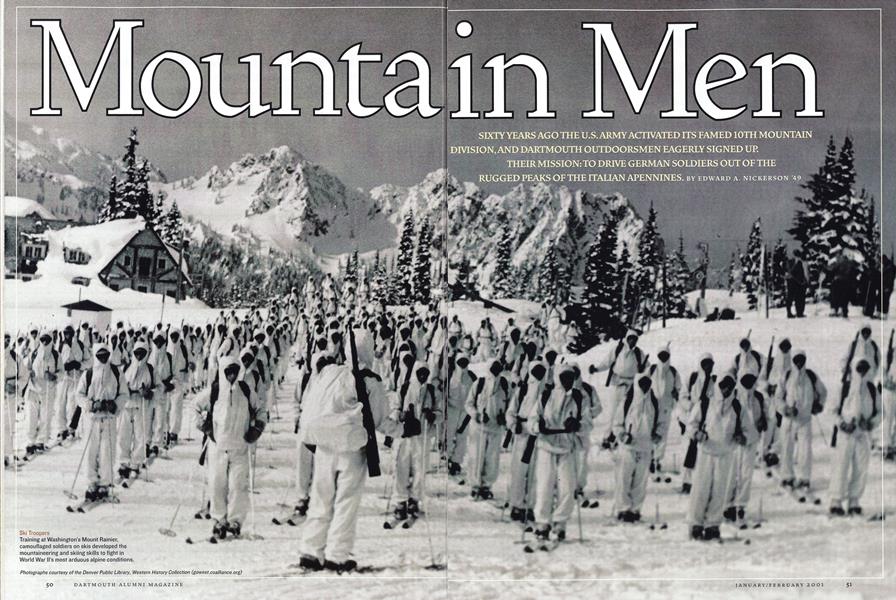
Ski Troopers Training at Washington's Mount Rainier, camouflaged soldiers on skis developed the mountaineering and skiing skills to fight in World War ll's most arduous alpine conditions.
Heights of Preparedness (clockwise from upper right): Amateur photographer Richard Rocker '33 captured his three years with the 10th on film; a Rocker photograph of Staff Sgt. Joel S. Coffin '44 training at Camp Hale, Colorado (Coffin died in battle in 1945); former Dartmouth ski coach Walter Prager, here on Mount Rainier, trained soldiers in rock climbing and skiing; skis, rifle and rucksack were standard issue for mountain soldiers. Top left; Skiing from Leadville to Aspen, Colorado, hardened the 10th to extremes of climate and altitude.
the training ground
the battlefield
Italy's Battlegrounds (counter-clockwise from upper left): The 10th passes through the bullet-ridden village of Corona, Italy, during its 1945 assault on Mount Belvedere; casualties mounted during the battle for Belvedere; upon breaking out of the mountains, the 10th faced harsh resistance in the Po Valley; Walter Prager writes a letter home during a quiet moment in Passatore, Italy, in April 1945, This page: At war's end the troops returned home and helped launch America's ski industry.
roll call
EDWARD A. NICKERSON served inthe 10th Mountain Division from 1943 to1945. He earned a Silver Star for gallantry in action on April 15, and aPurple Heart for a wound sustained thatday. A former English professor at theUniversity of Delaware, Nickerson livesin Lakeville, Connecticut.
More From This Issue
-
 Cover Story
Koop
January | February 2001 -
 Feature
Geek Chic
January | February 2001 -
 Feature
Funny Girl, Badly Drawn
January | February 2001 -
 PERSONAL HISTORY
Animal House
January | February 2001 -
 Article
Newsmakers
January | February 2001 -
 CLASSROOM
The Answers Are Blowin’ in the Wind
January | February 2001