Critical Faculties
The Hood Museum kicks off its 20th anniversary year with an exhibition of artwork and objects chosen by professors who utilize them in their teaching.
The Hood Museum kicks off its 20th anniversary year with an exhibition of artwork and objects chosen by professors who utilize them in their teaching.
Clearly the museum filled a void at Dartmouth, and in northern New England. By year's end more than 116,000 people had toured Charles W. Moore and J.P. Chadwick Floyd's award-winning building. In the past 20 years more than 800,000 visitors have taken in some of the museums 392 exhibitions and viewed some of its 60,000 works of art, which include a renowned set of Assyrian reliefs from the Northwest Palace of Ashurnasirpal II at Nimrud (883-859 B.C.). While art aficionados have benefited greatly from the Hood, the museum has been an even more valuable resource for students, largely because its dedicated staff embraces the Hoods mission as a teaching museum. Dartmouth undergraduates have the opportunity to not only study great art and artifacts in the museums galleries, but also to reserve pieces for more in-depth examination in the Bernstein Study Storage Center. Additionally, they may work as Hood tour guides and interns. Students also curate exhibits for A Space for Dialogue, a gallery at the museums entrance.
To celebrate the museums 20th anniversary, faculty members from the departments of anthropology, art history, studio art and classics have curated "Critical Faculties." The exhibition demonstrates how each discipline utilizes artwork and objects from the Hood's collection in its teaching.
"Students really value being able to actually look at something when you explain to them how it was used or how it was made," says Deborah Nichols, the William J. Bryant 1925 Professor of Anthropology. "When I talk about trade in ancient North America, to then be able to show students examples of the kinds of objects that might have been traded over hundreds of miles—that's invaluable."
Here is a preview of the exhibition, which runs from January 15 through March 15, with insights from the faculty members who selected the artwork.
Art History
PROFESSOR ANGELA ROSENTHAL
"In order to celebrate the rich collection of the Hood we thought it would be really wonderful to display a lot of work that is fascinating to us individually," says Rosenthal of the art history display.
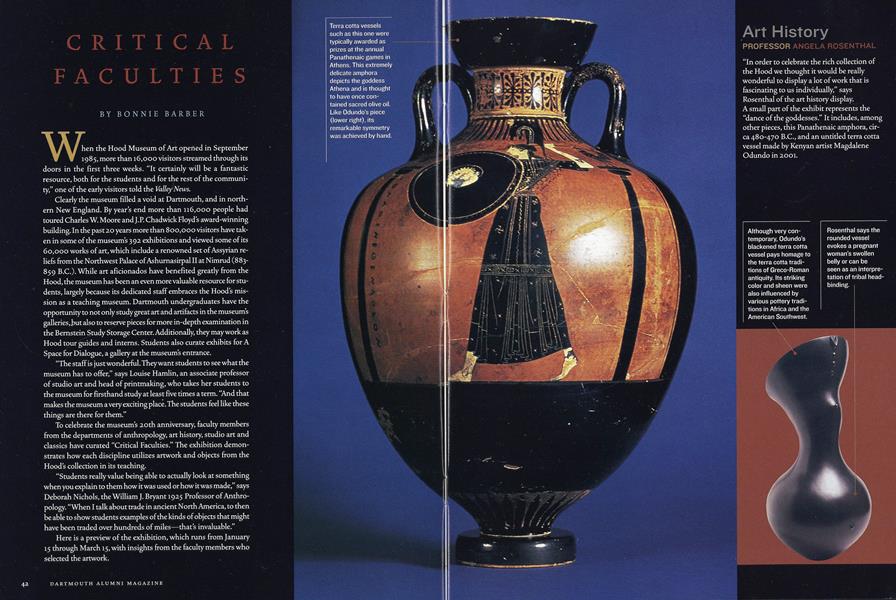
A small part of the exhibit represents the "dance of the goddesses." It includes, among other pieces, this Panathenaic amphora, circa 480-470 B.C., and an untitled terra cotta vessel made by Kenyan artist Magdalene Odundo in 2001.
Classics
PROFESSOR JEREMY RUTTER
This installation features Roman coins from the Hood collection, which "serve very well as teaching vehicles for our students in Roman history and Greek and Roman archaeology," says department chair Rutter. The installation also includes the spectacular, early-4th-century Roman Head of a Man, which possibly portrays Diocletian. (The piece is on loan from the Worcester Art Museum.) The sculpture is displayed alongside coins, some of which depict the Roman ruler, allowing students and visitors the opportunity to compare how portraiture was used in antiquity.
Studio Art
PROFESSOR LOUISE HAMLIN
The studio art installation features several pieces of student art alongside works by masters such as Rembrandt and Eicasso.
"I wanted to show that studying great works at the Hood helps inspire students," says Hamlin. Funeral, a line etching on zinc by Natalie Kiryankova '99, was greatly influenced by Marc Chagall's Sacrifice ofAbraham, an etching on copper. The two artists also share Russian ancestry; Chagall's native village of Vitebsk was an enduring source of imagery, as are Kiryankova's early childhood days in Kishinev, the capital of Moldova. Funeral recalls Kiryankova's grandmother's neighborhood, where services were often held for local war veterans.
Terra cotta vessels such as this one were typically awarded as prizes at the annual Panathenaic games in Athens. This extremely delicate amphora depicts the goddess Athena and is thought to have once con- tained sacred olive oil. Like Odundo's piece (lower right), its remarkable symmetry was achieved by hand.
Although very contemporary, Odundo's blackened terra cotta vessel pays homage to the terra cotta traditions of Greco-Roman antiquity. Its striking color and sheen were also influenced by various pottery traditions in Africa and the American Southwest.
Rosenthal says the rounded vessel evokes a pregnant woman's swollen belly or can be seen as an interpretation of tribal headbinding.
Carved in basalt, a very hard stone, this sculpture is thought to represent Diocletian, one of four rulers during the reign of the Tetrarchs (284-312 A.D.). The large, expressive eyes, knit brow and stern expression are all characteristic of an emperor's visage.
Minted during the social wars between Rome and the Italic communities from 91-88 B.C.E. (Before the Common Era), this is a silver denarius of moneyer Lucius Titurius Sabinus of 89 B.C.E. It features one of the first portraits of a historical figure to appear on a Roman coin, Sabine king Titus Tatius.
Associate professor of classics Roberta Stewart explains that the portrait of the legendary Sabine king, along with the reverse image de- picting the rape of the Sabine women (a Roman historical myth), illustrates the sense of humor of the moneyer Sabinus, who paid tribute to himself by using "Sabine" images.
"Kiryankova's spirited cyclist contrasts markedly with the naked, helpless vulnerability of Chagall's Isaac," says Hamlin, "but her other shadowy fig- ures hint at the more somber event taking place. In both prints, important things are happening to ordi- nary-looking people." Both artists, she adds, "combine memory and imagination to powerfully expressive effect."
Chagall's Sacrifice ofAbraham displays a "unique distribution of blacks and grays that give the print almost colorful tonality," says Hamlin. The professor encourages her students to study artwork with a magnifying glass to "appreciate intricacies of touch." The method allowed Kiryankova to better understand how Chagall created this vibrant composition of lights and darks. "She could see the many ways his lines scattered across the plate and his layering of marks to create atmospheric textures," says Hamlin.