CLASS OF 1877
The fortieth anniversary of graduation is an important milestone in the career of a college class, and we had expected to celebrate this anniversary by the greatest gathering in our history. Dis aliter visum. Only eighteen — not half of those who six months before expressed their purpose to be present - appeared at Hanover. The enforced economy which attends a state of war kept many at home, for there are few "malefactors of great wealth" among our number.
We had, however, a most enjoyable coming together, and were perhaps drawn more closely to one another because we were few. While we have all passed the years of military service, the war was brought vividly before us by our glimpse at the class banquet of Sewall's son, who had a brief leave of absence from Plattsburg to receive his diploma from the College, and by Temple's inability to remain more than a few hours with us owing to his son's sailing for France for ambulance service.
The formal meetings were two: a luncheon Tuesday at the Newton Inn, Norwich, in which such members of our families as were present participated; and the banquet for the class alone in the evening at College Hall, where Moore served as toastmaster and all took part in the speaking.
The following are the eighteen who were present. The farthest to come were the three from Minnesota: Henry L. Moore of Minneapolis, who has won large success in business, and whose splendid gift to the College, of which he is a trustee, is reported elsewhere in the MAGAZINE; Rev. William L. Sutherland, whose service in various lines of Christian activity have made him beloved through several states of the Middle West; and John W. Willis, counselor, advocate, judge, patriotic speaker, who has retained and increased his love for the classical studies of his youth. New York city was represented by Philip Carpenter, who has maintained for many years a high rank at the metropolitan bar ; John J. Hopper, who has entered political life after a successful career as engineer and contractor, and as register of the county of New York is giving the best and most business-like administration of the office that has been known; William G. Davis of the New York bar, and Fred W. Farnsworth, in successful business life. The sole representative from Connecticut was Alfred H. Campbell, still as for many years an active educator, whose labors have been untiring and fruitful. Boston sent us Dr. William F. Temple, one of the best known general practitioners of medicine in the city, and Justin H. Smith, formerly a publisher, later professor of modern history at Dartmouth and now engaged in historical research and authorship. From Massachusetts also came Albert H. Morton of Lowell, for many years at the head of a great machine shop, and now reaping the fruit of his many inventions in textile machinery. Dr. Samuel B. Thombs of Portland, Me., substantial in person and professional standing, represented the Pine Tree State. From New Hampshire were Prof. Charles D. Adams of Dartmouth, who needs no introduction to readers of the MAGAZINE, Ira A. Chase and George I. McAllister, lawyers of repute, and Ray T. Gile, civil engineer of long and successful practice. Vermont contributed Rev. John L. Sewall, now living in impaired health in St. Albans, but recently a pastor in Worcester, Mass., a man of great industry and versatility, and John M. Comstock, whose claim to distinction lies in his secretaryship of the class during the forty years. Of these, Campbell and Comstock have attended each reunion the class has held.
It was decided to meet again in 1919, at the 150th anniversary of the College.
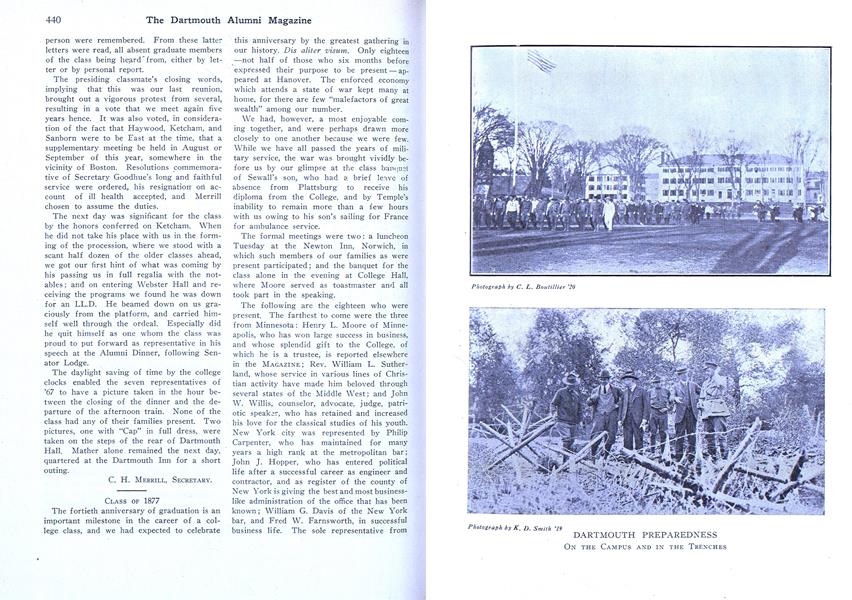
DARTMOUTH PREPAREDNESS ON THE CAMPUS AND IN THE TRENCHES
More From This Issue
-
 Article
VOLUNTEERS IN A CONSCRIPT ARMY
August 1917 -
 Article
GIFTS TO THE COLLEGE DURING THE PAST YEAR
August 1917 -
 Article
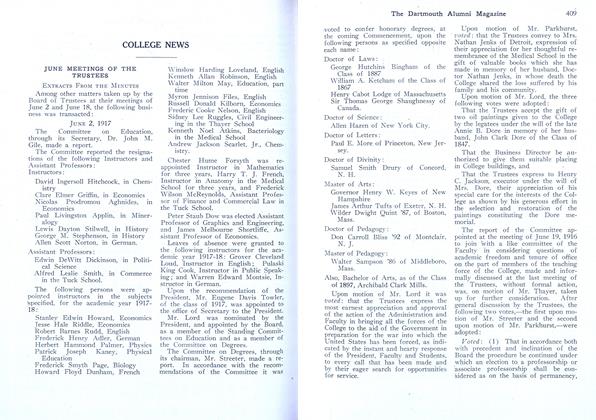
JUNE MEETINGS OF THE TRUSTEES
August 1917 -
 Article
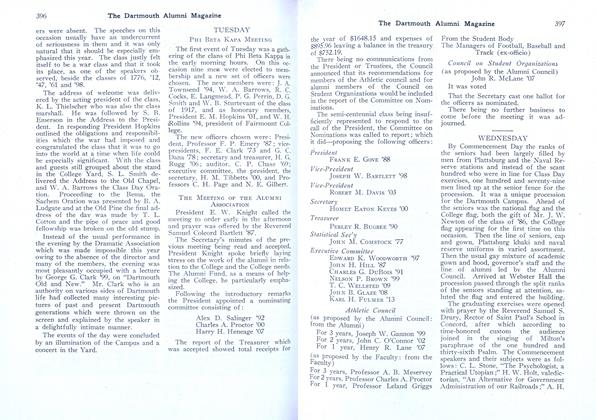
WEDNESDAY
August 1917 -
 Article
Few college presidents have been called upon within a first administrative
August 1917 -
 Article
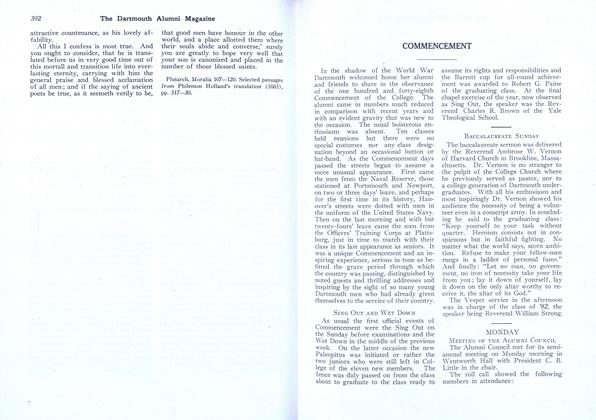
MONDAY
August 1917