The eve of a celebration is a poor time for editorializing;
but the exigencies of producing the MAGAZINE on or about November first necessitate the marshaling of appropriate thoughts before October fifteenth—two days in advance of the appointed shoutings of Dartmouth Night. To date there has been no sound reason for grief that the ceremonial was not set earlier. For the rest, advance comment would better be suppressed.
The one hundred and fiftieth anniversary of Dartmouth's chartering comes at an interesting,—a crucial,—period in the history of higher education in America, Upon its historic past the College may look back with unveiled pride and satisfaction. A century and a half of useful work has been accomplished. A monument may fittingly be erected to that fact and to the accompanying circumstance that the close of this period finds the institution free of floating debt and with other financial obligations negligible in amount.
It had been surmised that the first fall enrollment following the war would bring the student body to within three quarters of normal: and that another year would find the College back to complete numbers. It was realized that rising costs had cut the purchasing value of the income from endowment virtually in two; but it was hoped that an increase in tuition charges, the application of funds received from Mr. Tuck, the Sage bequest, and the timely aid of the Alumni Fund would come close to meeting the deficit.
The College plant was looked upon as adequate at most points. Chemistry was in straits for a new building; a library was recognized as a crying necessity. Otherwise, while these were needy enough, they constituted no crisis.
Then came the human deluge. Instead of 1200 men expected, or 1500—the previous maximum—l700 students poured into Hanover. They filled all the dormitories; they occupied every available inch of space in the private residences of the community. Some 650 of them are freshmen. If the present flow continues in three years the "small College, gentlemen", will have attained numbers in excess of 2000. That means that not only are the chemical laboratory and the library inadequate, but that the entire existing plant is on the way of becoming, almost immediately, quite insufficient.
Nor can sufficiency be obtained by such half measures as adding protuberances, here and there, to present buildings ; it is procurable only through a process of carefully planned and completely financed duplication. The magnitude of the money problem involved is one not easily realizable to one who considers the growth of the College provided for when dormitories are erected. Besides dormitories there must be recitation halls and laboratories; and, if these are to be utilized, there must be dwellings for instructors, and for the operating forces and their families. As things are now, these dwellings cannot be provided in terms of an investment profitable to anybody. They must be reckoned as part of plant or figured as disguised salary.
Who is sufficiently convinced of Dartmouth's duty to grow to assume genuine responsibility for securing adequate means to the end? Who, on the other hand can offer a satisfactory plan for keeping numbers at a predetermined limit? One way or the other, however, decision must be reached ere long; and clear lines of policy drawn.
At the present writing the football season is noisy but uncertain. The pre-war fervor of the undergraduate seems to have returned quite undiminished. From the grand-stand, as of yore, come valorous bellowings at critical moments when the hard pressed home team staggers back toward its own goal line. The bitterness of defeat, or even an unexpected score, is as the bitterness of an empire destroyed.
The players on many a this year's gridiron were busy, a twelvemonth since, in killing Germany so as to make the world safe for democracy. When the final contests come will they play more or less fiercely because of their experience on the wild fields of war? Will the fighting surge that carried them through the barriers of the Hindenburg defense drive them with equal resistlessness through their opponents' line? Or, in the high moment of suspense, will a sickening sense of the littleness and futility of the whole affair overwhelm them? Indications are that it will not.
More From This Issue
-
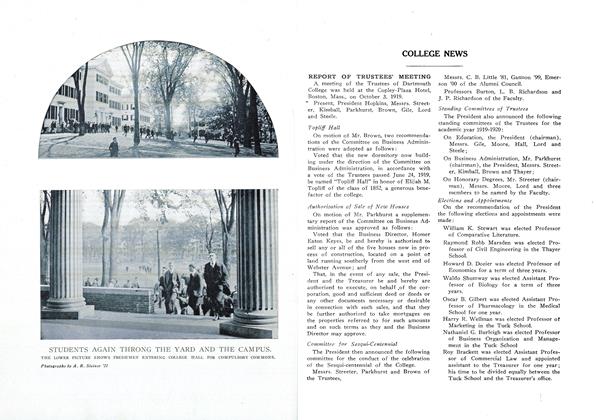 Article
REPORT OF TRUSTEES' MEETING
October 1919 -
 Article
ADDRESS OF PRESIDENT HOPKINS AT THE OPENING OF DARTMOUTH COLLEGE SEPTEMBER 25, 1919
October 1919 -
 Article
SALMON P. CHASE, UNDERGRADUATE AND PEDAGOGUE
October 1919 -
 Article
S. A. T. C. CONTRACTS AND THE COLLEGES
October 1919 -
 Article
BIG INCREASE IN THE FACULTY
October 1919 -
 Class Notes
NEW ENGLAND STATES
October 1919