Class of 1902
Thirty Years Out
It would be fairly easy to guess the general attitude of the class of 1902 at Commencement thirty years ago toward such men as "Bobby" Bartlett, "Dude" Colby, Charles R. Miller, Judge Pike, and "Tute" Worthen, not to mention many others. But if the class of 1872 made small impression on us at that time, it is safe to say that the tables were more than turned by the general situation in 1932. The class of 1902 paid little attention to the central figures of the stage, and apparently, with a few notable exceptions, itself received no notice in the crowd.
If '72 made important contributions to the faculty, so indeed has 1902, but it is difficult for us to rank Art, Leland, Bill, and Watty with the lights that shone for us. However, we could take pride in the able way in which Ducky Drake carried out the duties of the president of the Alumni Association, and in the effective share of Doctor Art Ruggles in the deliberations of the Alumni Council. We were particularly delighted that Jack Griffin arranged matters so as to have his elder son graduate on the occasion of our Thirtieth. But on the whole we were quite self-sufficient.
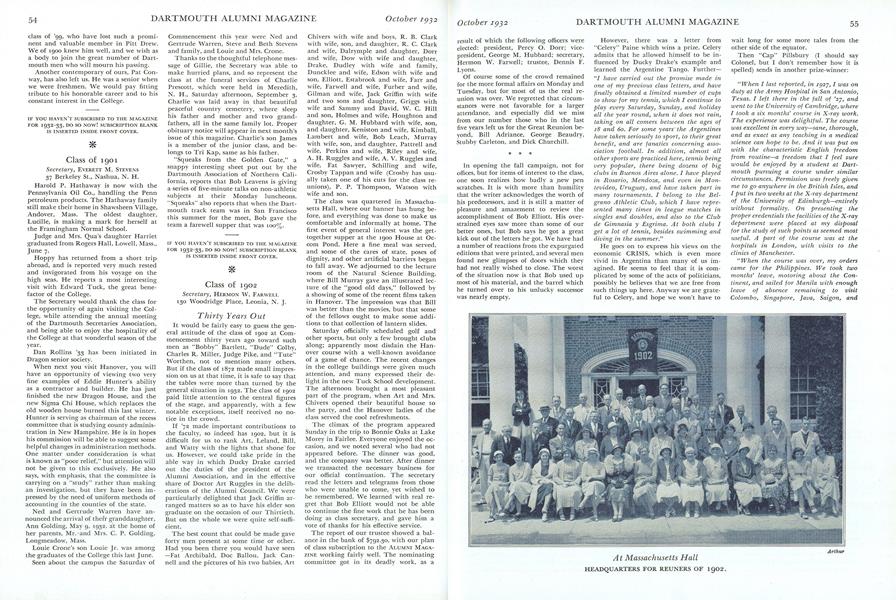
The best count that could be made gave forty men present at some time or other. Had you been there you would have seen —Fat Archibald, Doc Ballou, Jack Canned and the pictures of his two babies, Art Chivers with wife and boys, R. B. Clark with wife, son, and daughter, R. C. Clark and wife, Dalrymple and daughter, Dorr and wife, Dow with wife and daughter, Drake, Dudley with wife and family, Duncklee and wife, Edson with wife and son, Elliott, Estabrook and wife, Farr and wife, Farwell and wife, Furber and wife, Gilman and wife, Jack Griffin with wife and two sons and daughter, Griggs with wife and Sammy and David, W. C. Hill and son, Holmes and wife, Houghton and daughter, G. M. Hubbard with wife, son, and daughter, Keniston and wife, Kimball, Lambert and wife, Bob Leach, Murray with wife, son, and daughter, Pattrell and wife, Perkins and wife, Riley and wife, A. H. Ruggles and wife, A. V. Ruggles and wife, Fat Sawyer, Schilling and wife, Crosby Tappan and wife (Crosby has usually taken one of his cuts for the class reunions), P. P. Thompson, Watson with wife and son.
The class was quartered in Massachusetts Hall, where our banner has hung before, and everything was done to make us comfortable and informally at home. The first event of general interest was the gettogether supper at the 1900 House at Occom Pond. Here a fine meal was served, and some of the cares of state, poses of dignity, and other artificial barriers began to fall away. We adjourned to the lecture room of the Natural Science Building, where Bill Murray gave an illustrated lecture of the "good old days," followed by a showing of some of the recent films taken in Hanover. The impression was that Bill was better than the movies, but that some of the fellows ought to make some additions to that collection of lantern slides.
Saturday officially scheduled golf and other sports, but only a few brought clubs along; apparently most disdain the Hanover course with a well-known avoidance of a game of chance. The recent changes in the college buildings were given much attention, and many expressed their delight in the new Tuck School development. The afternoon brought a most pleasant part of the program, when Art and Mrs. Chivers opened their beautiful house to the party, and the Hanover ladies of the class served the cool refreshments.
The climax of the program appeared Sunday in the trip to Bonnie Oaks at Lake Morey in Fairlee. Everyone enjoyed the occasion, and we noted several who had not appeared before. The dinner was good, and the company was better. After dinner we transacted the necessary business for our official continuation. The secretary read the letters and telegrams from those who were unable to come, yet wished to be remembered. We learned with real regret that Bob Elliott would not be able to continue the fine work that he has been doing as class secretary, and gave him a vote of thanks for his effective service.
The report of our trustee showed a balance -in the bank of $792.30, with our plan of class subscription to the ALUMNI MAGAZINE working fairly well. The nominating committee got in its deadly work, as a result of which the following officers were elected: president, Percy O. Dorr; vice-president, George M. Hubbard; secretary, Hermon W. Farwell; trustee, Dennis F. Lyons.
Of course some of the crowd remained for the more formal affairs on Monday and Tuesday, but for most of us the real reunion was over. We regretted that circumstances were not favorable for a larger attendance, and especially did we miss from our number those who in the last five years left us for the Great Reunion beyond, Bill Adriance, George Beaudry, Stubby Carleton, and Dick Churchill.
In opening the fall campaign, not for offices, but for items of interest to the class, one soon realizes how badly a new pen scratches. It is with more than humility that the writer acknowledges the worth of his predecessors, and it is still a matter of pleasure and amazement to review the accomplishment of Bob Elliott. His overstrained eyes saw more than some of our better ones, but Bob says he got a great kick out of the letters he got. We have had a number of reactions from the expurgated editions that were printed, and several men found new glimpses of doors which they had not really wished to close. The worst of the situation now is that Bob used up most of his material, and the barrel which he turned over to his unlucky successor was nearly empty.
However, there was a letter from "Celery" Paine which wins a prize. Celery admits that he allowed himself to be influenced by Ducky Drake's example and learned the Argentine Tango. Further— "I have carried out the promise made inone of my previous class letters, and havefinally obtained a limited number of cupsto show for my tennis, which I continue toplay every Saturday, Sunday, and holidayall the year round, when it does not rain,taking on all comers between the ages of18 and 60. For some years'the Argentineshave taken seriously to sport, to their greatbenefit, and are fanatics concerning association football. In addition, almost allother sports are practiced here, tennis beingvery popular, there being dozens of bigclubs in Buenos Aires alone. I have playedin Rosario, Mendoza, and even in Montevideo, Uruguay, and have taken part inmany tournaments. I belong to the Belgrano Athletic Club, which I have represented many times in league matches insingles and doubles, and also to the Clubde Gimnasia y Esgrima. At both clubs Iget a lot of tennis, besides swimming anddiving in the summer."
He goes on to express his views on the economic CRISIS, which is even more vivid in Argentina than many of us imagined. He seems to feel that it is complicated by some of the acts of politicians, possibly he believes that we are free from such things up here. Anyway we are grateful to Celery, and hope we won't have to wait long for some more tales from the other side of the equator.
Then "Cap" Pillsbury (I should say Colonel, but I don't remember how it is spelled) sends in another prize-winner:
"When I last reported, in 1927, I was onduty at the Army Hospital in San Antonio,Texas. I left there in the fall of '27, andwent to the University of Cambridge, whereI took a six months' course in X-ray work.The experience was delightful. The coursewas excellent in every way—sane, thorough,and as exact as any teaching in a medicalscience can hope to be. And it was put onwith the characteristic English freedomfrom routine—a freedom that I feel surewould be enjoyed by a student at Dartmouth pursuing a course under similarcircumstances. Permission was freely givenme to go anywhere in the British Isles, andI put in two weeks at the X-ray departmentof the University of Edinburgh—entirelywithout formality. On presenting theproper credentials the facilities of the X-raydepartment were placed at my disposalfor the study of such points as seemed mostuseful. A part of the course was at thehospitals in London, with visits to theclinics of Manchester.
"When the course was over, my orderscame for the Philippines. We took twomonths' leave, motoring about the Continent, and sailed for Manila with enoughleave of absence remaining to visitColombo, Singapore, Java, Saigon, andHong Kong. Our visit to Java included atwo weeks' motor trip all over the island,when we studied the Dutch methods ofgovernment, as well as the very interestingold monuments and has reliefs of the earlyBuddhists. Just in passing, it is remarkableto see a colonial government that maintainsforty million people on one small island,has never permitted them to suffer famine,and has ensured them happy, contentedlives in complete security.
"And then to the Philippines, where mystation was at Fort Stotsenburg, located onthe edge of the Zat7ibales range, near thegreat central plain of Luzon. The garrisonwas made up of Filipino scouts—Filipinomen, officered by Americans sent there ona two-years' detail from the regular armyin the United States. Both Mrs. Pillsburyand I were in the Philippines twenty yearsago, and were struck with the changes inliving conditions, and with the improvement in the Filipinos themselves. OnLuzon, long stretches of excellent motorroads replace the almost impassable dirttracks; many of the villages have ice plantsand electric lighting systems. Schools areeverywhere. The markets are comparativelyclean and contain a wide variety of vegetables in addition to the staple rice. Andthe American ideal of Philippines for theFilipino has been met. Outside of Manilathe white race has few representatives, andof these most are teachers. The little villages and larger towns govern themselves,and do it fairly well. The Filipinos themselves are more alert, and are beginningto wish for more than food for the day,body covering, and simple shelter. Ourefforts during the past thirty years havebeen highly successful.
"Incidentally, the Filipinos are notready for self-government. When will theybe? I am not one of the minor prophets.
"We made a trip to China and Japan in1929, and visited Tientsin, Peiping, andShanghai. Even if we had remained inChina ten years instead of one month, itis doubtful if we could have obtained aclear idea of what is going on in that furnace of human development.
"We returned to the United States in thefall of 1930, and spent five months in Washington, where I finished rewriting andediting the second edition of the UnitedStates Army X-ray Manual. And then forduty at the Letterman General Hospitalin San Francisco, one of the large armyhospitals, where I am continuing my laborsin the X-ray field. Since that time I havebeen elected second vice-president of theRadiological Society of America.
"I shall miss the 30th reunion in Hanover and regret it."
Cap, that's fine, and we are proud of you, but we wouldn't have you know it for the world. There is only one difficulty in printing that letter, we can't all write like that. However, I know that Cap is as much interested to find out about some of our small successes and trials as we are to learn of his greater ones.
Apparently only a few in the class knew that Dalrymple lost his wife last February. We were glad that Dal could look in at the reunion, if only for a short time.
Phil Griffin sends in a new address at 6706 So. Ashland Ave., Chicago. He is manufacturing shades and awnings, trying to make the world brighter by making it darker, I suppose.
Bob Leach was a delegate to the Republican National Convention, but Bob says he prefers work to politics. Agreed.
John Denny Elderkin, born July 11, 1932. George says they like his looks and think they will keep him. The busy archaeologist is just back from the diggings, and reports progress. He saw Julius Arthur at Beirut some time in June.
At Massachusetts Hall HEADQUARTERS FOR REUNERS OF 1902.
Secretary, 130 Woodridge Place, Leonia, N. J.