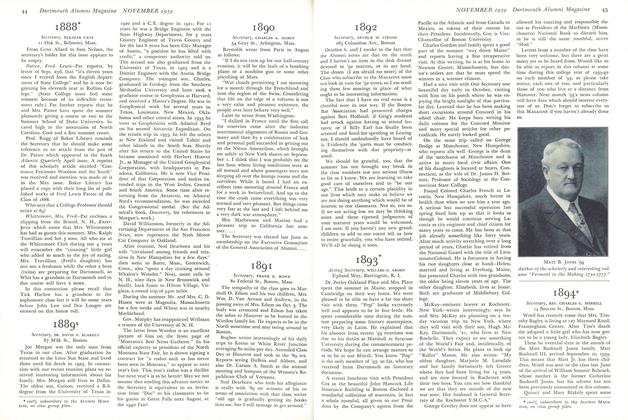
Class of 1894
The night before the Harvard game came the annual round-up by invitation of Matt Jones at his home, 30 Ledges Road, Newton Center, Mass. It was the old-time joyous reunion, which we have been given so often through Matt's unfailing and generous consideration. Those who have been there do not miss it if attendance is possible. Those who have never been should go when the next opportunity is given.
The happiest incident for us was to again meet Mrs. Jones and to note her recovery from a period of ill health.
The following were present: Adams, Ted Allen, John Allen, Ames, Curly Bartlett, Claggett, Gifford, Griffin, Hardy, Hurd, Jones, Knowlton, Lewis, Lyon, McGroty, Marden, Matthews, Parker, Ajax Rollins, Sawyer, Sherman, B. A. Smalley, F. L. Smalley, Spooner, A. W. Stone. Nunc Morris could not come, but a welcome substitute for the visible presence was provided by a telephone connection with Camden, Me. We all had a good chat with him, and look forward to the 1934 reunion in the hope that restored health will allow him to come.
Secretary Merrill has just returned from a trip across the country, and reports contacts with the trio of '94 men in San Francisco and Berkeley, Calif., and with Decker Field at Omaha.
An evening with Punch Rollins and his family brought out the fact that Punch is doing the daily job but not with the best of health. He is improving, however, and looks forward to retirement in a year or two. His three boys are all through college —at least, such was the Secretary's impression.
Jimmy Townsend's third son is studying law, which means that he will have at least two sons in the legal fraternity. The fourth boy will go to college shortly.
Ted Ruggles is helping to spend Uncle Sam's money on roads, in a way to relieve unemployment. Like so many other '94 women, Mrs. Ruggles is a great rooter for '94.
The Secretary reached Omaha at a time when Decker Field's picture came out in the paper as a member of the Waterways Commission of the Chamber of Commerce, which had been presiding over the beginning of a new era for transportation on the Missouri River. Decker has a small grandson, Frank Field Faris, who has already been registered for Dartmouth. His younger daughter says that the only fault her father finds with her is that she was not born a boy so she could go to Dartmouth. However, she could not be more loyal to the class or to the College or be more interested in the class publications if she were actually a graduate of the College. Decker wants it given out that any '94 man who goes through Omaha without seeing him will forfeit his membership in the class.
This poem was written by P. S. Marden for use on June 26, 1932.
THE LOST CHORD
Seated one day at the radio, I was weary with life and its trials, And my fingers fiddled idly, Twisting the different dials.
I know not what station was calling, But I heard the announcer say, "Dear old Nunc Norris '94 Is sixty years old today."
"Moreover," went on the announcer, "Today he's thirty years wed, I suggest your congratulations." He signed off and I went to bed. But the words had awakened an echo Of days of the long ago, When the radio wasn't dreamed of, And the pace of life was slow.
I was back in the Reed Hall bedroom, With Nunc as blithe as could be Crooning songs to his old guitar Of life on the little Pedee— And the Independent Cadets went march ing, Marching along Broadway— And the old folks would enjoy it, As they listened at close of day.
The strumming went on so gently I hoped it would never stop, Till he struck one chord of music Which he said was the barber shop. It flooded the crimson twilight Like a nigger-angel's psalm, And it soothed my soul to its inmost depths, As with Gilead's famous balm.
There is little consolation For aging cusses like us In saying those days can never come back, No virtue in making a fuss; But somehow it sort of warms the heart In the midst of these days that are, To think of the days as once they were And Nunc and his old guitar.
Secretary, 287 Fourth Ave., New York Editor, HENRY N. HURD, Clareraont, N. H