Class of 1899
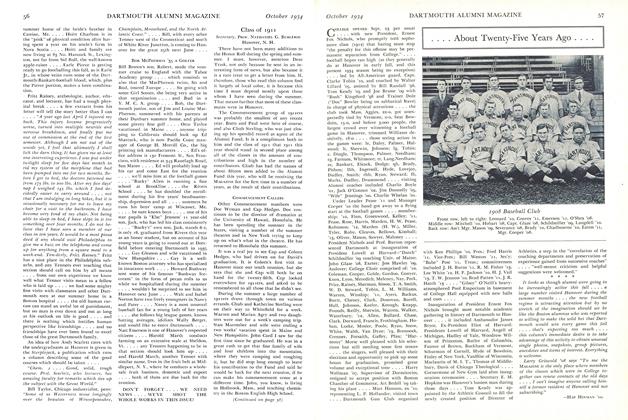
All Ninety-Nine reunions are good, each recurring one having about it a subtle something which sets it apart from all that have gone before. Our 35th, in June, was a week-end of satisfying pleasure made memorable by an attractive program of events, the large number in attendance, and the awakening of spiritual emotions hard to define.
Out of a possible eighty-three, sixty-three of the class were present at the reunion. Unfortunately not all arrived in season to be counted in the contest for the attendance cup awarded at the Alumni Luncheon Saturday noon. At that time we had fifty-five present, but before the class dinner that same day sixty-three had registered, giving the class an attendance percentage of seventy-five. The cup was won by 1894 with a percentage attendance of seventy-three, while we were second with sixty-three per cent at the hour of counting. Our congratulations to 1894. One hundred fifty-eight men, women, children, and guests made up the '99 family for the 35th.
A reunion with us really begins when Warren C. Kendall and George G. Clark arrive. Then it is that the '99 flag is formally hung from the balcony of Massachusetts Hall, the secretary's book is brought out for registrations, George impresses any idle bystanders to help him undo the decorations and hand out regalia, Joe Gannon resumes his duties as marshal, the clan begins to gather, the photographers, official and otherwise, begin to snap the shutters, and the reunion is on.
For personal adornment and marks of distinction, tasty buttons for the coat lapel, '99 stickers for auto windshields, and canes with a cutting gouge for carving them were provided for all—and did we carve them just as we did thirty-five years ago? Well, yes, some did. The trick signatures of senior year were a little hard to reproduce, but on the whole the results were not too bad and the carving did revive pleasant memories.
The first event on the program was a visit to the Orozco Frescoes, which were interpreted to us by Prof. Packard. This was one of the high lights of the reunion. Over a hundred of the class family took it in, and some who came to scoff remained to pray. Hawley B. Chase, that unvanquished debater of Reed Hall, was so moved that he wrote "A defence of Orozco," which appeared in the June 28 edition of The Argus—Champion of Newport, N. H., in which Hawley in true Reed Hall fashion lays the lash of his scorn on some carping critic who previously in the same columns had dared to sneer at the "New Deal" in art. Verily the old order doth change.
The evening of the first day was spent at '99 party in Richardson Hall, with Tim Lynch as chief in charge bossing Frank Staley, Mrs. Richardson, Mrs. Gannon, and Tom Whittier. The youngsters danced; the oldsters played whist, contract mostly, mixed with many torts.
During the afternoon of Friday the class presented to President Hopkins a picture of the Old Pine, suitably mounted in a frame made from the wood of the original tree, authenticated by Dr. Percy Drake, who inherited it from his brother-in-law, Dr. Charles F. Patterson, Dart. Med. 1896. A complete bound set of the '99 class reports was presented to the Baker Library, and Dr. Percy Drake presented to the class a gavel made from the wood of the old pine.
NEGLECTED WIVES CELEBRATE
Saturday night was high carnival. Widows' and orphans' dinner for the women and children was held at Villa Clara and the men's class dinner at the Alden Tavern in Lyme. Of the widows' and orphans' dinner we know nothing except from hearsay. Based on that and the negative evidence of no complaint, we conclude it was a success with a good time had by one and all under the leadership of Mrs. Eva A. Speare. As for the men's class dinner, who can describe it? Presided over by Ernest L. Silver and embellished by a postprandial flow of soul from Long Jim Richardson, dressed in the regalia made famous at 09's tenth reunion, followed by Luther Oakes, Bill Wiggin, Freme Sewall, Tony Willard, Bill Hutchinson, Frank Staley, Dr. Bonney, Tootell, Ray Pearl, Joe Gannon, Jack Ash, fresh from a 4,500 mile hike by auto to get there, and a moving wind-up by Guy E. Speare, it was an event which will linger as long as there is a '9ger to remember it.
Sunday morning was set aside for a memorial service to the departed. In the familiar chapel Rev. Montie J. B. Fuller presided, read the Scripture, and spoke. Alvah Sleeper, assisted by Raymond Pearl with his French horn, furnished the music. After the service at the chapel the class marched to the college cemetery to lay a wreath on the grave of Howard Tibbetts, and then drove to the new town cemetery to perform a like service for Frank A. Musgrove. Solemn as such exercises always are, this one was not only impressive but moving in its utter simplicity. The appropriate Scripture supplemented by the sincerity and purity of Montie Fuller's little talk left one with the feeling of having been cleansed spiritually.
The mecca for the big family party was Bonnie Oaks, Lake Morey. Here we gathered in mid-afternoon on Sunday for a big dinner; lots of fun, speeches by males and females, a class meeting, and such surprises as are bound to occur even in a program laid out by George G. Clark, Warren C. Kendall, and other good-time engineers. "Donny," boy again for a day, was pinchhitter for Luke Varney in toasting the ladies, getting a base hit. Mrs. M. F. Sewall responded with a larruping home run, winning the game for the weak side. Prof. Herbert A. Miller with characteristic precision simplified the complications of the present-day social, economic, and political scramble so that even a "D" scholar could see how simple, natural, and good it all is or is going to be, only to find, when he had finished, that Dr. Dave Parker held contrary views, which served to scramble the thing all over again, so that we all "Came out by the same door where we went in."
The class meeting was old style, politically; a committee reported a slate, the secretary cast one ballot, and the election was all over before the victims could think a protest let alone utter it. John Ash from Corvallis, Ore., won the long distance cup in a contest which was not even close.
From Bonnie Oaks we adjourned to No. 14 Natural Science Building, where a neighborly event took up the early evening. Members of the faculty of our day, reuners from other classes, and invited guests gathered here at a still picture and movie show under the charge of O. A. Hoban, but really run by Geo. Clark. George did the descriptions for the stills, which rapidly exposed to the view of the astonished audience a veritable rogue's gallery-looking series of pictures of '99ers in all stages of development; a sort of cradle to the grave panorama of men and events from freshman fall to senior spring which evoked many a laugh that choked back a tear. Hobe reminisced and Craven Laycock, belyingly youthful in pose and manner, ended a perfect evening with a hearty speech.
Finally we moved to the class tree, where in the weird light of green flares we sang "Shorty" Graham's ode, Warren Kendall passed on to "Hobe" the lighted candle, symbol of the ever burning loyalty and unity of the class, K. Beal pronounced the final words of benediction, and our 35th was over.
The gloom of the good-byes of blue Monday was brightened by the presentation to that sterling golfer, Weary Wardle, of "Tim's Golf Cup" to be his permanent possession. The impromptu speech of presentation cited all the famous trophies from the laurel crown of the Olympiads to the Congressional Medal, with allusions on the way down to Horatius at the bridge, William Tell, and other notables of song and story who triumphed in unequal combat. Finally the new secretary announced that a second issue of "Tim's Golf Club" had been provided, to be contested for in the next five years and awarded to the winner as a permanent possession at our 40th in '39.
And then the post-reunion party headed north and east for Clarkland at Plymouth, Ernest Silver's Teachers College, Rodney Sanborn's oasis at Ossipee, and Warren Kendall's at Kennebunk Port, where the 35th made a perfect "fade-out" on the crystal sands by the restless sea.
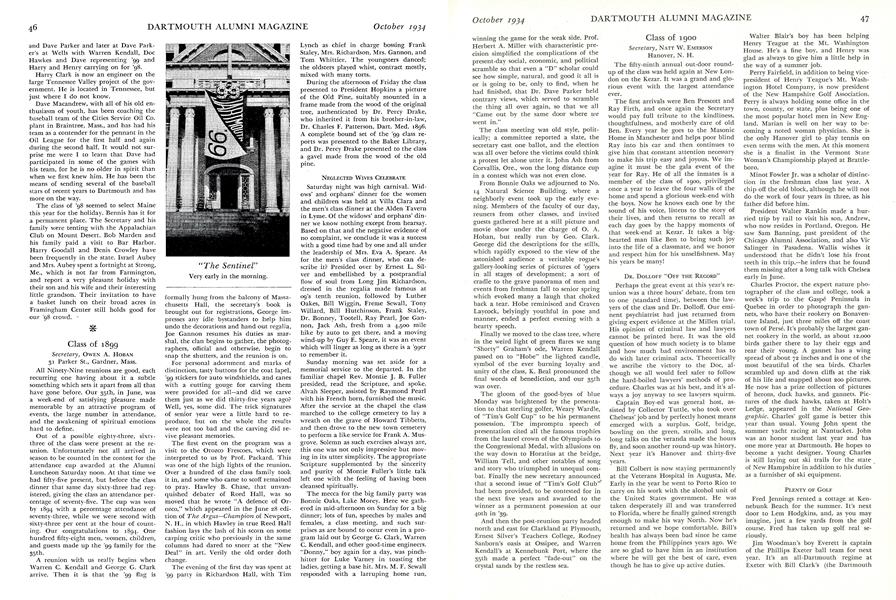
"The Sentinel" Very early in the morning.
Secretary, 31 Parker St., Gardner, Mass.