1894*
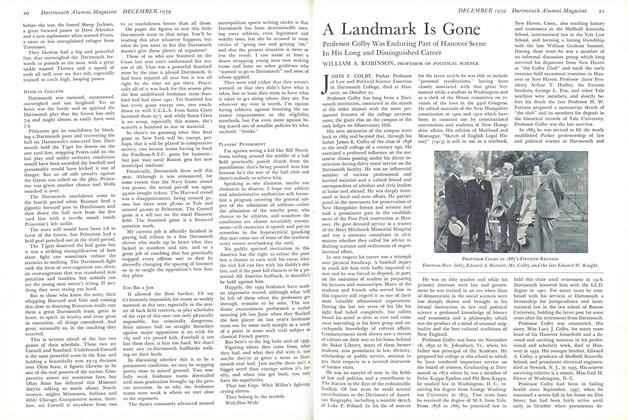
The obituary notice of Professor James F. Colby in the New York Times begins as follows:
Associated in the minds of the olderDartmouth alumni with the more permanent features of the college environment the giant elms on the campus, the stump ofthe "lone pine" or the changeless rockledges on Observatory Hill, Prof essor Colbyhad long been a Dartmouth institution.
For years this has been the feeling of the Class of '94 toward this man who is remembered as perhaps the most stimulating intellectual force on the faculty of our day. Four members of the class attended the funeral—Colby, Flurd, Cassin, and Hardy. The arrangement for flowers in behalf of the class was made by Hardy. With reference to the flowers the following comes from Professor James P. Richardson:
My colleague, Professor Robinson, and Iwish to express our very grateful thanksfor the beautiful floral tribute to thememory of Professor Colby which was sentby the Class of 1894. Many of your members knew Professor Colby well and I knowhow much they appreciated his sterlingqualities.
I would like to have this note of appreciation transmitted to as many of the classas is reasonably possible.
For the twenty-sixth time, Mr. and Mrs. Matt B. Jones entertained the class on the evening of October 27th. Twenty-three were present as follows:
Allen I, Allen 11, Ames, Bartlett 111, Boyd, Claggett, Colby, Dutton, Griffin, Hardy, Howland, Hurd, Jones, Knowlton, Lewis, Lyon, McGroty, Marden, Matthews, Merrill, C. C., Parker, Smalley I, Smalley 11.
A number of those who usually attend were kept away for special reasons:
Sherman because of the 175th anniversary of his paper.
Rossiter on account of the 175 th anniversary of his town.
Wilson on account of his wife's illness. Spooner because he was sick himself.
Blakely because he was occupied with preparations for his California trip.
Jack Nutt because he had married a wife and could not come. (See below)
Trow by 1700 turkeys.
Billy Wallis by the severe illness of his sister.
Ham by professional duties.
Jimmy Townsend's only reason for absence was 3000 miles.
Dutton told of his marriage to Mrs. Christina Schick of Kingston, New York, the date being September 18th. Those of us who had the privilege of meeting the former Mrs. Schick at our Forty-Fifth will heartily approve.... Billy Ames reported that he was better than he had been for ten years. . . . Knowlton announced his prospective removal to Lowell, Mass., which brings to an end many years of commuting between Lowell and W. Medway....
Matthews came the farthest and seemed to be in fine fettle. ... B. Smalley announced his annual hunting trip to Maine beginning the next day. He alleged that he was going after birds, not deer. ... Curley Bartlett circulated among the crowd a number of clippings which he had been collecting during the years.... It is a simple truth to say that the evening measured up to previous years and then some. Food better than ever, comradeship better than ever, signs of approaching senility conspicuously absent, etc. Again we were privileged to see Matt's daughter Catherine and her husband, and his son. We were all glad that Mrs. Jones seemed to be so well.
All best wishes to Jack Nutt over the following:
Mrs. Joseph Walter Craneannounces the marriage of her daughterHelen RosetoDoctor John Joseph Nutton Sunday, the twenty-second of OctoberOne thousand nine hundred and thirty-nineat Petersburg, Virginia
Irreverent people sometimes refer to folks who go to California to live as successively passing through three stages, first, the "knockers"; second, the "boosters"; and third, the "liars." Quincy and Mary Blakely have plainly not gotten into the third class. However, it is fair to assume that they are out of the first because after November 6th their winter address will be Pilgrim Place, Claremont, California.
The Washington Post of October 21st carried the word that on the day before President Roosevelt had accepted with reluctance and sincere regret the resignation of John H. Bartlett from the International Joint Commission of United States and Canada of which he had been a member for ten years. Previous to his service on this Commission he had been First Assistant Postmaster General in the Coolidge Administration and before that had been chairman of the Civil Service Commission. His work at Washington had been preceded by notable service as Governor of New Hampshire. The Post concluded its notice by quoting John as saying that he had resigned to attend to his extensive real estate and banking interests and to write a "book history" of New Hampshire. Let us hope that we will be seeing him every now and then at the "Gang" meetings in Boston.
Secretary, 14 Beacon St., Boston, Mass.
* 100% subscribers to the ALUMNI MAGAZINE, on class group plan.