Brief Biographies of Buildings
VI. Wheeler Hall
JOHN BROOKS WHEELER was born in 1771. It is said that he "learned his letters by lightwood candles and was but six weeks in any school until by his own labor he paid for six months' tuition and board at the New Ipswich Academy under Professor John Hubbard (later a member of the Dartmouth faculty) and then, axe in hand, he entered the woods and felled trees for a farm." This farm apparently was at Grafton, Vermont, but in 1806 he moved to Orford, N. H„ and entered upon an extensive mercantile career, his place of business being located at the corner of Bridge St. and River Road, on the site of the present general store in that town. About 1809 he built a large and most attractive house, the southernmost of the structures on the terrace which make Orford, from an architectural point of view, one of the most beautiful of the smaller villages of New England. The house still stands and still remains in the possession of the Wheeler family. John Brooks was extraordinarily successful in his business affairs, which he prosecuted for many years. "By energy and perseverance, with uncommon financial ability, he accumulated a fortune seldom realized in a country business. He was a prominent and influential citizen, filling acceptably many responsible offices and represented the town in the legislature." He died in 1842.
Each of Wheeler's two sons was a graduate of Dartmouth. John, 1798-1862, a member of the class of 1816, received a professional degree from the Andover Theological Seminary and preached for a time in Windsor, Vt. He served as a trustee of Dartmouth from 1826 to 1833, and from 1833 to 1849 was President of the University of Vermont. Daniel Everett, 1805-1870, Dartmouth 1827, attended the Harvard Law School and from 1830 until his death was a successful lawyer in New York City, at one time a member of the state assembly. Two of John Brooks Wheeler's grandsons attained sufficient prominence to be included in the Dictionary of American Biography: John Rignall Wheeler, long Professor of Greek and Dean of the College of Liberal Arts in Columbia University, and Everett P. Wheeler, widely known New York lawyer and publicist.
Commencement at Dartmouth in August, 1816, was a gloomy occasion for the eight trustees constituting a majority of the Board who in the year just previous had removed John Wheelock from the presidency and had elected Francis Brown in his place. The displaced president had been successful in his appeal to the electorate in March, 1816; the Democratic party, his supporters, had carried the legislature, and that body in June had enacted a measure replacing Dartmouth College by Dartmouth University and so changing the composition of the governing body that control of the institution was completely removed from the previously existing trustees. It is true that the latter (or the eight of them who made up the fighting element of the Board) refused to accept the act, and it was also true that the new organiza tion temporarily failed to function because of lack of a quorum—a difficulty, however, which obviously would be remedied in time. It was also true that good legal grounds existed for an appeal to the courts, whereby the act of the legislature might be pronounced invalid. But one overwhelming difficulty stood in the way—absolutely no money was available to the old Board to carry on such litigation. The funds of the College—small in any case—were in the custody of Treasurer Woodward, a partisan of the University. Moreover, the supporters of the latter felt that they could rely on funds of the state, to be appropriated for that purpose by a friendly legislature, if large legal expenses became necessary.
The College trustees were contemplating this situation in gloomy perplexity when an unsolicited and totally unexpected communication, signed by "A Citizen of New Hampshire" was brought to them. It read as follows:
"Considering that from science and literature emanate the most rational enjoyments of social life, that these have ameliorated the condition of man and have raised him from barbarity and degradation to all the endearments of social intercourse, I have viewed with pleasure the gradual rise of your respected seminary. Under your auspices it has flourished and under them, I trust, it will continue to flourish, though for a time power may contribute with party for its destruction. Yet it seems one of those instances in which good is educed from evil. Having learned that the funds have in some instances been withheld from the legitimate authorities, I feel it a duty to afford you this assistance. Accept, therefore, Gentlemen, this donation not as the effect of personal friendship but as something from a conviction that all mankind are morally bound to use their endeavors to support the cause of science & virtue."
The "citizen of New Hampshire" turned out to be John Brooks Wheeler, of Orford, and "this assistance" a draft for one thousand dollars. It is not apparent that the trustees had ever heard of Mr. Wheeler, certainly they had never considered him as a source of relief in their condition of financial embarrassment. Apparently he was in attendance at Commencement, as was the custom of many people in the region, such festivities then being one of the few gala events of the year. In his case the additional inducement existed that his son was a member of the graduating class. He seems to have been a guest of Professor Adams, from whom he must have learned the details of the controversy. The letter, quoted above, was the result.
The stilted language of the communication (at any rate, as it appeals to us) did nothing to impair the solid nature of the proffered "assistance." The trustees, as a result, took new heart, and entered upon the necessary litigation, sure to be long continued, with the courage coming from assured financial backing. The gift did not, of course, cover more than a fraction of the eventual expense of the contest, but it enabled a start to be made, with time becoming available for a more leisurely and laborious collection of additional funds. In the absence of this contribution it is doubtful if the trustees would have had the courage to enter upon the contest. Viewed in that light the contribution must be regarded as the most timely of the benefactions made to Dartmouth in all the 170 years of her history. And so to John Brooks Wheeler must be awarded a large share of the credit that the college organization exists in its present form.
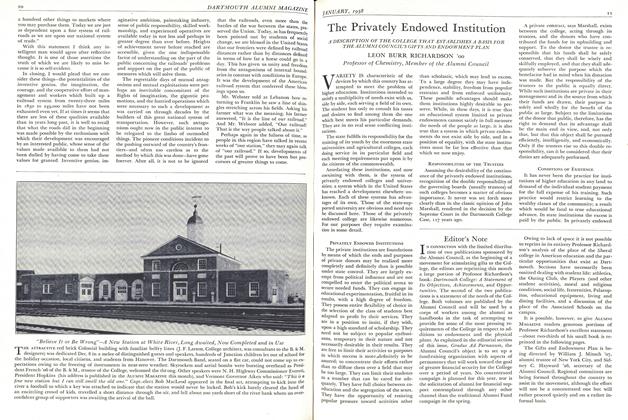
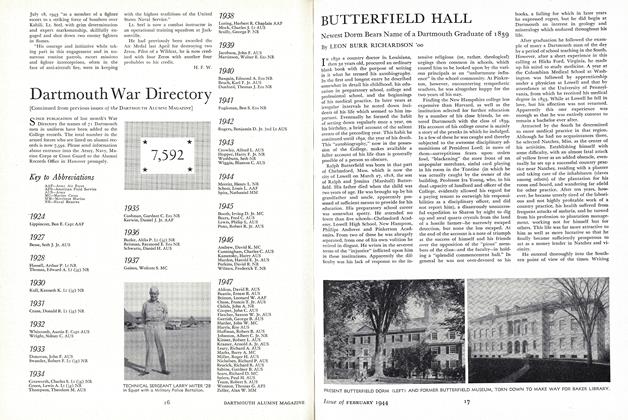
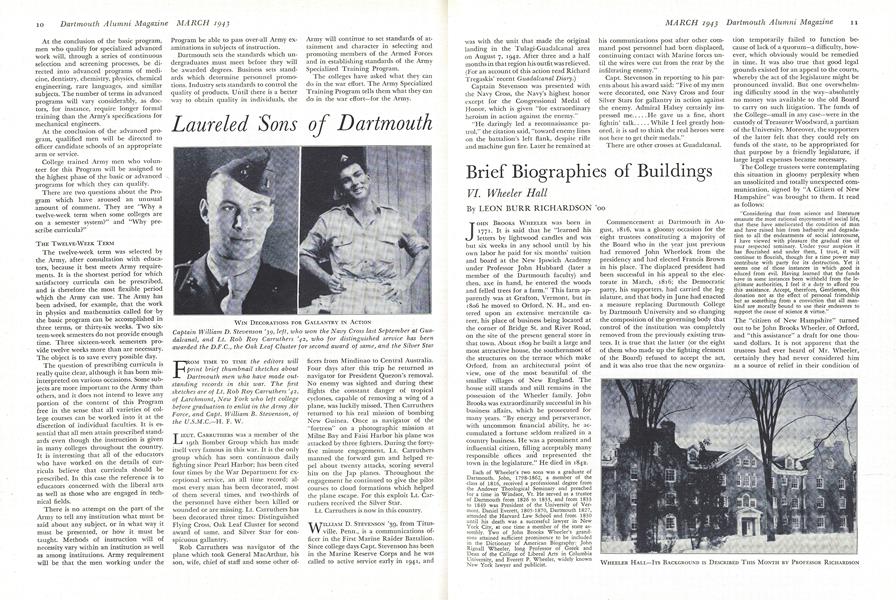
For ninety years no permanent recognition of this timely gift was available. When, under President Tucker's leadership, the trustees embarked upon the policy of investing college endowment in facilities, largely dormitories, indispensable to the adequate growth of the institution, the contribution of this early benefactor was recalled. The fourth of these new buildings (other than reconstructed and enlarged dwelling houses), built in 1905-1906 was given the name Wheeler Hall. Placed north of Rollins Chapel, to make way for it the dwelling of Professor Emerson was removed —in itself, in its earlier form of Rowley Hall of some significance in connection with the Dartmouth College case in that it housed the College when that institution was the "TiJniversity from its own quarters during tHe pfogriss of the litigation, From' an architectural !poinfe| of - view Wheeler Hall is one. of the more successful of the dormitory buildings. Costing about $83,000, it was designed to accommodate 98 students. Subsequent rebuilding of the interior, to ensure more fire-resisting qualities, has called for additional expenditure, so that it is now carried on the college books at $135,000. In 1941-1942 the net yield on endowment capital thus invested was $7,070.
WHEELER HALL—ITS BACKGROUND IS DESCRIBED THIS MONTH BY PROFESSOR RICHARDSON