1915
With not so much as a single item of newmaterial -before me, the editorial pen is thedriest it has been for many moons, but neverlet it be said that 1915 was missing from an issue, nor that an old time editor can't conjureup a story when deadlines call.
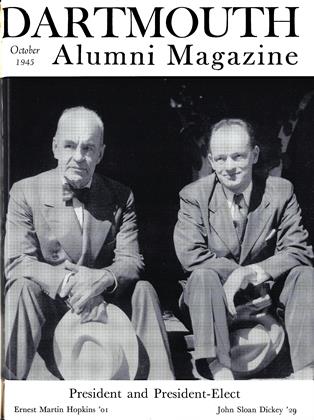
Today, just two days after the announcement that President Hopkins has resigned, one can perhaps, however, consistently revert to other days when we sat at the feet of Johnny King Lord, and recall at least one classical quotation appropriate to the moment Ave atVale.
Although we knew that within a short period Hoppy would lay down his duties which became doubly arduous in the stress of wartime administration of the College, yet it did come as a bit of a shock to realize that he is now stepping aside. Ave yes, hail to him, first as second only to his own beloved William Jewett Tucker, and again—hail to his successor, John Sloan Dickey '29, who carries on from here.
Vale—ah, a most fond farewell, to one whom none of us in 1915 were privileged to know in undergraduate days, but whom we have admired from afar in the twenty-nine years of his fruitful administration. Yet, though he came to command Dartmouth's destinies after our Commencement, he never seemed far away from us, for he was in reality of our generation, and always expressed a sincere pleasure in being greeted by us at Reunions and other convocations of the College either in or away from Hanover.
What Hoppy's greatest asset was, it would be hard to determine, and perhaps that is a job for the historians. To us of 1915, however, he seemed to be a reincarnation of William Jewett Tucker, whom we missed at one end of our career and his own unique personality which we just failed to capture at the other limit of our stay among the Hanover Hills. We have glowed with pride at the almost instant advances the College made when he took over the reins of administration. Those were hard years for that then young college president. A World War broke almost before he could form a policy; and then came a period when everything was caught in the maelstrom of the blase attitude of youth in the roaring Twenties; to be followed by the world's No. 1 depression of all time; and then well, we know all about that part of it.
Through it all, however, he maintained the poise and purpose of the true educator, and consistently, persistently, if you will, carried the torch for the cultural college against every ism and attack by those who believed that the cultural college was a relic of a moss-grown era. Ernest Martin Hopkins could never have allowed Dartmouth to become a trade school, glorified or otherwise, and in his curriculum there was no place for a degree of Bachelor of Handiwork. His college, at least, still found basic educational fundamentals in the pursuit of the Arts.
That his policies were sound in every respect is evidenced by the growth of the College on the one hand, and by the undeniable esteem in which our President was held by educators throughout the land and on the other, by those in high places of government, who sought his advice and counsel in years of peace as well as in the years of war just closed.
Truly he walked with kings and potentates, but to those of Dartmouth, he never lost the common touch. Ave at Vale!
A few changes of address came to me this month from the college office, and are: James H. Brackett, 2001 S. Ross St., Santa Ana, Calif.; Julia W. Hall, Hotel Cordova, 826 West Bth St., Los Angeles 14, Calif.; Joseph B. Comstock, Comstock Coaching School, 126 West 3rd St., Los Angeles, Calif.
Secretary, Bay State Building, Lawrence, Mass
Treasurer, 31 State Street, Boston, Mass.