1896
Your Secretary and Tom Ham are preparing a series of short sketches concerning the activities since Graduation of living members of 1896. This is No. 2 in the series—No. 3 will appear in October.
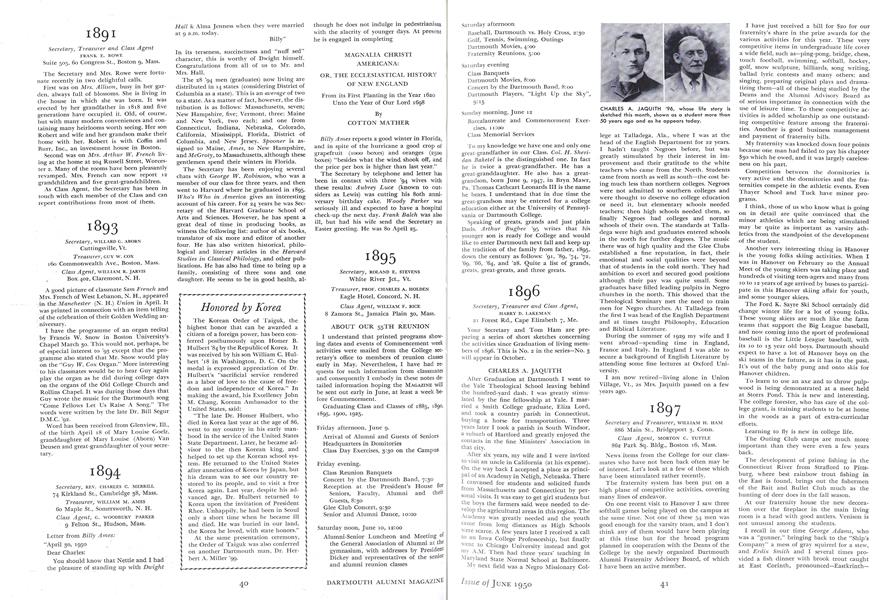
CHARLES A. JAQUITH
After Graduation at Dartmouth I went to the Yale Theological School leaving behind the hundred-yard dash. I was greatly stimulated by the fine fellowship at Yale. I married a Smith College graduate, Eliza Lord, and took a country parish in Connecticut, buying a horse for transportation. Three years later I took a parish in South Windsor, a suburb of Hartford and greatly enjoyed the contacts in the fine Ministers' Association in that city.
After six years, my wife and I were invited to visit an uncle in California (at his expense). On the way back I accepted a place as principal of an Academy in Neligh, Nebraska. There I canvassed for students and solicited funds from Massachusetts and Connecticut by personal visits. It was easy to get girl students but the boys the farmers said were needed to de- velop the agricultural areas in this region. The Academy was greatly needed and the youth came from long distances as High Schools were scarce. A few years later I received a call to an lowa College Professorship, but finally went to Chicago University instead and got my A.M. Then had three years' teaching in Maryland State Normal School at Baltimore.
My next field was a Negro Missionary College at Talladega, Ala., where I was at the head of the English Department for 22 years. I hadn't taught Negroes before, but was greatly stimulated by their interest in improvement and their gratitude to the white teachers who came from the North. Students came from north as well as south—the cost being much less than northern colleges. Negroes were not admitted to southern colleges and were thought to deserve no college education or need it, but elementary schools needed teachers; then high schools needed them, so finally Negroes had colleges and normal schools of their own. The standards at Talladega were high and graduates entered schools in the north for further degrees. The music there was of high quality and the Glee Clubs established a fine reputation, in fact, their emotional and social qualities were beyond that of students in the cold north. They had ambition to excel and secured good positions although their pay was quite small. Some graduates have filled leading pulpits in Negro churches in the north. This showed that the Theological Seminary met the need to train men for Negro churches. At Talladega from the first I was head of the English Department and at times taught Philosophy, Education and Biblical Literature.
During the summer of 1929 my wife and I went abroad—spending time in England, France and Italy. In England I was able to secure a background of English Literature by attending some fine lectures at Oxford University.
I am now retired—living alone in Union Village, Vt., as Mrs. Jaquith passed on a few years ago.
CHARLES A. JAQUITH '96, whose life story is sketched this month, shown as a student more than 50 years ago and as he appears today.
Secretary, Treasurer and Class Agent, 21 Forest Rd., Cape Elizabeth 7, Me.