BASEBALL
In our last communique, we pointed sadly to the fact that there was little or no news in the athletic department at that time. In this bulletin, our difficulty is just the opposite. The first two weeks in May (at the end of which we go to press) are marked by feverish activity in all sectors of the athletic front, with the result that we couldn't possibly begin to tell you all about it. Hence we shall have to adopt the shabby subterfuge of listing the scores (elsewhere in these pages) and concentrating on a typical engagement of each of the Green teams. Otherwise, this department would take up most of the MAGAZINE.
There is nothing wrong with the Dartmouth baseball team this spring that a little good pitching wouldn't fix. Coach Jeremiah currently finds himself in the unhappy position of having only one dependable pitcher, in the person of sophomore Frank Logan. Every time this elongated right hander is on the mound, the Indians look like a ball team, even if they don't always win. When any one of the other hurlers is up there, something horrendous usually happens. In the Navy game, for example, a group of Dartmouth pitchers issued the incredible total of 18 passes, a record only slightly surpassing that of the Boston University game, when the visitors received 12 free trips to first base.
With Logan on the mound, on the other hand, the boys look like a different group. The varsity infield, composed of Parker, Bray, Lindquist, and Hart (reading around the diamond) is one of the best the Green has had in many years, both in terms of fielding and hitting. The outfield, with Matthews, Dey, and Churchill, is also as good as anyone might reasonably expect. The catching, even with Captain Roger Frechette out for the season with a broken ankle, is capably performed by Boardman and Barton. But the pitching is something else again. With big Emil Hudak troubled with the misery in his throwing arm all spring and the rest of the pitchers unable to find the plate, Coach Jeremiah is forced to rely upon Logan to pitch the big ones and hope for the best in the rest. As it was, in the week of May 6-13, Logan pitched three times, losing to Yale and Holy Cross, and winning from Army. -The rest of the time, they beat our brains out.
In the Yale game, Logan held the enemy to six scattered hits and 3 runs, fanning three and walking three over the whole route. The only trouble was that the home boys were able to muster only 4 hits and no runs during the afternoon. Against the traditionally powerful Crusaders of Holy Cross, Logan had a no-hitter going into the ninth inning, during which time he had fanned six and walked only one man. The Indians were reposing on the long end of a comfortable 3-0 lead at that point, at which juncture the ropf fell in on Dartmouth, and the invaders sent five runs clattering across the plate before they could be put out. All this happened on only four hits for Holy Cross, but they were combined with a Dartmouth error and some other unfortunate work afield which did not show up in the box score.
The high point in Logan's pitching career, as well as that in the fortunes of the Dartmouth team to date came on May 13, when the Green upset hitherto undefeated Army by the convincing score of 3-1. In this encounter, Logan stilled the booming bats of the Cadets, striking out 9 and holding them to six hits, two of them by the great Army quarterback, Arnold GalifEa. Logan's control was so good that he walked only one man all afternoon, while his mates were collecting 7 passes off the Army hurler. Army's only run came in the ninth, when they bunched two hits and had the benefit of an error, but the lanky Logan put out the fire. The Indians were not exactly lethal at the plate themselves, with only five hits for the afternoon, but they bunched them to score one in the third and two in the fifth. Center fielder Jim Churchill drove in all three Dartmouth runs, sending Ray Lindquist across in the third and two other mates across in the fifth with the ones which sewed up the ball game. This was the first League win for the Green, after three successive circuit defeats.
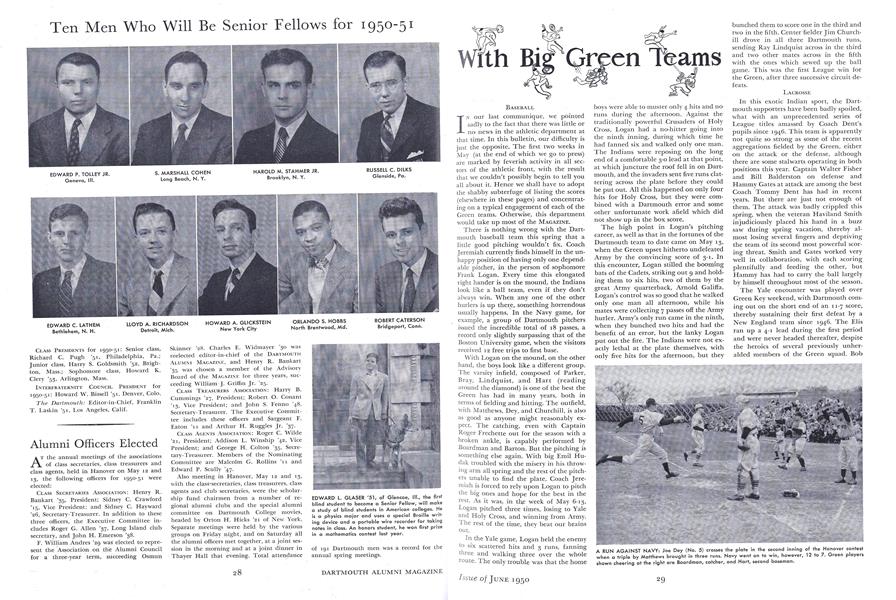
A RUN AGAINST NAVY: Joe Dey (No. 5) crosses the plate in the second inning of the Hanover contest when a triple by Matthews brought in three runs. Navy went on to win, however, 12 to 7. Green players shown cheering at the right are Boardman, catcher, and Hart, second baseman.
NO SCORE: McDermott of Yale out at the plate when he tried to steal home in the eighth inning. Barton, the Dartmouth catcher, is tagging him, while Gormley, the Yale batter, crowds in for a close look.