1932
The weather is news in Washington as X write this in the first week of October. The temperature is over 90 for the second day in a row, a fact which does not remind me that the football season is on and this column will appear shortly before the Yale-Dartmouth game. That seems to be a popular gathering place for the Easterners of '32, and I understand from Gordon Mackenzie that there will be a marked off parking area, in the official parking space near the Bowl, reserved for classmates' cars. Look for it, whoever can arrange to be there, and hope the weather will not be like last year, when everything went on despite the continual downpour. It may be of some interest to you to hear that my small son and I kept thoroughly dry by draping ourselves with plastic, translucent sheeting. The program was wrapped in it, so that it could be read while staying dry. It worked, but I'll take the sunshine.
I have heard that Bob Ryan has a new daughter, but it will have to be classified as an unconfirmed report from sources usually known to be reliable. If true, it means that the Ryans now have two boys and a girl, and that they are to be heartily congratulated. On one of the rare occasions when I see a movie I watched Bob last summer in Flying Leathernecks. The title being what it is, you won't be suprised to hear that Bob plays the part of an officer in a squadron of Marine airmen. It's all about fighting in the Pacific area against the Japs, the theme being that this little group is going to show the stuffy brass in Washington that air support of ground forces can work. In the effort, Bob's group is badly overworked and a number of them are lost, the suggestion being that the tough colonel in charge has no heart and therefore uses his men up regardless of cost. Needless to say, the tough colonel, in lonely moments, is shown to have a soft, fatherly heart which he merely encases in a steel shell because war is tough and this is war. The picture certainly made war look tough, but unfortunately just enough guys come through all that smoke and shell and fire to make little boys grow up thinking that the most gloriously exciting thing you can have happen to you is to see an enemy plane swoop down, guns blazing and bombs dropping, right over the camp where you and your buddies are trying to keep enough equipment in shape to fight back.
To return to Bob Ryan, however—he was not the tough colonel. He was the executive officer who seemed to the tough colonel just a little too soft to be able to make a squadron do its job. Eventually, however, Bob shows that he can put that steel shell around the soft heart, so he gets the job. I must say that Bob puts on a convincing show of being these two different people. That dual personality idea seems to be one of his strong points. I wasn't able to see Best of the Badmen, but Michael (age 11) did, and at my request he wrote me a note giving his impressions. Since none of the rest of you have written to me, I'll take the liberty of quoting him:
"Dear Daddy: I saw Best of the Badmen last night. The star Bob Ryan was very good and acted well. At the beginning he was an army major. In the middle of the picture he was a badman and acted tough and made me feel he was tough. At the end he won a girl and he and she went to get married. In boxing matches he looked like a good boxer and he knocked out quite a few people. I thought he is a good movie star and would like to see him again."
That give you the idea, I think.
Bain Davis, you may recall, is in the State Department, in charge of Venezuelan affairs. He has been active with the Friends, and last summer spent about two weeks at one of their work projects, in connection with an Indian reservation near Old Town, Me. His particular job was to help in the painting of one of the houses. He discovered that a fellow worker was an undergraduate at Dartmouth, and that the house was occupied by an elderly Indian who attended Dartmouth many years ago. I forgot to ask, but I'm sure the house is green now.
The '32 contingent in Washington, a very noticeable group at local Dartmouth gatherings, has been augmented again by the return of Chuck Owsley, who spent the last four years in our Embassy in Bern, Switzerland. Chuck is as trim as ever, and simply exudes distinction. He hasn't lost a single hair, but the iron grey has turned to snowy white. While he's pretty youthful looking, that thatch makes him look enough like a father to be able to carry off the six-child family without trouble. Chuck has found a house in Georgetown already, and, at least for the time being, has been assigned to special work in the Legal Adviser's office at the State Department.
Joe Fanelli gave a little talk at the last Washington Dartmouth Club lunch, inspired by two trips and some other work he has been doing for the International Refugee Organization. The whole class deserves to hear from Joe's own lips the story of his midnight sightseeing tour of Rome, and they would profit by hearing his views of the refugee problem and how it is affected by the general trend in this country to try to "judge a person's present fitness by his past beliefs." Attending the lunch from '32 were Ben Burch, Tom Curtis, DonMacPhail, Brandy Marsh, Fred Orner, EvStuhrman, Bain Davis and Mike Cardozo.
The New York City group had its annual dinner at the Dartmouth Club on September 26. The following 24 attended: Brown Dickinson, Morry Hubbard, Ray Bartlett, Jay Whitehair, Bill Morton, Dick Beck, Walt Rushmore,Wally Modarelli, Ken LaVine, John Wolff,Art Allen, John Weisenfluh, Ted Monnel, George Coxon, Al Zinggeler, Marv Chandler, Don Marcus, Warren Moore, JohnCouzens, George Blaesi, Jim Corbett, ArtMayes, Gordon Mackenzie and Red Tucker.
Warren Moore has left Eastern Air Lines to become assistant treasurer of Lever Brothers. Red Tucker is now living in Oklahoma City; I wish I could tell you why. I will, if someone will tell me. A note in the Exeter AlumniBulletin states that Joe Robinson is living in Winter Park, Fla., with his wife, two sons and two daughters, and that he is in the wholesale building supply and lumber business in Orlando. If it was news to the Exeter group, it's news for us.
Carl Baker's latest review for the New YorkTimes Book Review section covers a book called The Golden Age of Travel, edited by Helen Barber Morrison. Carl says that the book contains "hundreds of literary anecdotes .. . from the pens of famous men and women who did their travelling in the eighteenth and nineteenth centuries." He concludes with the following, "Armchair travelers should welcome this book. Those who combine the love of reading with the act of moving from place to place will find it better than Baedeker as an antidote to what Mrs. Morrison calls 'the creeping paralysis of museum fatigue.' " I like Carl's reviews because I always end up really knowing what the book's about and being able to guess how much I'd like it.
The very distressing news has come in of the death in July of Bob Kendal. That's all I know about it just now; an obituary note will appear later.
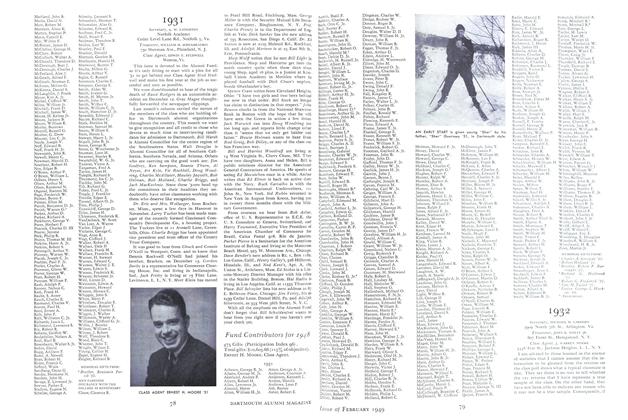
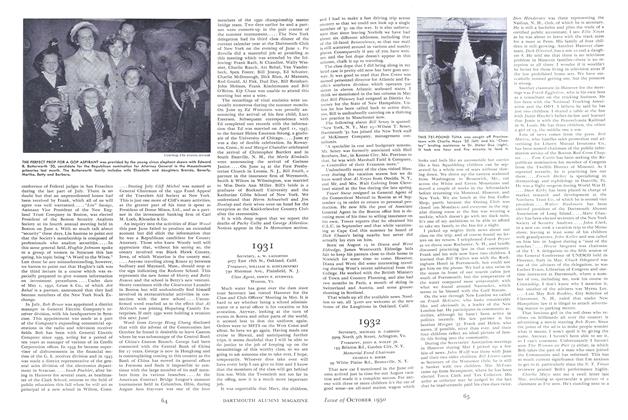
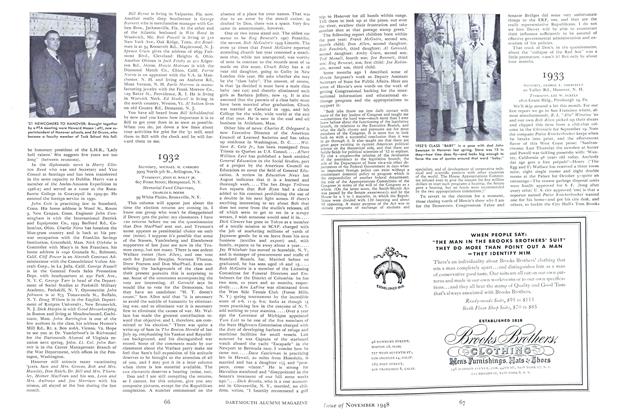
SCUTTLEBUTT ABOUT THE COLLEGE: On board the "U.S.S. Midway" Dartmouth men get together. Comdr. Frederick L. Ashworth '32, USN (I) is host to Lt. Dean J. Kutchera, USN (center) who was a V-12er '43-U4, and Lt. Robert J. Adams '44. Comdr. Ashworth, who transferred from Dartmouth to the U.S. Naval Acad- emy, was recently promoted to Captain. Lt. Kutchera is assistant on the ' U.S.S. Midway to Lt. Comdr. "Whitey" Fuller '37, USNR.
Secretary, 3909 North 5th Street, Arlington, Va.
Treasurer, 144 Brixton Rd., Garden City, N. Y.
Memorial Fund Chairman, 99 White Plains Rd., Bronxville, N. Y.