The 1955 Commencement
WELL, it had to happen sooner or later. After an even twenty years of holding Commencement out-of-doors - a remarkable record in view of the vagaries of Hanover weather in the spring - the clouds hung low, the heavens opened and the deluge came down.
As the College has done for all those twenty years, alternate arrangements had been carefully made ahead of time to hold the exercises in Alumni Gymnasium. But whether they would actually work had never been tested.
President Dickey, ten minutes before the stipulated deadline of 10 o'clock, looked out of his office window at the rain-sodden campus, at the rows of wetly gleaming chairs standing empty on the lawn in front of Baker Library - and without a trace of hesitation said, "The Commencement exercises will be held in the gym."
It was a hard decision to make, for it meant that many people who had come many miles to see the young man graduate just wouldn't be able to do so. But all things considered, it was a fine Commencement that ended the College's 186th year. Everybody said so as they filed out of the Gymnasium after the degrees were conferred, the diplomas handed out, and the honorary citations heard and appreciated.
When President Dickey made his decision, he set in motion a chain of events of which the alumni, the parents and even the seniors were only partially unaware.
The word was passed to the Commencement Committee, headed by Sidney C. Hayward '26, Secretary of the College, and from there it went rapidly to Dean Joseph L. McDonald and to the officers and members of the senior class. They already were assembling, all 566 of them, in Rollins Chapel for the final meeting of the class as a group.
Arrangements proceeded to carry the Commencement exercises by public address system to Webster Hall and to the chapel for the hundreds who would not be able to get into the-Gymnasium and a final check was made there to see that all was in readiness for the throngs who would soon be filling the hall to capacity.
Headed by Profs. Edmund H. Booth '18 and John B. Stearns '16, the faculty marshals for the academic procession, the honorary degree recipients gathered in the office of the director of athletics, to be gowned. Then they moved on into the Trophy Room for the customary photographs with President Dickey and then, as in the outdoor ceremony, were seated with their Trustee escorts in the order in which they would file down the center aisle of the upstairs gym floor.
Members of the faculty also were seated in long lines of chairs, and as they waited for the seniors to circle the indoor track and march to their places upstairs, they made an odd appearance, dressed in their long, black robes and seated in a solemn column, many alone with their own thoughts and others quietly talking with the men seated near them.
It was at this point only that there was any indication the exercises were not running with absolute smoothness and precision. The procession was four minutes late in passing down the center aisle between the parents and friends, who by 10:45 already had filled the Gymnasium to overflowing. And it was not until six minutes past 11 o'clock that everyone was in place and head marshal Gerald E. Samuelson Jr., also class president, signaled the seniors to sit down.
Dean McDonald rose, and with his customary gravity announced, "The Rev. Roy B. Chamberlin will give the invocation." Thus solemnly began an essentially joyous and happy occasion, an event to which the combined efforts, hopes, even prayers of roughly 2,000 persons - students, faculty and parents - had been leading for four years.
The exercises flew by - they always seem to - through the Valedictory Address by Jere Daniell and President Dickey's response from the College (both printed in full in this issue). In his brief remarks to the seniors, President Dickey said that the important thing about a college education is the "follow-through" and that "after all the honors and the flunks, after all else in college that was or was not just right, after all this is behind you ... the quality of your liberation as a brother of man and as a son of God will be seen in those things that even the least accomplished among us must now know is within his grasp as a graduate of Dartmouth."
With this, and the presentation of Master of Arts degrees to seven candidates and the Diploma in Medicine to 23 men, the exercises got down to the climactic part of the program - the conferring of the eleven honorary degrees.
First on the list was Joseph B. Dodge of Gorham, N. H., huts manager of the Appalachian Mountain Club and good friend of the legions of Dartmouth men who love the out-of-doors. President Dickey's citation for the Master of Arts degree, which was presented from "one New Hampshire institution to another," described Mr. Dodge, father of skier Brooks Dodge '51, as "longtime mountaineer, student of Mount Washington's ways and weather, you have been more than a match for storms, slides, fools, skiers and porcupines."
Lane Dwinell '28, Governor of New Hampshire, was next on the list to receive the traditional Master of Arts degree awarded "with affection and pride" to the Governor as an ex-officio member of the Board of Trustees.
Edgar H. Hunter '01, of Hanover, received the Master of Arts degree for "mastery of the arts of making the North Country a better neighborhood."
From this point the conferring of the honorary degrees proceeded quickly to the honoring of the Rev. William C. H. Moe '10 of Tolland, Conn., pastor of a small church there, with the Doctor of Divinity degree. The citation for Mr. Moe, who is the father of Miss Orilla Moe, secretary to President Dickey, brought a tightening of the throat to many of the audience, and after the degree was awarded, the seniors, parents and faculty applauded long and loud for a man who in what many would call a backwater had really lived a life "immense in all the dimensions that count: courage, conscience, competence, kindness and generosity." Its full text, which appears with the others in another section of this issue, is well worth careful reading, as are the others.
In order, degrees were conferred on Dr. Frank L. Meleney '10 of New York, a surgeon who received a Doctorate of Science - "teacher and researcher, your life has been given to advancing man's health through surgery"; to Rene d'Harnon-court of New York, director of the Museum of Modern Art, a Doctor of Humane Letters — "a director whose unique talent for bringing into focus for millions the art images of our time"; and to Theodor Seuss Geisel '25 of La Jolla, Calif., the creator of the "Dr. Seuss" cartoons - "flying elephants and man-eating mosquitoes makes us rejoice you were not around to be director of admissions on Mr. Noah's Ark."
Ellis O. Briggs '21 of Lima, Peru, U. S. Ambassador to that nation, received the Doctor of Laws degree. In a citation which spoke of diplomacy in ten foreign countries, President Dickey also said, "During thirty years as a career Foreign Service Officer you have borne the disciplined duty of a young vice-consul, the lonely burdens of our Ambassador in communist-attacked Korea and it has been your lot as an American diplomat to live through a period of harassment at home such as no other professional foreign service has ever borne."
Rep. Joseph W. Martin Jr. was honored with the Doctor of Laws degree as a man whose "life was planned as an American political classic." President Dickey said, "One of America's foremost practitioners of the honorable art of politics, your example has taught two generations that in a republic where the great wheel of governing goes round and round, political parties are spokes dependent on each other's strength as well as on their own and as such must be honored at both the top and the bottom of the wheel's turning."
Also receiving an honorary Doctor of Laws degree was Henry M. Wriston, retiring president of Brown University, dean of American college presidents. In a citation that sparkled with good humor, President Dickey said that President Wriston, born on July 4, had manifested "a lifetime affinity for fireworks and reversing the course of things." During his 30 years as a college president, first at Lawrence in Appleton, Wis., and then at Brown, President Wriston has become noted for his always good-natured and often fiery pronouncements on education and youth, the state of the nation and international affairs.
The last to receive an honorary degree was Robert L. Frost '96 of Rip ton, Vt. In awarding him a Doctorate of Laws, Dartmouth set another precedent, far more reaching than the 20-year outdoor scene broken by the day's bad weather. In 1933 the College honored Mr. Frost with a Doctor of Letters degree, and at this year's Commencement he was the first man in College history to receive a second doctorate.
"You have done more good teaching than any other man we know, teaching us to like and know that which we do not know we know," President Dickey said of Mr. Frost. The four-time winner of the Pulitzer Prize for poetry, who has often spoken sharply about formalized education, took it all in stride.
In his Commencement Address, which was "pure Frost" with comments on life and readings by the poet of some of his favorite works, Mr. Frost came back again at formal education and its inability to provide sufficient freedom for the nonconformist.
Frost compared himself to the legendary John Ledyard of the Class of 1776, who in his freshman year could no longer stand Dartmouth and Hanover, went down to the Connecticut and hollowed out a log for a canoe, and set forth downstream on a life of wandering that never saw his return to the College.
"Ledyard ran away to escape conformity, and so did I. I've been dodging ever since," Mr. Frost told the seniors. Unlike most commencement speakers, he spoke to the seniors alone, and while what he talked about was heard by others, it was apparent that he didn't consider them as part of his audience.
During his talk Mr. Frost's new Doctor's hood kept slipping from his shoulders - a symbol, no doubt, of the elusive relationship between the great American poet and formal education. He had no prepared text for "talking" with the seniors, but a tape recording was made and the full transcript appears in this issue.
With the end of the formal exercises, Dr. Chamberlin pronounced the benediction and the seniors filed out of the Gymnasium, into as wet a Sunday as Hanover has seen in twenty years. The alternate arrangements, which had been set up again and again in the Gymnasium and never used, had been tested and found to be entirely satisfactory.
At least they were entirely satisfactory so far as the eye could see. Immediately after the benediction had been pronounced, Mr. Hayward was observed dictating notes to Miss Case, his secretary. Without doubt these were suggestions for future improvement. But it may be hoped that another twenty years will go by before another Commencement will be rained out.
CLASS Day this year followed a familiar pattern, although as a portent of things to come, the concluding moments of the exercises were rushed through against a background of lightning flashes, peals of thunder and spatters of rain.
Six speakers from the senior class delivered the traditional addresses in the ceremonies in which the class formally pushes off the authority held over them by the faculty and trustees and assumes upon its shoulders the responsibilities of alumni status.
After gathering on the campus under the guidance of Gerald E. Samuelson, the seniors marched up the hill to the Bema. The band led the way, and parents and friends brought up the rear. After the seniors had seated themselves around the stone rostrum at the foot of the rocky cliff, Samuelson gave the Address of Welcome to all there in "a cherished and traditional place." He spoke about how Dartmouth men feel about their college, its town and the intangibles that make up what the graduate takes away with him; and he expressed the hope that parents would understand something of that feeling before the weekend was over.
The Class Oration was delivered by Thomas Waddell, president of the Forensic Union, who expressed the optimistic belief that the students and their parents had gotten a full return out of the four-year college experience when he said, "I believe that many of us have acquired the most vital skill toward which man can aspire — we have acquired the power to think, and to think for ourselves."
David Rafael Wang, otherwise known as Wang Hsin-Fu, delivered the Class Poem, which proved to be unique both for its length and for the oriental obliqueness of its figures of speech.
Wang put forth a plea for greater emphasis upon the academic side of the College, for more stimulating teaching and for greater intellectual activity on the part of the students. He criticized his fellow students when he said:
Let books be burnt like incense to the ghosts, Who risk no hurdle beyond teacher's desk, Who swim no channel beyond logic strait, Who seek no summit beyond Mont Parnasse.
In similar fashion, Robert M. Wool was critical of both College and undergraduates in his Address to the College. He was critical, too, of what he felt to be an insufficient chance for the non-conforming intellect to grow in the garden of formal education under the tending of professorial gardeners. He said that the number of times "anything (intellectually) important" had happened in his four years as the result, solely, of student initiative could "be noted on this one hand."
But with all this, Wool spoke up strongly for the liberal arts college when he said: "A liberal arts education is a luxury, in the sense that people can and do live without it. But when one considers how much more valuable, important, and essential it is, if only to enjoy life more, than say some four-tone Cadillac, perhaps we can agree on it as an awfully high-priority luxury."
After hearing this series of self-appraisals and evaluations of their collective four-year experience, the seniors marched from the Bema to the Old Pine for the Address to the Old Pine, by John L. Callahan, and the Sachem Oration by Robert A. Morton, in full Indian regalia.
Mr. Callahan said that the only difference now between Old Pine gatherings and those of the old days is the fact that the class does not include a single fullblooded Indian. All other factors of time, place and common bond among the undergraduates are exactly the same.
Class Day exercises closed with Morton's humorous oration, which began in the top of the Bartlett Tower and proceeded downward, section by section, as Morton shouted out the windows to the populace below. Upon reaching the ground, he mounted a horse, backward for a reason still unexplained, and rode to the stump of the Old Pine, where he concluded his talk.
Then, with the breaking of their clay pipes upon the stump, the seniors formally severed their connections as undergraduates, waiting only for the stamp of approval symbolized in the conferring of the Bachelor of Arts degree and the diploma "in hand."
The full day's events wound up with a serenade that evening by the Class of '79 Trumpeters - after the shower, Hanover was treated to one of its wonderful golden evenings —, the traditional reception at their home by President and Mrs. Dickey, a Glee Club concert in Webster Hall, a band concert on the campus and the annual Commencement Dance in College Hall.
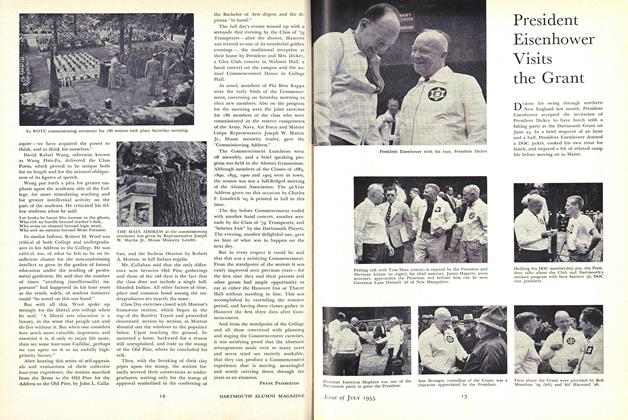
As usual, members of Phi Beta Kappa were the early birds of the Commencement, convening on Saturday morning to elect new members. Also on the program for the morning were the joint exercises for 186 members of the class who were commissioned in the reserve components, of the Army, Navy, Air Force and Marine Corps. Representative Joseph W. Martin Jr., House minority leader, gave the "Commissioning Address."
The Commencement Luncheon went off smoothly, and a brief speaking program was held in the Alumni Gymnasium: Although members of the Classes of 1885, 1890, 1895, 1900 and 1905 were in town, the session was not a full-fledged meeting of the Alumni Association. The 50-Year Address given on this occasion by Charles F. Goodrich '05 is printed in full in this, issue.
The day before Commencement ended with another band concert, another serenade by the Class of '79 Trumpeters, and "Sabrina Fair" by the Dartmouth Players. The evening, another delightful one, gave no hint of what was to happen on the next day.
But in every respect it could be said that this was a satisfying Commencement. From the standpoint of the seniors it was. vastly improved over previous years - for the first time they and their parents and other guests had ample opportunity to eat at either the Hanover Inn or Thayer Hall without standing in line. This was. accomplished by extending the reunion period, and having three classes gather in Hanover the first three days after Commencement.
And from the standpoint of the College and all those concerned with planning and staging the Commencement exercises, it was satisfying proof that the alternate arrangements made over so many years, and never tried are entirely workable, that they can produce a Commencement experience that is moving, meaningful and worth carrying down through the years as an alumnus.
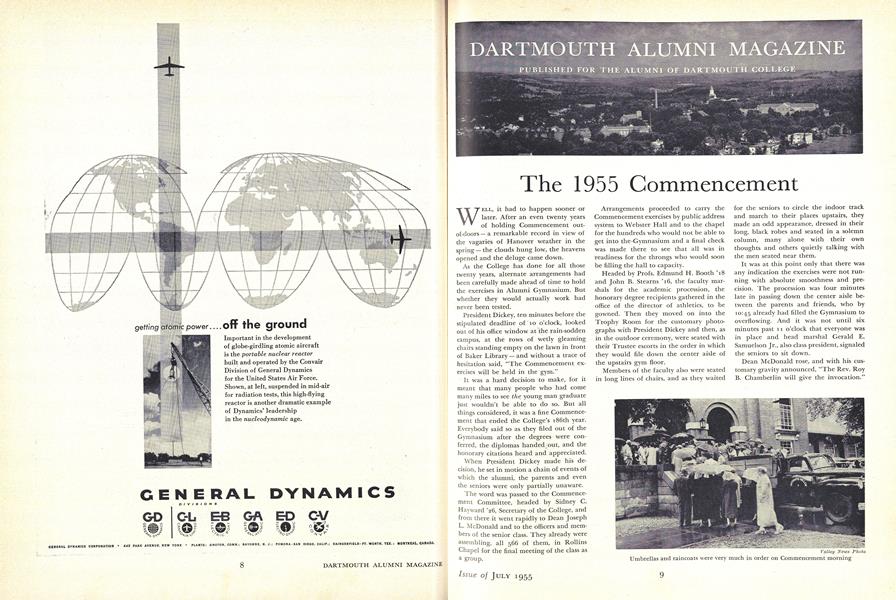
Umbrellas and raincoats were very much in order on Commencement morning
Class President Samuelson opens Class Day exercises in the Bema
A view of the Commencement audience snug and dry in Alumni Gymnasium
An ROTC commissioning ceremony for 186 seniors took place Saturday morning
THE MAIN ADDRESS at the commissioning ceremony was given by Representative Joseph W. Martin Jr., House Minority Leader.