A Famed Collection and How It Grew
The existence in Dartmouth's BakerLibrary of the famous Stefansson Collection on the polar regions has frequentlybeen mentioned in the ALUMNI MAGAZINE. How did such a remarkable job ofbook-collecting, almost entirely by oneman, come about? The editors have invited Mrs. Evelyn Stefansson, wife of theexplorer and librarian of the collection atDartmouth, to answer that question andto tell something of the fascinating storyof the collection. This short account isadapted in part from an article Mrs. Stefansson wrote for Volume I, Number I of"Polar Notes," a new Baker Library publication stemming from the StefanssonCollection.
LIBRARIAN, THE STEFANSSON COLLECTION
THE marrow of a polar library is in the narratives of journeys. Journeys made on foot, by dog sledge, ship, plane, dirigible and submarine - journeys made, they say, for science, discovery, trade, war, whales, gold, love or escape. But who knows the secret, circuitous reasoning that triggers the decision to embark on that most bewitching of journeys, the collecting of a special library? This short, comfortably prejudiced account of one such voyage solves no mystery. At best it may provide a few useful sailing directions for those considering a similar trip.
About thirty-five years ago Dr. Isaiah Bowman, Director of the American Geographical Society of New York, suggested to his Board of Councillors that instead of selling some 300-odd polar duplicates from the Society's library for a pittance, they be given to his friend, the arctic explorer Vilhjalmur Stefansson. The board accepted his suggestion, and in Stefansson's hands the volumes became the nu- cleus for a collection which grew during the 1940s into the largest polar library in the world. At about the time of the Geographical Society's gift, Stefansson with lavish and characteristic generosity had, as it happened, just spent some thousands of dollars in backing a singer who proved to be lazy as well as talented, and Olive Wilcox, his long-time, devoted assistant, said wearily as she tallied up his expenditures on the unsuccessful Icelandic tenor, "Now, if only you had put that money into books, you would have had something to show for it." Thus, through the combined influence of Isaiah Bowman and Olive Wilcox, Stefansson began to collect his library.
Along with a competence in a number of the more orthodox branches of knowledge, an above-average knowledge of anthropology, geography, history, and lin- guistics, Stefansson brought his lively enthusiasm for things unknown, unorthodox, and even unpopular. The library had a plan: to trace the steady northward migration of man from his tropical birthplace to the expanding northern frontier, a migration frequently delayed by eastwest diversions, but always resumed eventually. To make the collection manageable in size, its area of coverage would start at both temperate zones, increasing in emphasis as it reached toward the poles.
From the moment Stefansson decided to form a polar library, his entire income, beyond his living expenses, was spent on books. On his lecture tours he inquired about and visited second-hand book stores at each new town, sometimes finding bargains that seem incredible today. Most fruitful in book discoveries were seaboard cities like New York, Boston, Philadelphia, and San Francisco, but inland communities of New York state, Pennsylvania, Ohio, and Ontario also proved important. Portland, Vancouver, and especially Seattle were richest in Alaska-Yukon books, while Winnipeg, Montreal, and Toronto offered volumes on the fur trade. Dealers in most of these places would often write Stefansson when something interesting in his line turned up.
In those early days auction rooms played a significant role. Typically, books were sold in "lots" - "Five books on Alaska," "Ten volumes on whaling," "A job lot of Antarctic books." After haunting auction rooms for a time, the accumulation of duplicate volumes had grown formidable. Stefansson then watched to see which dealer bought the lots, and tried to buy from him the single book he wanted. But too often it happened that the dealer was interested in the same book, realized its value and asked an exhorbitant price for it. So Stefansson went back to job lot buying, using the duplicates for trading with other collectors.
Stefansson has the true collector's religious belief that since one can never know what will become valuable, the only safe course to follow is to collect everything. Signed menus from Explorers and other club dinners, autographed photographs, letters from famous contemporary explorers and scientists - all were carefully preserved. Friends would often willingly hand over to him manuscript material they hadn't thought especially valuable, pleased that he considered it so. All correspondence and diaries related to expeditions he commanded were saved. To them were added book manuscripts that never found publishers, the original form of a manuscript drastically edited or rewritten by a publisher, and diaries he provoked people into keeping and begged into presenting to the library.
Since the Far North and the Far South were new collecting fields, the standard works were cheap, and it was not long before Stefansson had most of them and began to search for rarities. In doing so he necessarily invaded on occasion fields of specialization that boasted numerous collectors - areas like the Far West, or the Plains, Whaling, Herbals - and to his cost. John Rae's Narrative of an Expedition to the Shores of the Arctic Sea (London, 1850) was, for example, bringing $50.000 and $75.00 at auction, while other works of the same period by equally, if not more, famous men, and ones harder to find, were going at $5.00 and $10.00. The reason? Rae's book had been included in someone's Plains bibliography, whereupon all Plains collectors needed it and the price kept going up.
Among the real and costly rarities in the Arctic field are items connected with the lively controversy involving two British explorers, George Dixon and John Meares. Dixon published in 1789 A Voyage Round the World, But More Particularly to the North-West Coast ofAmerica, Performed in 1785-88. In 1790 Meares produced Voyages Made in theYears 1788 and 1789 from China to theNorth-West Coast of America. Both these books sold for around $ 100.00 in the 19205. In addition, there was a series of quarto pamphlets pointing up the contradictions of the original works. The first, by Dixon, Remarks on the Voyagesof John Meares, was worth about $1150.00; the second, a rebuttal by Meares, An Answer to Mr. George Dixon, Late Commander of the 'Queen Charlotte', was selling for about $450.00; and a third, Dixon's Further Remarks on the Voyagesof John Meares, Esq., had not been offered for sale for many years and was therefore in the 'priceless' class. No set was recorded as privately owned. Then one day in a pile of books which had come to a dealer from a liquidated private estate Stefansson happened on a com- plete set, all for only $30.00! It was the kind of 'find' that added zest and excitement to that early period of collecting.
Over the years many choice additions have been made through gifts to the collection, and perhaps the greatest single acquisition in its history came, appropriately enough, through a man connected with New England whaling, William B. Macy of Boston. Macy had retired to Nantucket Island, there to devote himself to the rejuvenation and development of the Nantucket whaling museum and especially to its library. A part of the museum's renewed activity was to bring celebrated speakers to lecture on whales and whaling, and in July 1933 Stefansson was asked to give a talk. Because of his friendship for Macy and his interest in the Nantucket library, Stefansson expected to donate his services. Macy, however, insisted on paying his regular lecture fee, which at that time was $350.00, but said, if agreeable, it would be paid in books. He had been eliminating duplicates from the library's shelves and withdrawing works not considered pertinent to Nantucket whaling. Accordingly, he invited Stefansson to choose $350.00 worth of hooks from the large pile of rejected volumes. When Stefansson had selected all he felt entitled to and wanted to stop, he discovered that Macy meant to use the original purchase price of each volume in arriving at the amount of his fee. Many of the books had been bought in pre-Civil War days and earlier! Stefansson and Charles P. Everitt, author of The Adventures of a Treasure Hunter and a famous New York book dealer, once figured out that the value of what came to be known as the "Macy lot" came to over §10,000.00.
The collection soon reached a point where help was required for its administration. The small group of specialists making up the staff of the library in the early days knew the books intimately and could safely rely on knowledge and memory to find what was needed. But as Stefansson's collection continued to increase,
so did the problem of quickly finding information become more complex. A special subject-heading index was the solution. Any important data easily overlooked or difficult to find again was noted on an appropriate card. A book containing more than a passing reference to whaling would be entered on "Whales and Whaling" cards, a discussion of scurvy in the narrative of a voyage around the world would be entered on the "Scurvy" card, and so on for such things as snowshoes, snowblindness, snow houses, aurora, permafrost, Vikings, vitamins, vulcanism, or Yakutia. Geographical areas were divided and subdivided as the need arose. Important arctic ships, like the Polaris or the Roosevelt, acquired cards, and men too, like Parry, Peary, Perry, Phipps, and Pytheas. The categories grew, until now there are well over 5000 headings, at least half of which are subjects, the other half being names of people, ships, etc. It usually cost two or three times as much to analyze a book as to buy it, and Stefansson has often said that the card catalog of the collection cost several times the price of the books. The size of the staff has varied through the years. At times, in the good years, there were not only trained librarians, but also lots of secretarial help, who would be freed for work on the catalog when Stefansson would go off on his lecture tours. In lean years, on the other hand, the staff would dwindle, and sometimes only a lone secretary would be left, devoting but part of her time to the cataloging.
With the growth of the collection, Stefansson found himself crowded out of his apartment at 17 Grove Street in downtown New York. He moved to 36 Bedford Street, and then again to a large apartment house at 67 Morton Street. Here the space problem was greatly simplified, for as accumulating books demanded space, he simply took another apartment in the building, usually on the same floor, but during the wartime housing shortage, one apartment was several floors above the others. Eventually Stefansson had one four-room apartment and three three-room apartments in the Morton Street establishment, not to mention a ground-floor store which was used temporarily until a regular apartment became available. Shelves covered every available inch of wall space, even bathroom walls were utilized, but still the need for more book storage continued to increase. There was one more move, around the corner to 4 Saint Luke's Place, an old-fashioned, high-ceilinged building. Here, occupying half the house, the books were consolidated in an attractive setting. It was from Saint Luke's Place that the collection was transferred finally to Hanover.
In the thirties Stefansson had begun to spend his summers in London and from headquarters at his flat in New Court, Middle Temple, he explored the shops of the great book dealers in England and Scotland. The fruits of his scouting expeditions started a contest between staff members trying to catch up with the processing of books and the arrival of innumerable new parcels. Some parcels were not opened until years after they were purchased, a few not until the collection was moved to Hanover when many fifteen- and twenty-year-old unopened book packages were discovered.
In New York it was traditional, especially during Stefansson's two terms as President of the Explorers Club, for most Arctic men, whether explorers, anthropologists, geologists, or physiologists, to stop in at the library before and after each northern journey. It was our custom to try to help "brief" them, to lend them any rare books they couldn't obtain elsewhere, show them what their predecessors in a given area had written, and arrange for introductions to people who might be helpful to them. Stefansson would usually advise on survival techniques, equipment, possible publishers, and give enthusiastic encouragement. In time we would usually receive, as a token of gratitude for this interest and help, an autographed copy of the report or book which resulted from the expedition. A technique was also evolved for extracting valuable information from non-writers with special knowledge. The "victim" would be invited to a staff lunch during which Stefansson would question him and a shorthand writer would record the interview.
Until 1933 the library had been a collection made by one man for his own pleasure. In that year, when Stefansson was appointed Adviser on Northern Operations to Pan American Airways, a new direction was taken. Both library and staff now grew steadily to meet demands for new types of information related to pioneering northern aviation. Starting in 1935, and for well over a decade afterwards, many branches of the Federal Government made use of the. special resources commanded by Stefansson and the highly trained staff of his now-sizable library. The Army's Air Forces, Quartermaster General, and Corps of Engineers; the Coordinator of Information (later the Office of Strategic Services); the Arctic, Desert and Tropic Information Center; the Navy's Hydrographic Office and Office of Naval Research; all these and other departments called for information. Each request was different; the range of subjects covered was enormous. There were arctic survival manuals for aviators, coast pilots for navigating arctic waters, translations from Polish on ice physics, from the Russian on permafrost, and into Icelandic to provide phrase books for our soldiers.
In 1950 Stefansson began to search for a permanent home for his library, which had grown to such proportions that both Stefanssons were beginning to find it difficult to keep up. He hoped for a location where it might be kept together, improved, and form a nucleus for a polar studies program. Dartmouth offered all. In December 1951, books, pamphlets, manuscripts, letter files, maps and the card catalog filled three enormous trailer trucks, each the size of a railroad car, which were driven up to Hanover. Here they were welcomed by DOC volunteers who shelved the books in an area assigned to them in Baker. Here, too, the Stefanssons once more set up their polar information factory. Within a year, through the generosity of Albert Bradley '15, a Trustee of the College, Dartmouth acquired ownership of the library, and it became one of Baker's special collections.
Its presence on the campus resulted in the addition of three new courses in the curriculum, "Geography of the Polar Regions," "Peoples of the North," and the "Arctic Seminar." Visitors and users of the collection from many parts of the world stimulated the growing polar interest of both undergraduates and faculty. Under Dartmouth's care the collection has grown, and its presence in Hanover is said to have been an important factor in the decision of the Army Corps of Engineers to locate here their Cold Regions Research and Engineering-Laboratory, known as CRREL. New quarters now under construction in Baker promise to solve our traffic problems and to permit the holding of seminars in the collection. The future of the Stefansson Collection looks wonderful!
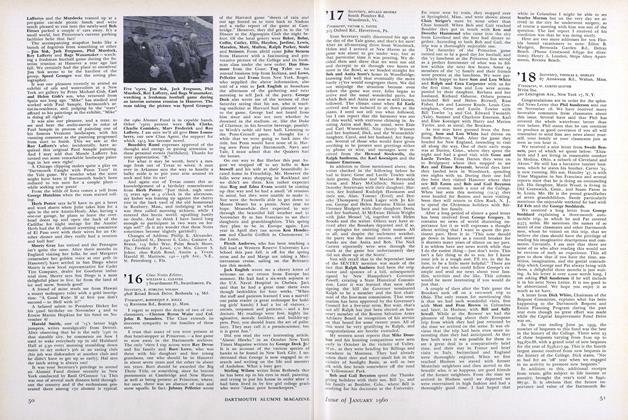
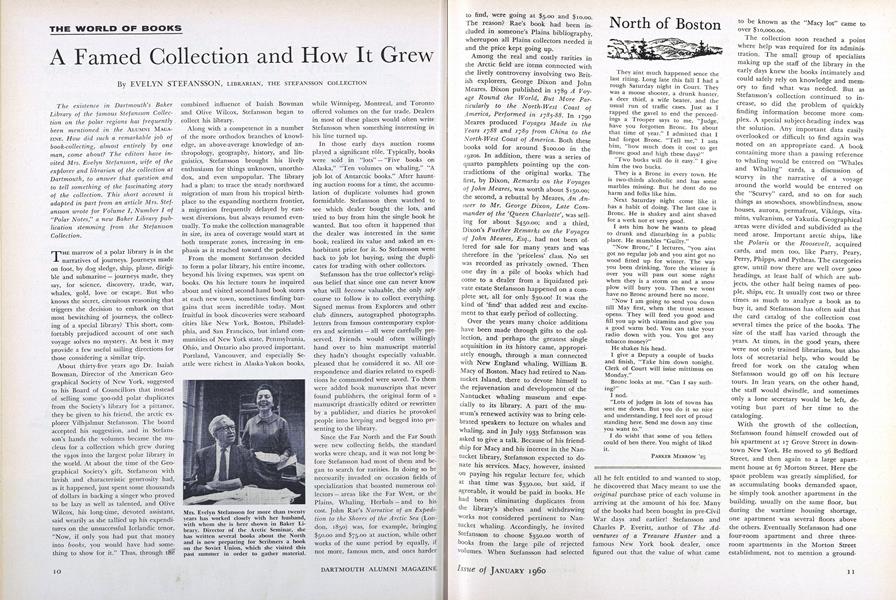
Mrs. Evelyn Stefansson for more than twenty years has worked closely with her husband, with whom she is here shown in Baker Library. Director of the Arctic Seminar, she has written several books about the North and is now preparing for Scribners a book on the Soviet Union, which she visited this past summer in order to gather material.