SHOW ME THE WAY TO GO HOME.
By Jerome Beatty Jr. '39. New York: ThomasY. Crowell, 1959. 247 pp. $3.95.
Until I read Mr. Beatty's book I assumed that the plight of the commuter had been as well documented as the wretched conditions suffered by Class D ballplayers, high school Latin teachers, and other minority groups. How wrong I was. A swift riffle through the index cards at Baker Library revealed that field was wide open to Jerome's probing pen. Only four other book-type writers have worked parts of this claim. Only four books in over 100 years, and no one knows how many miles of commuting, is not many when one considers the noise the oppressed victims have created.
And so it remained for Jerry Beatty to write the definitive book on commuting. I may be doing him a disservice, but I think he started out to write a funny book, then while digging into his subject uncovered such a rich lode of material he couldn't confine himself to its traditionally humorous aspects.
Be assured that there is a heavy load of laughs on this trip with Beatty. He dissects the rigid protocol developed by the riders in self-defense. The abrupt dropping of any vestige of chivalry, respect, or plain good manners upon boarding the train is reported with chilling accuracy. Anecdotes about simple mishaps that would not slow down a sub-normal airedale, but which can tie up four inbound and two outbound tracks, 23 trains and 25,000 hungry people, for 'five hours are recounted. All the famous commuting types are lovingly sketched: the readers, the non-readers and the sleepers; the bridge players and their kibitzers; the smokers and the non-smokers; the drinkers, both club-car and station-bar types; and the best-educated crooks extant, those whose greatest pleasure lies in getting a free ride from the RR either by forgery, sleight of hand, picking pockets, or with glib tongue. To the uninitiated and unscarred, much of this section of the book will seem exaggerated or at best apocryphal, but to those who have been there and Got- ten Out Alive, these stories all ring with the raucous clang of the untuned Truth.
After Beatty has exposed the commuter for the miserable specimen he is, he turns to the railroads and line-by-line across the country pokes into every neglected hot box, unpainted station, undecipherable timetable, and unmade feather bed. In a chapter entitled "Above and Beyond the Call of Commuting" he paints an inspiring portrait of the many heroes among the daily passengers. Commuters who have spent years of evenings and weekends organizing committees, attending hearings, challenging accounting methods, filing briefs, and getting injunc- tions slapped on the roads are here enshrined. Then Beatty jumps over the net and begins serving up smashes that prove conclusively that the railroads are as helpless as a monkey in a missile. He skilfully reviews all the facts about bonded indebtedness, right-of-way maintenance, the competition of the bus lines and highways, high terminal costs, etc., but manages to make them believable and not just railroad propaganda.
This is it. The definitive work on commuting. As amusing, instructive, enthralling, and suspenseful as a trip on the 5:21 to Bronxville. As a matter of fact, Beatty almost made me homesick for the old 8:35 and 5:21. Almost, but not quite.
JOHN R. SCOTFORD JR. '38
-
 Letters to the Editor
Letters to the Editor
November 1976 -
 Feature
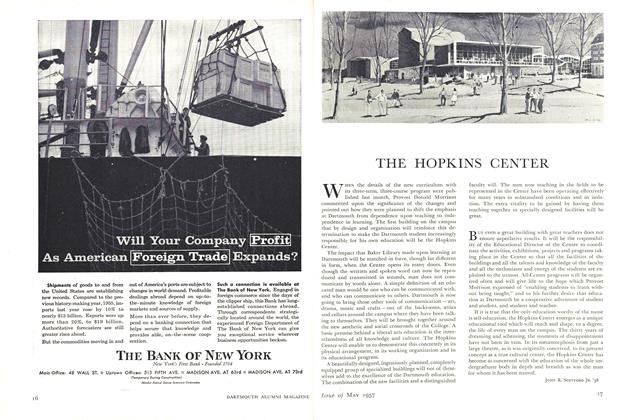
THE HOPKINS CENTER
MAY 1957 -
 Feature
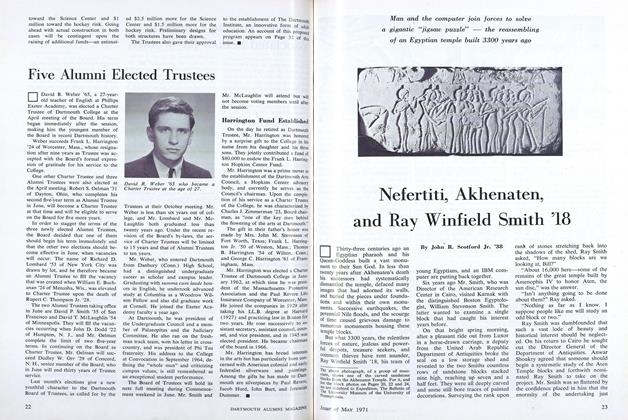
Nefertiti, Akhenaten, and Ray Winfield Smith '18
MAY 1971 -
 Article
jeez, Did You Ever See So Many Indians?*
MAY 1972 -
 Article
Gall Him "Danny" and He's Yours
APRIL 1991 -
 Cover Story
The Tasting
MARCH 1995