1921
Out of the country, Tom Staley did not have to read that the Wappingers Falls sale of bulls and 66 Angus cows would gross more than $800,000. Nor would he have to read that the two Sanders brothers, 79 and 75, very small, very rich, were very much in need of bull semen for their 2,000 cows in Kentucky, nor that one-third interest in a bull cost $187,500, nor that Jack Dick, a New Yorker, paid the record price of $176,400 for a bull, the greatest stud of all, which turned out to be sterile. Tom has his good memories of Staley bulls, which did not merely walk. They swaggered. When they exhaled, bursts of dust shot into the air to cover skies with (what some say) the mile-high initials TWS. From Hotel Bristol, Vienna, Tom comments not on big bulls but small worlds. Knowing Tom, you will not be surprised that on a Rhine cruise from Cologne to Coblenz he fell into conversation with a pretty woman from Maine who knew Missouri. When she learned that Tom had spent five years in Hanover, she mentioned that a certain Jack and Flora Garfein of Dartmouth were on board. Tom had fun teasing Jack, who could not despite broad hints guess who Tom was. Elbows began crooking, and Rhine wine began disappearing. Though at different hotels, the Staleys and Garfeins ran across one another again in Heidelberg. Jack and Flora, who love night life, suggested that they, paint the town green, but Tom and Anne, who have passed their 50th birthday, demurred and Heidelerg wide open for the younger, footloose, and fancy-free Garfeins. This is not to suggests that the, Staleys are slowpokes: they toured .Scotland,, England, Ireland, Holland, Belgiurp, Switzerland, Germany, France, and Holland.
Even if. you do not care for live wriggly fish or inert dead fish served with hot butter or cold mayonnaise, you may like brown trout and bright salmon served with Lamb mint fresh. Author of "On Trout Streams and Salmon Rivers," Dana Lamb has written a sequel, "Bright Salmon and Brown Trout." No, it does not concern itself with "how-to-do-it" texts or with winter lucubrations on how to tie flies or how to practise casting in your backyard. Nor does it spend more time' than it should philosophizing about the articulated pugnacity of fishermen with rods as weak as cooked macaroni versus the articulated pugnacity of salmon with backbones as strong as steel. Rather, it consists of essays and stories based on Dana Lamb's Canadian expeditions. ? He omits some piscatorial whimsicalities to include vagaries of wild: animals staring down rifle barrels. Published in Holland, with profits going to the Quebec-Labrador Mission Foundation, the book is being :eagerly read by such enthusiasts as Roger Wilde and Corey Ford, Ort Hicks and Hilt Campbell, Ellis Briggs and -Bob Loeb (who reads everything except novels), Bunny Gardner and Tom Griffith, Dick Hart and Hoy Schulting, Ted Sonnenfeld and Dave Trainer. The edition is 1,500 copies at $10, plus 350 copies on rag paper with gilt top, bound in quarter oasis niger paper over boards, with slipcase, signed by the author, at $17.50.
This is how the New York Times Book Review handled the advertisement of 'the new book by Ellis Briggs, "Farewell to Foggy Bottom, The Recollections of a Career Diplomat": "No armchair critic - Ellis Briggs has served in some of the hottest posts abroad - he has watched with apprehension the vast proliferation of our diplomatic apparatus. He categorically states that our embassies abroad would work far better with half the present personnel, and has some pointed arguments against those who think that the only answer to saving the free world is a steady flow of dollars. In spite of the enormous financial assistance and goodwill programs, the United States is still hated in large areas of the world and embarrassed by even our closest allies. Ambassador Briggs will tell us why. Readers will find his book ... a fond somewhat rueful, sharp-eyed and witty hail and farewell to the misty area in Washington identified with the State Department. It is thoroughly enjoyable reading with plenty of timely overtones."
Laurie Erskine, our adopted member, writes cheerfully from Cambridge, England, that he has spent a rewarding week with a Fellow of one of the university colleges where he was bathed in an aura of learning mellowed by the centuries. Oxford and Cambridge, he remarks, spring from the same roots of Anglo-Saxon devotion to learning and these roots have spread from them to make possible the intellectual foliage at Dartmouth, Harvard, Yale, and every other college in America.
Phez Taylor rubbed his eyes on his birthday. In 1921 clothes, guests bowed into the Sun Valley Lodge dining room, the ladies in short and shapeless beaded dresses, the kind they once wore dancing the Charleston with us in Robinson Hall. Men strutted coonskin coats, discovered in attics, and they gave off redolent aromas of mothballs and carefree undergraduate excesses. All guests sported in hats and hair , green Dartmouth feathers. Talk was hot about the sale of Sun Valley by the Union Pacific Road to the Janss Corp., Los Angeles, which involved 4,000 acres of land and resort facilities, including the 155-room Sun Valley Lodge; the Challenger Inn, 185 rooms; the 250 bed chalet: seven ski lifts; a golf course; trap-shooting facilities; and a large ranch 20 miles, south of Sun Valley. Janss expects to spend $30,000,000 on the resort to rehabilitate accommodations and create facilities, and increase the capacity for skiers. The sale does hot affect Phez, for he has never had any title in Sun Valley, though he is l rusteo of the Incorporated Village, attorney for Sun Valley, and local attorney for the Union Pacific Railroad. Dorice, Publicity Director and Head of the Sun Valley News Bureau, will continue under the Janss Corp.
It was a great occasion for the Mayo Clinic: three days of reunion for the alumni of the Mayo Foundation, a concert by the Minneapolis Symphony Orchestra, and a two-day symposium with a panel of speakers on "Man's Adaptation to His Expanding Environment." It was a great occasion also for Nelson Barker - one entire morning was given over to a special scientific program in his honor. For two years his young colleagues in the Vascular Section of the Clinic had planned it. Speakers and readers of papers outlined current developments in peripheral vascular diseases in which Nels had pioneered. Former students and younger colleagues praised Dr. Barker as physician, researcher, writer, teacher, and friend. The Barkers appreciated the thoughtful compliment of inviting Nelson not as onlooker but as active participant commenting on each paper, which he did with his usual astute brilliance. He loved every minute of it, and his family - all his children were present — nearly burst with pride. A banquet for members of the vascular section and their wives ended the day. Though Nels retired officially from the Clinic July 1, at the request of his colleagues he is continuing to make hospital rounds on Saturday mornings, and two mornings a week he serves as medical consultant at the Rochester State Hospital. A young medical friend was overheard to remark, "The most hilarious thing I have ever heard is the idea of Dr. Barker retiring. That man will never retire." A smaller man might have. In 1955 the published articles and books by Dr. Nelson Barker ran to 180 items. In 1956 he became totally blind.
Secretary, 33 East Wheelock St. Hanover, N. H.
Treasurer, 12 W. Mystic Ave., Mystic, Conn. 06355
More From This Issue
-
 Feature
VANISHING ABSOLUTES
December 1964 -
 Feature
Our Battle To Reform The Education of Teachers
December 1964 -
 Feature
PRESIDENT'S POLLSTER
December 1964 -
 Feature
Twin Pillar of Alumni Support
December 1964 -
 Feature
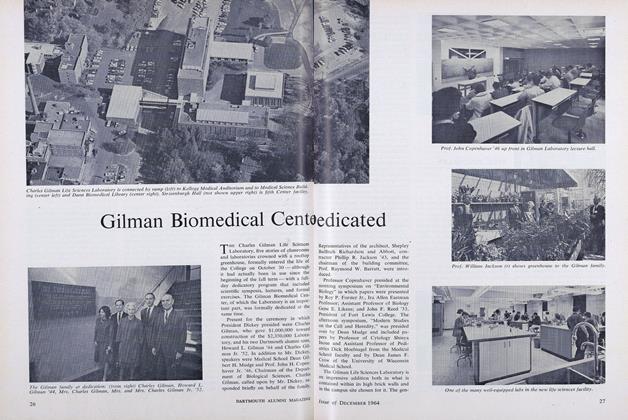
Gilman Biomedical Centedicated
December 1964 -
 Article
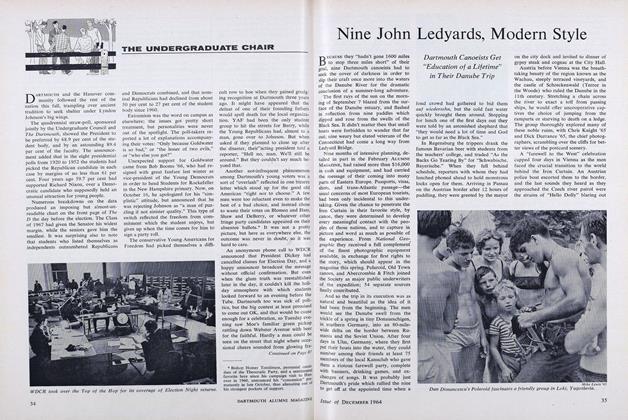
Nine John Ledyards, Modern Style
December 1964