1921
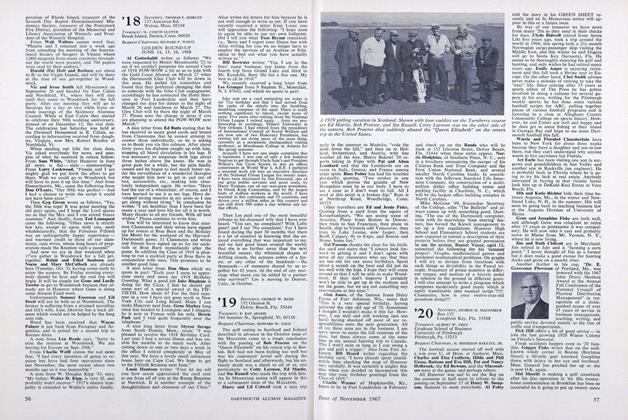
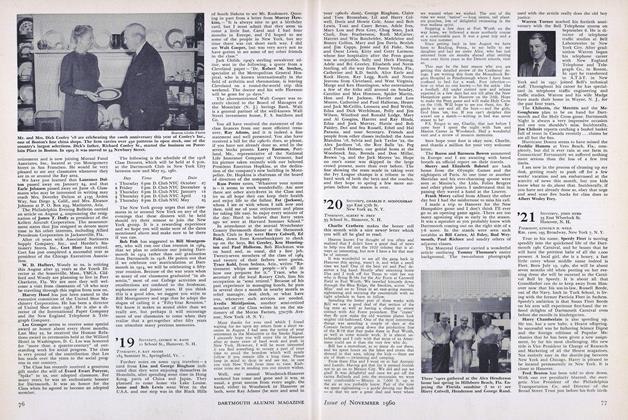
What does Kaddy Kadison, a country boy at heart loving buttercups, pastoral brooks, and bluebirds nesting in fence posts, do when his wife Diane, a city girl at heart loving the yellow glow of theatre lights, the stream of Park Avenue traffic, and jet planes nesting in international airports, grows increasingly citified? After 32 years of marriage, Kaddy, broadminded if agoraphobic but not uxorious, admits that some compromise is necessary. And so Diane with unbucolic eyes looks about New York each year and picks a swank apartment, furnished, and invited Kaddy to make his home with her. Then Kaddy, equally hospitable, moves into the White Plains house he built in 1936 and ever since has loved increasingly. He invites Diane to pick buttercups, wander along pastoral brooks, and look for blue-birds' eggs in fence posts. She acquiesces, but she says that crows' eggs would suit her just as well, that she is no lass to go wading in brooks, and that a buttercup placed under her chin would prove nothing.
Sun to be soaked up is difficult now in Mystic, Conn.; it is missed because of the mist. Far away, Hugh and Betty McKay enjoy the application of their tan lotion in Deerfield Beach, Fla. In mid-April, preferring son shine to sunshine, they will fly to Southern California to visit Hugh's daughter Helen busy with three fast-growing Dartmouth prospects. In May, indulgent, they will give their Mystic a chance to prove that it is neither misty nor mystical but practical Floridian or Californian overhead.
Jerry and Helen Cutler flew around the world year before last and described it as only an aperitif, a provincial cocktail. In April, hungry, they settled into a European banquet. They jetted to Greece for a Mediterranean cruise. On a chartered ship, the Delos, they cruised among Greek islands to discover a paradise for artists, Mykonos, and a monasterv, very old, on Patmos, that island where Saint lohn is supposed to have written the Apocalypse. The Cutlers put on their far-sighted glasses in Crete where civilization based on copper and bronze (you remember. Minoan) was highly developed about 3,000 years before Saint John. On the Nile in heat of 120 degrees they had an adventure. Plastered with sand and dirt with no hotel and no baggage, thev waited in vain for a plane grounded by a Sahara sandstorm to fly them to Cairo. They prefer to remember their camel rides to the Sphinx and the Pyramids or Tut's tomb in the Valley of the Dead as being more lively. Then Beirut, Lebanon, Jerusalem, Nazareth, Bethlehem, Galilee, Jordan, Cyprus, Rhodes, the Bosporus, the Golden Horn, Istanbul, Athens, and Mont Blanc. Then the American contrast: Detroit, California, the Painted Desert, the Petrified Forest, the Grand Canyon, King's Canyon and the Yosemite. A major impression in Europe was the friendliness of persons described in American newspapers as being incorrigibly hostile. The Cutlers saw Arabs and Jews walking hand in hand, Greeks and Turks, and children on Cyprus playing together with laughter whose parents like best to kill one another.
Last year Frank Ross drove up from Cape Cod and Rudi Blesh flew on from New York to enjoy the 1920-1921 MidWinter Frolic, attended by 55. Better not miss, this year. Date: March 6. Place: Highway Hotel, Concord. Hours: cocktails 5 to 6 and dinner shortly after. Price: $4. Speaker:
For a married couple, retired lawyers, Newc and Pearl Newcomb, what is a typical day? Pearl, who worked hard on the presidential campaign, receives congratulations on her election to Secretary of the County Republican Executive Committee. She waits for word from Governor Romney about the local executive committee's recommendation that she be appointed as Circuit Court Commissioner. Newc prepares himself to teach his course in Income Taxes for Practitioners at Delta College with so many enrollments that he must lecture two nights a week instead of one. Together, the retired couple spend much of the morning in the Municipal Court, attend a hearing before the Liquor Control Commission in the afternoon, go on to the Circuit Court for a case, and witness the signing of an agreement for an incapacitated man. Typical? No. Every day is different.
Though 1921 has more businessmen than ministers, the ministers, only four, have influenced thousands (shall we say millions?) of persons: Bishop Gilson in the Far East, George Ferguson in the Southwest, and Hugh Penney and Chuck Allen in Massachusetts. Aged 66, Chuck has no intentions of retiring right now. Do you know that the Methodist Church permits its ministers to serve until they are 72? Apparently the rule may be waived: Hugh Penney, born 1888, our oldest man, is not really retired. Though Chuck was with us only one year, he writes, "I have always been proud of my Dartmouth connections," a pleasing statement from a man who transferred to Ohio Wesleyan and the Boston University School of Theology.
You probably have never been there. It is in Martin County, Southern Minnesota, 41 miles SSW of Mankato, with a population of 8,193, a few miles north of lowa. Fairmont is the name, and Brad Richardson, who has never returned to Hanover and doubts that he ever will, lives there. Although he spent most of his waking hours in Hanover working at the Inn, he writes, "I do have the most wonderful memories of the two years I spent at Dartmouth. I love the hills and the beauty of New Hampshire." One of Brad's happinesses is that he influenced a boy to go to Dartmouth and enjoyed vicariously that boy s intellectual and emotional fulfilment. One of his unhappinesses is that from 1922 to 1946 he saw only two Dartmouth men. Is this not something for Doug Storer?
Speaking of Doug ... RCA Recorded Program Services sent out to 4,000 radio stations a radio Christmas sales and programming package described as "truly unique": "Christmas Vignettes that are Amazing but True, by Doug Storer." Within two weeks some 200 stations had sent in orders, but the information came too late for many. The 16 two-minute vignettes present strange and unusual Christmas stories about famous personalities, bizarre events, origins of Christmas carols and stories, and peculiar Christmas customs — all produced and narrated by Doug.
Hilt Campbell will commute no longer between New York and South America'. He retired at the end of October from Lybrand, Ross Bros. & Montgomery. "Com- mute" suggests a regularity of arrivals and departures generally observed by North American planes, buses, and trains. South Americans lack our crispness. Hilt can tell you how nerve racking it was to land at one South American airport only with the help of automobile headlights. Why? Not because the airport electricity had failed but because it had been deliberately shut off. The plane landed safely, but it could not take off - too risky in pitch darkness with ribbons of light from automobile headlights. But first things first in South America. Soccer is more important than Pan American jet arrivals from foreign countries. The day before a big game the government went on the air to assure the South American public that during the game they could be assured of full electrical service. Why 9 Those without tickets would be hanging over their TV's. For TV's, automobile headlights would be less useful than for jets in an international airport.
Secretary, Box 925 Hanover, N. H.
Treasurer, 12 W. Mystic Ave., Mystic, Conn. 06355
More From This Issue
-
 Feature
A NEW BREED OF CHUBBER
February 1965 -
 Feature
"It Was Quiet, Serene, and Beautiful"
February 1965 -
 Feature
Business Still Draws Its Share of Graduates
February 1965 -
 Feature
Freshman-Sophomore Curriculum Revised
February 1965 -
 Article
THE UNDERGRADUATE CHAIR
February 1965 -
 Article
Dartmouth's Story Superbly Told
February 1965