1951
Woody Klein's star continues to rise in the New York City administration at a rate with which I at least have difficulty in keeping up. By the time this column reported his move from Mayor Lindsay's Press Secretary to Assistant to the Mayor for Housing and Urban Development, Woody had already been appointed Assistant Administrator of the City's newly-created Housing and Development Administration.
Mayor Lindsay described Woody as "an expert housing observer" whom he was happy to have working on "reorganizing and mapping out a vigorous, new development program for New York City." That is no small task.
The next two or three inches of this column would be required to list all the awards journalist Woody has won for his reporting in the field of housing and urban affairs. Since 1960 he has also taught journalism at N.Y.U. and now holds the rank of Adjunct Associate Professor. Woody, wife Audrey, and three-year-old daughter Wendy live in Greenwich Village.
The White House has announced the appointment of Berl Bernhard to the Board of Higher Education of the District of Columbia and as a Trustee of the new Federal City College. In addition to practicing law in Washington, Berl is at present Executive Director of the Lawyers' Committee for Civil Rights Under Law, a consultant to both the Secretary of State and the Ford Foundation, and special counsel to the White House Conference "To Fulfill These Rights."
For the benefit of those of you who don't know Berl that well, he does have time for a family as well. He and wife Janice have two sons, Peter and Andrew, and a daughter, Robin.
Gulf Plastic Products Co., a whollyowned subsidiary of Gulf Oil, has named Ed Welsenfeld as Production Control Superintendent of its Totowa, N. J., plant. With Gulf since 1964 in packaging operations, Ed will be responsible for production scheduling, order processing, inventory control, warehousing and shipping at Totowa.
Jack Burnett is now plant manager of the H. N. Saylor Corp., which I assume to be in the St. Louis area since the clipping comes from a St. Louis newspaper. He had previously been plant manager of a Crown-Zellerbach flexible packaging materials plant in Indiana.
Sometimes I suspect that there are enough '51's working for IBM that we ought to be able to give the College a majority stock interest as a 50th Reunion Gift, Heres another. Nels McElfaatten is controler of the Components Division. He is married and has two children.
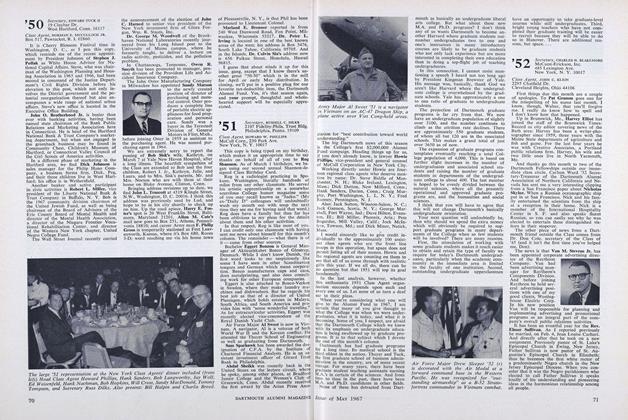
In addition to our professional military classmates, we have our reservists, including the ready reservists, one of whom is U.S. Navy Commander Dick Rogers. He recently completed two weeks' active duty training on the "USS Randolph," a flattop which is flagship for COMHUKFORLANT. Dick translates that as Commander, HunterKiller Forces - Atlantic, which he says means that they are supposed to sink submarines in the Atlantic before they present any problems.
By now, Dick is back at work in advertising sales for Modern Plastics Magazine, a McGraw-Hill publication, operating out of Cleveland. Nearby I hope you will find a picture of Dick and his two oldest daughters, which he bills as "The Hudson, Ohio, Big Green '67 hockey team."
Ryerson Steel has appointed Charlie Benson sales manager at its Cincinnati, Ohio, service center. He went with Ryerson in Boston in 1949, then moved on to Connecticut and Charlotte, N. C., before serving as Cincinnati general order-merchandise manager prior to this promotion. Charlie and wife Carole have two children.
In a concluding paragraph which was cut from my March copy, I promised to share with you this month some of the things I learned and observed on the occasion of the January Alumni Council meeting. Also cut was another paragraph which came after that which mentioned the renovation of the Hanover Inn. I hope the editors won't cut it again because I think it provides a good lead-in to my conclusion this month. The paragraph read as follows:
"You may recall that the elevator was located in the 'old' part of the Inn, so it was a walk-up job for us, four flights from the temporary lobby on the eastern end of the dining room, five from the bar in the basement. When I complained to Inn Manager Jim McFate about the climb, he said that the fourth floor quarters were reserved for the younger guests. I replied that the climb made me realize I wasn't that young any more."
As this month we begin another Alumni Fund campaign, I think it is about time that most of us realized that we aren't "that young any more." What do I mean? Two things.
First, as middle-agers in a few cases and near middle-agers in the rest, we should have the wit by now to realize the importance of private higher education to American society, the role of Dartmouth as a leading undergraduate institution of higher education, and the cost of being a leading academic institution.
At the January joint meeting of the Trustees and the Alumni Council, there was outlined in considerable detail the College's monetary needs over the next decade if it is to maintain a position of leadership. I should hasten to add that those monetary requirements are substantial; particularly when it is realized that they should be capitalized as they are at most of the institutions we regard as our real competitors.
Dartmouth's needs include improved faculty and staff compensation, a strengthened scholarship and financial aid program, Baker Library's requirements to regain the position of leadership from which it has slipped, enriched academic programs and, to some extent, additional plant facilities. The latter include athletic as well as academic. The faculty housed in Dartmouth Row, for example, is splitting those buildings at their seams.
There is not the space in this column to detail these needs, which I am sure will be fully presented elsewhere in this MAGAZINE in the coming months.
Second, as almost middle-agers, we should realize that we are no longer that young a class and that we bear an increasingly weighty moral responsibility to support the College monetarily.
We owe it to ourselves and to the College to consider honestly our present financial situation, rather than what we gave last year, when it comes to deciding what our Alumni Fund contribution should be. Many of us are paying substantially more in taxes because we're earning substantially more, we're living in nice homes instead of the hole-in-the-wall apartment of ten years ago, we're eating steak instead of hamburger and drinking Chivas Regal instead of Old Overshoe.
Without intending to take away one whit from what our individual talents and hard work contributed to our improved status, I somehow suspect that our Dartmouth experience also made a substantial contribution. Isn't it about time that rather than keeping our contributions at the hamburger and Old Overshoe level, which was the best we could do ten years ago, those of us who can cut the Dartmouth Alumni Fund in on the steak and Chivas Regal?
Secretary, 2107 Fidelity-Phila. Trust Bldg. Philadelphia, Penna. 19109
Class Agent, McCall Corp., 230 Park Ave. New York, N. Y. 10017