1951
This copy is being typed on my birthday, which makes it an appropriate time to say thanks on behalf of all of you to RogShannon. As of March 1 birthdays, we began using our second annual Shannon-designed Class Birthday Card.
Rog is a radiologist practicing in Spokane, Washington, literally hundreds of miles from any other classmate. He served his artistic apprenticeship on a somewhat scurrilous College humor magazine some of you may recall known as "Jacko." (My ex-"Daily D" colleagues will undoubtedly wash my mouth out with soap the next time they see me for having said that word.) Rog does have a family but thus far has been oblivious to my pleas for the details about them and his other activities.
In that respect, Rog is like most of you. I can credit only one classmate with having sent me news about himself for this month's column. The remainder - what there is of it - came from other sources.
Bachelor Eggert Benzon is General Manager of Aktieselskabet Benco of Glostrup, Denmark. While I don't know Danish, the first word looks to me suspiciously like some I have seen in other Scandinavian tongues and German which mean corporation. Benco manufactures caps and cans, does metalprinting, and also does consulting work for other European companies.
Eggert is also attached to Benco-Verken in Sweden, where they make laundry machines and dishwashers. But he regards his best job as that of a director of United Plantagen, which holds estates in Malaya, South Africa, and South America and provides him with "some wonderful traveling." As for extracurricular activities, Eggert was recently elected vice-commodore of the Royal Danish Yacht Club.
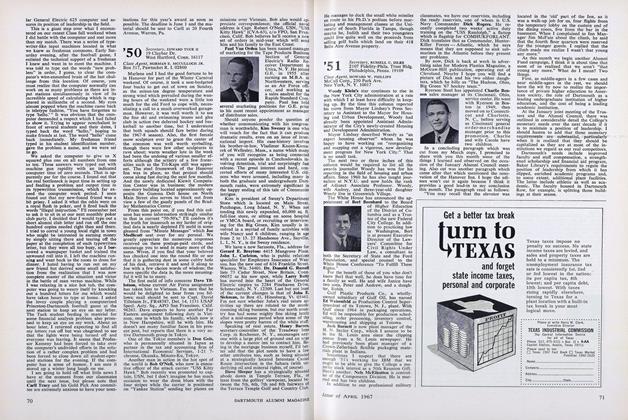
Air Force Major Al Sweet is now in Vietnam. A navigator, Al is a veteran of both World War II and the Korean conflict. He attended the Thayer School of Engineering as well as graduating from Dartmouth.
Sam Sparhawk has been awarded the designation of C.F.A. by the Institute of Chartered Financial Analysts. He is an assistant investment officer of Girard Trust Bank in Philadelphia.
Abdul Sheikh was recently back in the United States on the lecture circuit, where he spoke, among other places, at Bradford Junior College and the Woman's Club of Greenwich, Conn. Abdul recently received the first award by the Asian Press Association for "best contribution toward world understanding."
The big Dartmouth news of this season is the College's first $2,000,000 Alumni Fund campaign. Heading things up for us, if you don't already know, is lawyer HowiePhillips, vice-president and general counsel of McCall Corporation in New York City.
Working directly under Howie are fourteen regional class agents who deserve mention by name: Dr. Steve Biddle of Manchester, N. H.; Blake Ireland, Lexington, Mass.; Dick Dutton, New Milford, Conn.; Hank Sanders, Darien, Conn.; Craig Murphy, Port Washington, L. 1., N. Y.; Fred Ranney, Pennington, N. J.
Also: Jack Sutton, Winston-Salem, N. C.; Jack Gannon, Scotia, N. Y.; George Marshall, Fort Wayne, Ind.; Dave Hilton, Evanston, Ill.; Bill Miller, Phoenix, Ariz.; Pete Bogardus, Mill Valley, Calif.; Jock Mclntyre, Towson, Md.; and Dick Miner, Natick, Mass.
I would sincerely like to give credit individually to the approximately 100 assistant class agents who are the front line troops in this operation, but space does not permit listing all of their names. Howie and the regional agents are counting on them to see that all of us come through with realistic gifts this year. If we all do, there can be no question but that 1951 will top its goal handsomely.
In the last analysis, however, whether this enthusiastic 1951 Class Agent organization succeeds depends upon each and every one of us. Let none of us turn a deaf ear to their pleas.
When you're considering what you will give to the Alumni Fund in 1967, I am certain that many of you give thought to what the College was when we were undergraduates, what it is today, and what it is becoming. Some of you, I suspect, are afraid that the Dartmouth College which we knew with its emphasis on undergraduate education is being swallowed up by graduate programs. It is to that subject which I devote the rest of this month's column.
Dartmouth has had graduate programs for a long time. Its medical school is the third oldest in the nation. Thayer and Tuck, the first graduate school of business administration in the country, are of more recent vintage. For many years, there have been graduate student teaching assistants earning M.A.'s in certain of the sciences. And from time to time in the past, there have been M.A. and Ph.D. candidates in other fields.
None of these has detracted from Dartmouth as basically an undergraduate liberal arts college. But what about these new M.A. and Ph.D. programs? I don't think any of us wants Dartmouth to become another Harvard where graduate students outnumber undergraduates two to one and one's instructors in many introductory courses are likely to be graduate students who not only lack experience but are more interested in completing their own education than in doing a top-flight job of teaching undergraduates.
In this connection, I cannot resist mentioning a speech I heard not too long ago by President Kingman Brewster of Yale. His message was, basically, thank God we aren't like Harvard where the undergraduate college is overwhelmed by the graduate schools. Yale has approximately a one to one ratio of graduate to undergraduate students.
The projection of Dartmouth graduate programs is far cry from that. We now have an undergraduate population of slightly over 3100, and the number continues to climb as the attrition rate declines. There are approximately 550 graduate students, of whom all but 120 are in the associated schools. This makes a grand total of just over 3650 as of now.
The expansion of graduate programs contemplates eventually reaching a total College population of 4,000. This is based on further slight increases in the number of undergraduates and associated school students and raising the number of graduate students in departments of the undergraduate college to about 400. The last number is hoped to be evenly divided between the natural sciences, where all the presently operational and approved graduate programs are, and the humanities and social sciences.
I think that you will have to agree that this will not change Dartmouth's basically undergraduate orientation.
Your next question will undoubtedly be, then why should we spend the extra money which will obviously be required to support graduate programs in many departments of the College when so few students will be involved? There are many reasons.
First, the stimulation of working with some graduate students makes it much easier to obtain and retain the type of faculty we require for today's Dartmouth undergraduates, particularly when the academic community in the immediate area is limited to the faculty of one institution. Second, outstanding undergraduate upperclassmen have an opportunity to take graduate-level courses while still undergraduates. Third, bright young teachers who have not completed their graduate training will be easier to recruit because they will be able to do so in Hanover. There are additional reasons, but space....
Army Major Al Sweet '51 is a navigatorin Vietnam on an AC-47 Dragon Ship, aplane active over Viet Cong-held areas.
Air Force Major Drew Sleeper '52 (r)is decorated with the Air Medal at aforward command base in the WesternPacificHe was recognized for "outstanding airmanship" as a B-52 Stratofortress commander in Vietnam combat.
Secretary, 2107 Fidelity-Phila. Trust Bldg. Philadelphia, Penna. 19109
Class Agent, McCall Corp., 230 Park Ave. New York, N. Y. 10017